Doping bans should be met with celebration, not resignation
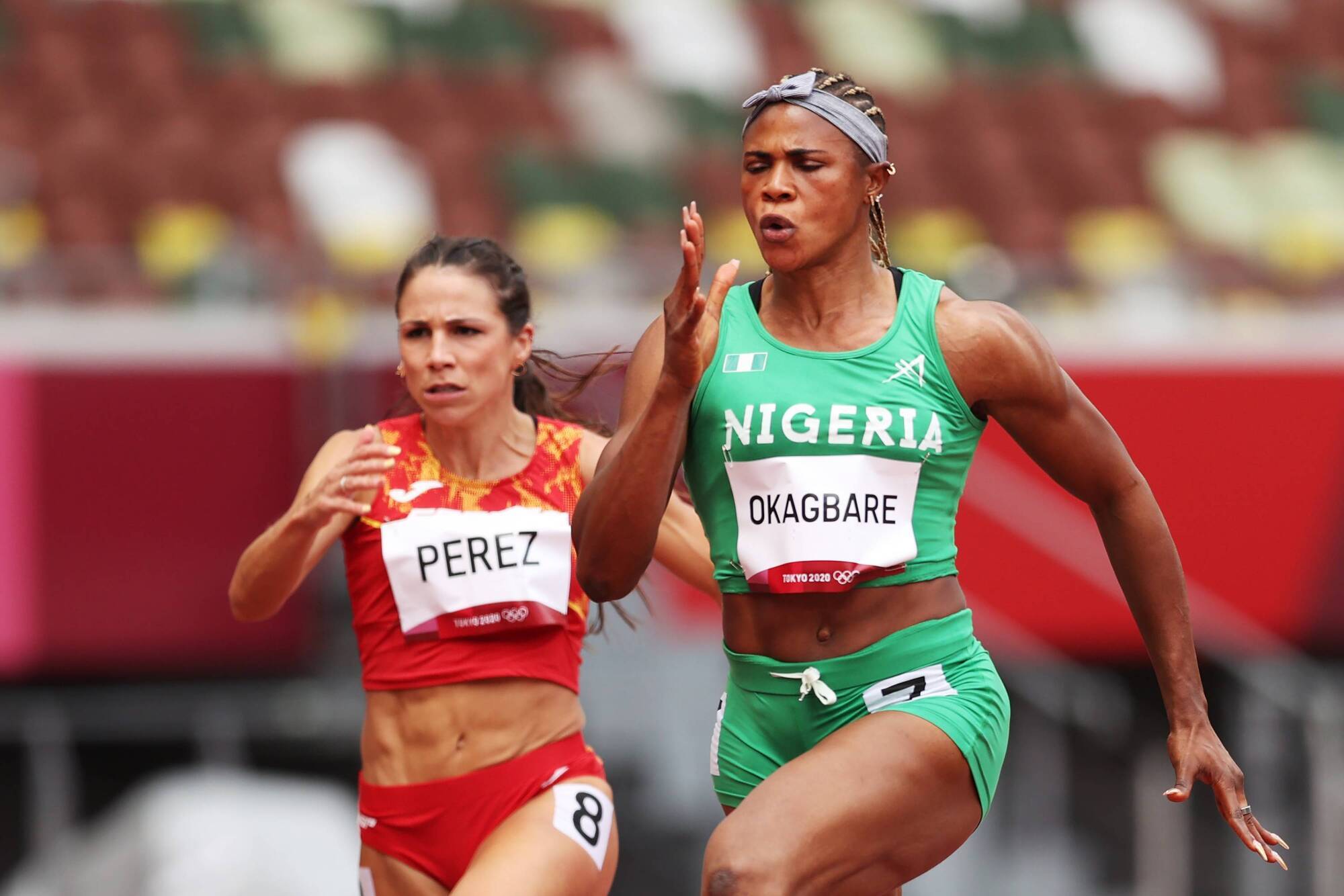
LENGTHY BAN: Blessing Okagbare of Team Nigeria competes during round one of the Women's 100m heats on day seven of the Tokyo 2020 Olympic Games. Pic: Patrick Smith/Getty Images
By now it’s an annual tradition: major athletics event on the horizon, major doping bust. This is a good thing. Always has been, always will be. Because when it comes to drugs in sport, ignorance is a very misguided form of bliss.
At the Doha World Championships in 2019, it was Alberto Salazar, the US coach whose unashamed embrace of the grey area turned out to involve dabbling in the dark arts, as many suspected. We never did find out which, if any, of his athletes was doping, though.
During the Tokyo Olympics in 2021, it was Blessing Okagbare, the world and Olympic medallist handed a 10-year ban for using multiple banned substances and failing to cooperate with the investigation. At the age of 32, that was game over for her make-believe career.
Ahead of last year’s World Championships, it was Nijel Amos from Botswana, the third fastest 800m runner in history, who tested positive for GW1516. If that sounds like something a human shouldn’t consume, it’s because it is. Otherwise known as cardarine or endurobol, it improves endurance and modifies how the body metabolises fat, though it’s not approved for use in humans since being found to be carcinogenic.
Amos was part of the now-defunct Nike Oregon Track Club, not to be confused with the now-defunct Nike Oregon Project, of Salazar infamy, or indeed the Nike Bowerman Track Club, whose untainted legacy came to an end ahead of the Tokyo Olympics when its star female athlete, Shelby Houlihan, tested positive test for nandrolone – her claim that it was ingested from a burrito proving not just improbable but highly implausible.
Those were huge, huge names and ahead of this year’s World Championships, more look set to join them. In recent weeks the Athletics Integrity Unity (AIU) suspended Nigeria’s Tobi Amusan for three whereabouts failures – essentially not making herself available for drug tests – with a disciplinary tribunal set to hear her case this week.
Amusan had long been a world-class hurdler but went from very good to all-time great when clocking a world record of 12.12 at last year’s World Championships.
An athlete who made a similar sharp rise was Issam Asinga, an 18-year-old sprinter from Suriname, who clocked a South American 100m record of 9.89 last month. But last week he was suspended after testing positive for GW1516. His B sample will be tested this week to see if he’ll be on the start line in Budapest or off on an extended hiatus.
Asinga is based at the Montverde Academy in Florida and recently got to know Justin Gatlin, the twice-banned drugs cheat, who promised him that if he ran “anything close” to the wind-assisted 9.83 he ran in April with a legal wind, he’d get him a PlayStation 5.
“You know I’m right down the street, I’m going to hand deliver it to you,” said Gatlin, who was true to his word. You’d have to wonder what Asinga’s parents, or his coach, thought of him hanging out with a sprinter whose name is most associated with pharmaceutical aid.
Gatlin was coached to the world title in 2017 by Dennis Mitchell, who was banned for two years in 1998 for unusually high levels of testosterone, which he said was due to drinking five bottles of beer and having sex with his wife “at least” four times.
Mitchell later testified that disgraced coach Trevor Graham injected him with growth hormone, but his dark past didn’t stop USA Track and Field making him its head relay coach and it sure didn’t dissuade Nike, which still sends many of its best sprinters to work under Mitchell.
One of those, Sha’Carri Richardson, is among the favourites for the women’s 100m in Budapest, having clocked a PB of 10.71 last month. Richardson missed the Tokyo Olympics after testing positive for the not-so-performance-enhancing cannabis and USA’s other star 100m sprinter of that time, Christian Coleman, missed those Games after missing three drugs tests.
Whatever the level of fault, the existence of such infractions is proof that no name is now too big to fall. Those who’ve been around this sport a long time will tell you that wasn’t always the case.
Anti-doping is far from foolproof, and false positives are a real danger to clean athletes. Just ask Australia’s Peter Bol, whose name was wrongly dragged through the mud this year after his A-sample was reported positive for synthetic EPO, his B-sample negative, clearing his name.
The current system is far from perfect, but it’s much better than it was, the AIU taking a scorched-earth policy in recent years to rooting out cheats. It’s why, ahead of the World Championships, doping bans should be met with celebration, not resignation, given each one means clean athletes have a better shot at victory.
It’s why, when watching what unfolds in Budapest, fans now have more reason to believe in what they’re watching than they once did.
CONNECT WITH US TODAY



Be the first to know the latest news and updates