From there to here: Women to the fore as Irish rowing finds its stride
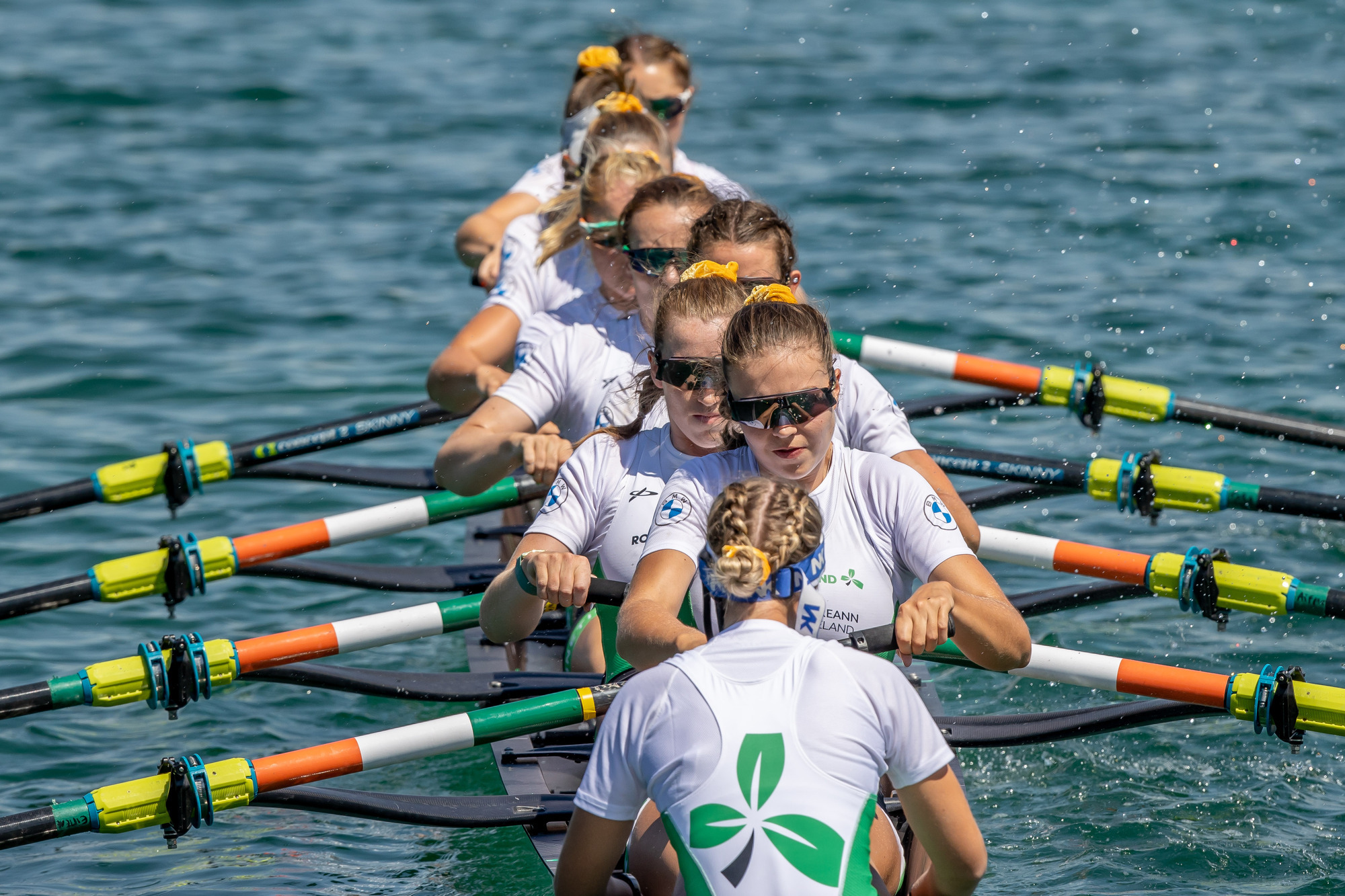
POWER OF EIGHT: Ireland’s Leah O’Regan, Eimear Lambe, Emily Hegarty, Fiona Murtagh, Aifric Keogh, Sanita Puspure, Tara Hanlon, Natalie Long and Zoe Hyde. Pic: INPHO/Morgan Treacy
Ireland’s rowing contingent has opted to do more or less all of its talking on the water since arriving in Bavaria for these European Championships, but Eimear Lambe needed no more than a tweet on Thursday to capture the extraordinary strides the sport has taken in recent years and the role which women have played.
Lambe’s post dropped after her part in a women’s 8 race in which Ireland had finished second. Aifric Keogh, Natalie Long and Tara Hanlon, her colleagues in the women’s fours this week, were also among the crew. The other half was made up of Sanita Puspure and Zoe Hyde from the women’s double sculls and Fiona Murtagh and Emily Hegarty from the women’s pair.
Lambe shared how this was Ireland’s first ever senior 8 at a Europeans, and how it had fallen six years to the day after this country had qualified a first women’s boat to an Olympic A final. That was the lightweight double sculls duo of Sinead Jennings and Claire Lambe whose achievement was lost somewhat in the wash at the time.
The silver medal claimed by Paul and Gary O’Donovan that same day, and mere minutes later, spilled far beyond the boundaries of rowing, sport and Ireland. Their post-race banter seemed to suck in every last drop of oxygen from the Rodrigo de Freitas lagoon but it is the women who are poised to claim the spotlight in Munich.
Twelve of the 15 Irish rowers here this week are female. Four of the six crews through to A finals today and tomorrow are in female categories. Paul O’Donovan and Fintan McCarthy go in the lightweight double sculls while Steven McGowan partners Katie O’Brien in the mixed double sculls in the para division.
It could have been even better had Sanita Puspure not fallen ill before yesterday’s races, preventing her and Zoe Hyde from running in the double sculls semi-final, and it also cost the women’s 8 the chance to contest its repechage later. Disappointing though that is, it can’t disguise the waves Irish rowing in general is making right now.
If an Olympic podium is the bar that everyone wants to reach then these championships are a useful barometer of where Irish rowing was, where it has come, and where it might yet go.
Ireland failed to win a single European medal between 2007, when the competition were reconstituted, and 2013. A bronze for Puspure in 2014 and a gold for the O’Donovan brothers two years later signalled a start of something and then the team won a gold and two silvers at the 2017 edition in the Czech Republic.
Munich will, barring utter disaster, bring to six in a row the number of Europeans that have produced at least one Irish medal and there are already signs that this isn’t one spin of a cycle. Of the five who stood on podiums in Račice five years ago, only Paul O’Donovan is part of this team and the crop here in Germany includes four who didn’t see a start line in Tokyo last year.
Rowing is now Irish Olympic sport’s star pupil.
High-performance programme backing to the tune of €1,093,333 per annum means it has catapulted from seventh-highest on the list of Sport Ireland-funded sports in the last Olympic cycle to the highest from here through to Paris 2024. And no sport has more athletes receiving the highest possible figure of €40,000 every year for ‘podium’ athletes.
The eye-opening part in all this is that there is clear room for improvement.
The chapter focusing on rowing in the Tokyo Review document threw up a number of small but not insignificant warning flags. The bottom line is that the stated goal of three medals in the last Games actually fell one short and the governing body itself “was not fully satisfied” with the return.
The nitpicks were varied. Longer camps due to Covid created some fatigue in the team; opinions varied on the impact caused by the head coach leaving the programme mid-cycle; the relationship between the rowing programme and the Sport Ireland Institute needed work; and the team base in Ovens was described as functional but isolated and lacking in comfort.
Most of that is easily fixed, as are issues that arose over the provision of kit. Another of the low-hanging fruit variety would be the needless distance and tension being created with the media - that has manifested itself here in Munich and prior to Tokyo – given the overwhelmingly positive press that their results have prompted.
The overall picture though? One of rude health. Covid has set the conveyor belt back in terms of training and competition opportunities but that is the same for every nation and every sport. Two silvers at last year’s U23 World Championships were followed last month by the 2022 edition when all four Irish crews made their podiums.
This success story has plenty of pages left in it. Starting this weekend.
CONNECT WITH US TODAY



Be the first to know the latest news and updates