Jimmy Diggins: Tralee basketball's founding father inspiring Warriors in quest for glory
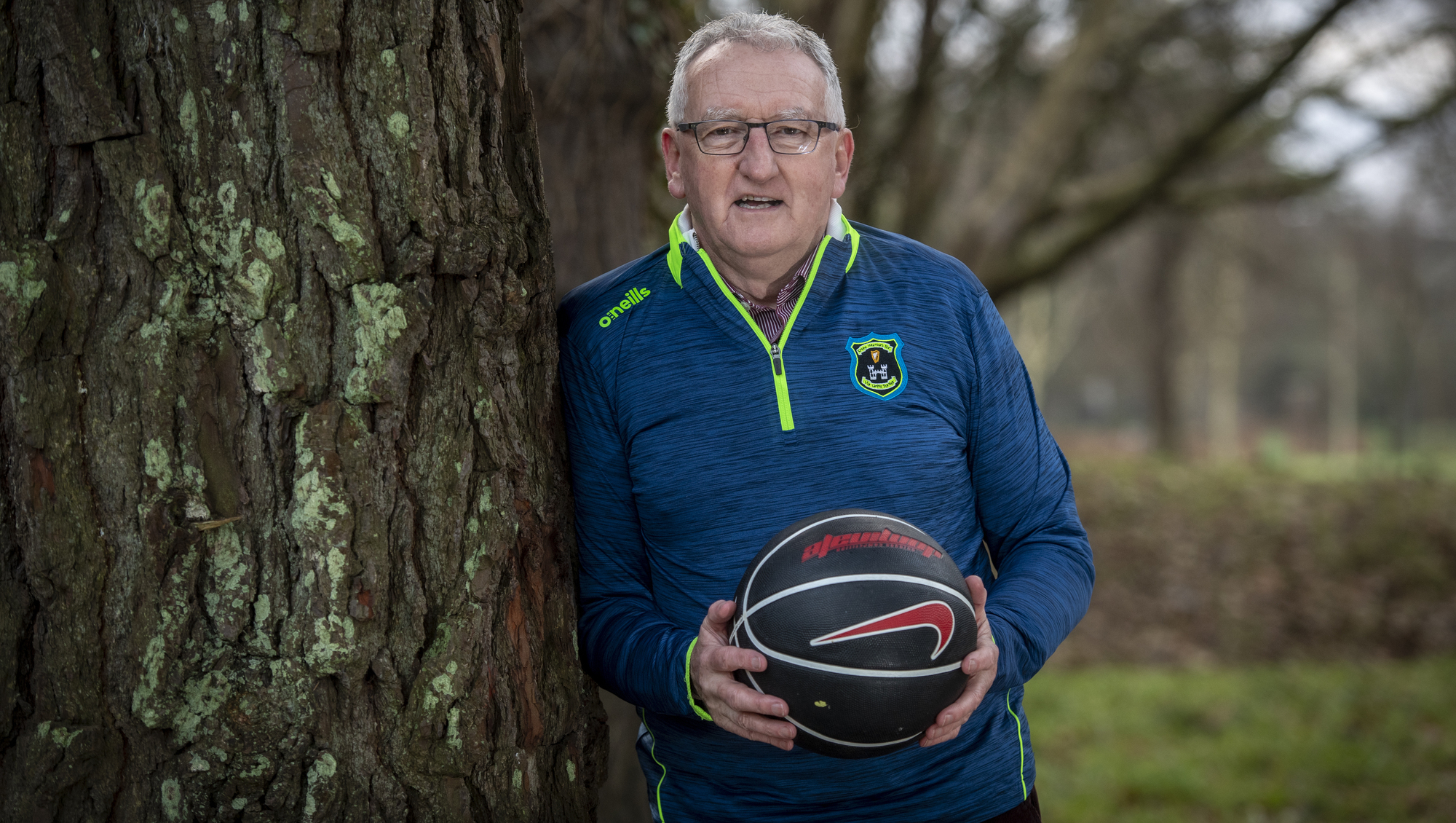
Jimmy Diggins in Tralee town park. He has spent a lifetime in sport in the town and remains as enthusiastic as ever. Picture: Domnick Walsh
You could call him a lifer but the Warriors call him The Gator.
Jimmy Diggins has been around pretty much since a basketball was first hopped in Tralee, but Kieran Donaghy for one couldn’t tell you how old the man’s birth certificate is, his guess could be a good eight years out; he only knows how young he is at heart. A while back the team had a night away down in Waterville to help to blend and bond the team’s new Americans and Eastern European professionals with the local ballers. A hen party was staying in the same Sea Lodge hotel and when the music got going it was the non-drinker amongst the Warriors posse that engaged with them and charmed them the most, dancing the night away.
“Jimmy,” says Donaghy, “completely stole the show.”
So that’s how he got the nickname. A bit like Will Ferrell’s seemingly straight-laced character in The Other Guys who reverts to his alternative personality Gator that he possessed in a previous life as a pimp, the Warriors witnessed their assistant coach break out moves he’d have acquired back in the showband days, jiving in the Brandon with his now wife Sheila to Dickie Rock and Brendan Bowyer. Check out The Gator! Gator still has game!
As it happens, Jimmy Diggins is a few months short of turning 72 years young —— you can hardly say old. Continuing to give to the game of his life has continued to give him life.
We’ve caught him on a Tuesday around lunchtime. At four o’clock he’ll head over to Mercy Mounthawk where as an assistant coach to John Dowling he will help fine-tune their U16s and U19s preparations ahead of them both playing in National A Cup schools finals the next day in the National Basketball Arena.
At six o’clock he’ll go coach his grandson Rian and his U12 Imperials team in a game against Killorglin. Then he’ll shoot over to the same Tralee Sports Complex that as a worker in the local ball-bearing factory he would contribute two shillings of his weekly wage to help fund. The Warriors also have an upcoming National Cup final to prepare for, with Dowling their head coach as well and Diggins again his trusted consigliere.
And that’s without mentioning that another former Warriors head coach, Pat Price, has Gator as his assistant to the Irish U16 boys’ programme.
“I don’t know why they want me at this hour of my life,” he laughs. “They’d be better off kicking me out the door! But I just love it. I just love life. I’m blessed that me and my family are all in good health. Whenever I’ve been to hospital it has only been for a day or two. I thank God every day for that. And I have this outlook: you can get up in the morning and choose to be positive or negative. I try to see something positive in everything.”
Take the fact he never went to college. For 38 years he worked in a local primary school, Scoil Eoin Balloonagh, and though at least one principal there would say that Diggins was the real principal, his official job title didn’t extend beyond caretaker. Yet he never felt hard done by. Again, he felt blessed. He spun his job title into a positive: caretaker meant taking care of everyone there, so he did, just as he saw mentors of his look after him and others in the community.
Old stock like James Hobbart who helped him learn how to play and then coach basketball. And John Dowling, not the current Warriors head coach but the legendary local figure who captained the victorious 1955 Kerry football team, owned a local sports shop and first got Diggins into coaching female basketball.
“John Dowling was a decent, decent man. He’d give football boots to lads who wouldn’t have had the money for them. I went to matches with him where people would come up to him, saying, ‘I’ll give you money for that All-Ireland ticket’ and he’d say ‘No, you won’t, you’ve been coaching my kids for years, you deserve this.’ I don’t know if I was attracted to people like that or they were attracted to me but I was very lucky with the people that I’ve been around. Yes, I didn’t get the opportunity to go to college but that’s just how it was for my generation.”
Tralee was his university in life.
He comes from St Brendan’s Park, just off Rock Road, real Austin Stacks country. He’s a Stacks man, having the distinction of playing not just football for them but hurling and basketball as well. He wasn’t particularly good at the football; in those days if you were, they’d hardly stick you in goals. He was handy enough at the hurling, possibly from all the tennis he’d play on his street, and won a minor county championship alongside the likes of John O’Keeffe, Jackie Power’s son Ger, and a certain future Tanáiste, Dick Spring, a proud Strand Road man who crossed enemy lines as his own club didn’t cater for the small ball.
It was the basketball though that would come to consume Diggins. Way before anyone even coined the now fashionable term ‘transferrable skills’, a few good men in the Stacks shrewdly identified that a winter sport could help its footballers ticking over and play a part in reviving a sleeping giant.
“At the time the club was in the doldrums, hadn’t won a county championship since 1936. So the likes of Michael Hayes, a teacher in the Christian Brothers at the time, and Jackie Power and Tom Parker came up with the idea of having a youth policy, something unheard of. So they got a group of 30-50 kids together, and after about two years, decided to introduce them to basketball.”
That’s where James Hobbart came into their lives, a man Mikey Sheehy has cited as one of the most influential figures in his career and who certainly was one of Diggins’. Sheehy was much more a soccer player than a basketball player — “I lived across the road from Mikey and you could see at any time of the day kicking the ball off the wall, right foot, left foot” — and certainly not as accomplished on the hardwood as the likes of John O’Keeffe and Ger Power, but hoops would still inform his brilliance.
“James was a basketball coach before he was a football coach. He actually coached the national senior men’s team. He’d become an unbelievable juvenile football coach and take the Stacks seniors for a few years, and a lot of what he would do would be to bring basketball onto the football field, like pulling a full forward out to the middle of the field to leave gaps for fellas to run into.
“He was always like that. I remember when I was about 19, [fellow Tralee basketball diehard] Gat Carey and myself would meet with him on a Friday night on Rock Street and James would have these orange Lucozade lids on the counter and be moving them around, showing us plays.”
The summer the Troubles broke out, Diggins and Hobbart along with Ned Scott and Ray Grace went up to Belfast for a week-long residential coaching course featuring some leading British coaches. It was a tricky enough expedition, driving up with a southern registration plate, staying on the campus of a protestant university while venturing down to the Falls Road one night, but for hoops it was worth it.
They’d travel all over the country for it. During the ’70s when Stacks were back winning county football championships and the likes of O’Keeffe, Sheehy, and Power were winning multiple All-Stars and All-Irelands, the club was also fielding a basketball team in the fledgling national league. “We used to travel all over, Sligo one weekend, then Dublin another. It was quite expensive for a club, in those days you had to hire a mini-bus to get around, but it was hugely enjoyable.”
You also still had inter-county championships. Kerry-Cork Munster finals on the hardwood were as heated on the hardwood as they were on the football field, especially with it not uncommon for the two referees to be plucked from the crowd. “There was no referees association then! It was a scream!”
At the turn of the decade though all was changing. In the autumn of 1979 a fellow Kerryman, Paudie O’Connor, famously parachuted two American professional players in to play for Killarney. That first season of the Americans proved to be the last year of the inter-county championships, and as it transpired, also the last season Stacks would play national league. Tralee Celtics would carry the torch for another year or two before it then flamed out.
Across the town though, another fire had been ignited.
“When I was about 24, John Dowling knocked on my door. ‘I have five daughters and I want them to play sport. They’re going to school in Moyderwell. Will you come up and coach them?’ I said I didn’t know; I was working shifts at the time in the ball-bearing factory and I was still playing. But he insisted. ‘Look, I’ll organise everything. All you have to do is show up.’
“So I cycled up to the Complex — I’d no car in those days — and went into the hall to find 40 kids and just four basketballs. And John said, ‘I told you they wanted to play.’ And that was the start of it.’”
Soon Moyderwell were winning All-Irelands, with the likes of Dowling’s daughters, Bernice, a future international, and the eldest Mary, who would marry Jimmy Deenihan. And when it wasn’t Moyderwell winning All-Irelands, it was often Presentation just down the road. Balloonagh, where Buddy Burrows’ brother, Seánie, was coaching, were another powerhouse, not to mention the remarkable work Tom Crowley was doing down in Dingle with Coláiste Íde, producing international centres such as Máire Ní Laighin and Éilis Ní Laoire. The rivalries were intense but there was also a realisation that together they could be stronger — unbeatable. And so they came together and entered the national league with Diggins as head coach, and his old rival and friend, Seánie Burrows as his assistant.
Within three years, the 1984-85 season, they had won the national top four championships, the first top-flight title a club from outside Dublin had ever won. The following season they won the National Cup. The following year they won the league. Over the span of a decade they would accumulate three leagues, three cups and four national championships.
“They were magical years, a lot like what we have with the Warriors now. You could even say that it was the precursor to the Warriors. You had the schools acting as feeders to the one team. That was the beauty of it and it’s the beauty of the Warriors. Everyone in the town is behind the team because everyone feels like the team belongs to them and that they represent the town. In football you have Stacks on their own, Mitchels on their own, Strand Road [Kerins O’Rahillys] on their own. In the Tigers [Superleague years], not everyone, especially in [St] Brendan’s or Imperials, could feel it was their team. But with the girls they could.”
To this day his bond and affection for his players remains. “I met Rose Breen the last day in Cork. I was coming out from our semi-final and she was going in to support Neptune. It was as if we were coming out of a training session. It’s the same whenever you meet any of them. Mary Jo Curran. The Fordes. Martina O’Leary. Sandy Fitzgibbon. The Dowlings down at the shop. We just started talking, lighting up.”
The team itself couldn’t go on forever. By the late 1990s they had faded as a force and this millennium has yet to see a Tralee team feature in the women’s Superleague.
“You know what happened in Kerry? Football became much stronger and girls started to go over to it earlier at underage. Look, I love both sports, but I think now the seasons are overlapping too much. I don’t think there should be as much football as there now is December, January, and February. It’s unfair, not just to the basketball, but to the kids themselves who would like to stay longer playing both. And I think the attraction of the basketball has fallen down for the girls.”
That’s not the case with the boys now though. That’s the beauty of having a flagship team like the Warriors. The Mounthawk teams that astonishingly played in two National A schools finals on the one day last week are to a man all footballers too. Between John Dowling (the current Warriors coach, not the 1955 football legend) and the kids and their football coaches, they make it work: okay, this night you’re with us, this night you’re with football. They don’t have to choose yet whether to take the fork that might lead to Croker or one that might lead to playing in front of a packed Complex on a Saturday night and maybe a US college scholarship.
That was always the vision a diehard like Diggins had for the town after the Tigers exited the Superleague for good at the end of 2009. And the winter of 2015 he found that there were a few fellow dreamers. On St Stephen’s Day he brought Mark Bernsen, the American who had coached Tigers to a Superleague title in 2008 and was now coaching a couple of Imperials teams, down to Dingle to experience the Wren. When they walked into Paul Geaney’s pub who did they find already in the middle of a session but Strand Road royalty — Seánie Walsh, Tommy Walsh, Ogie Moran, David Moran — along with a certain titan from the Rock: Star.

“Of course when we joined them it wasn’t long before they were hopping balls about the basketball, who was the best and all that. And of course being a Stacks man I was pumping up Star. ‘Star, Star was the best I’ve seen [from the town]’, while of course the Narries were making the case for Micheál Quirke! So the craic was mighty but then after a while Seánie said something Mark had said to me on the car down, ‘Will there ever be a Tralee team in the Superleague again? Wouldn’t it be great?’”
Nine months later there was. A few days after those pints in Geaney’s, Donaghy along with Moran and Walsh would head to Florida on the Kerry team holiday where they would win a legendary pick-up game in Flamingo Park, and then when Donaghy returned he would lead St Brendan’s to the intermediate National Cup title. That run confirmed there was an appetite in the town for big-time basketball and so they went to work, sounding out the local clubs if they could set aside their differences for a common purpose, and then making a pitch to Basketball Ireland and its then CEO Bernard O’Byrne: if we’re going back national league, it has to be straight into Superleague. If we’re going for it, we have to go for the jugular.
Diggins, Dowling, and Donaghy were the three men in the room where it happened. They made it happen. First Diggins outlined the town’s proud tradition, way back to the 1960s when his Stacks teams would go up against the likes of Parnells and the FCA and the ESB and the hall would be jointed twice a week; the girls’ glory days; the Tigers intermittently through the 90s and noughties, packing the Complex, winning cups in the Arena. In this town they didn’t just play the game, they turned out in their droves to watch it, be a part of it.
Dowling then outlined the robust health of the clubs and schools in the area — and how they’d become even stronger for having Superleague basketball for the kids to watch and aspire towards. This would not be like the Tigers who had been boom and bust, winning a league and then out of it altogether only two years later.
“That was the main selling point. This wouldn’t just be about getting back to the Tigers’ days. This would be even better. This would be more sustainable. We had the schools up and running. We had all the clubs on board. Kieran rammed that home. ‘We will make this even better [than the Tigers days]. We’re going to make this an event, not just a fixture. It’s going to be magical.’”
And it has. The kids running onto the floor. The connection between the supporters and the players. The Champions Trophy won under Bernsen their very first year, then winning the league their first year under Pat Price. And being around someone like Donaghy.
“I’m 55 years in the game of basketball and I would put him at the very top of my list over all that time. Just as a package: as a player, as a colleague, as a person. He gives time to everyone. To the kids who might be at a game, to the rookies when he comes up to training, encouraging them. There’s just an aura about him that he developed. I knew him when he was 18 and 19 and had his own troubles at home, and it’s a great story how he has developed as a human being. He’s just this person you would love to be around. I would be around him day and night if I could.”
To win this cup outright would elevate the whole thing to another level, he feels. Already there is a culture in Mounthawk and around the town of kids being in the school gym at 7.45am with Dowling and Diggins overseeing them working on their shot an hour before school opens. Win and there’ll be even more kids doing that.
And if they lose? Well, Diggins will still be there to open that gym hall on those dark cold mornings.
Even though he retired from the day job years ago, he’s still Tralee basketball’s caretaker, taking care of everyone who feels and wants to be part of it.

Cancel anytime
CONNECT WITH US TODAY
Be the first to know the latest news and updates