When football and politics collide
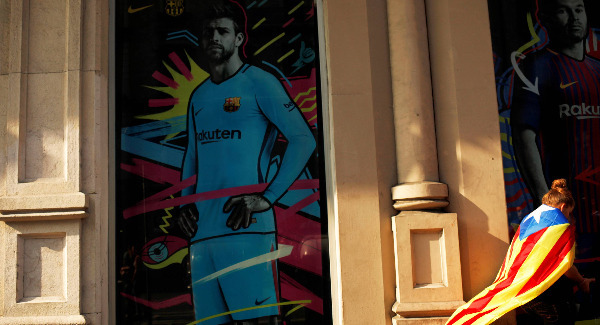

Tonight’s match against Chelsea — the nearest thing they have to a bogey team in Europe — could have been the first international occasion for Barca to fly the flag for a country on the road to independence.
That was the thought anyway.
But the deadlock of the past two months has led to frustration on all sides and also confirmed some of the differences of opinion within a very politicised club.
As a club, Barcelona has been a byword for Catalan national identity and consciousness since the time of the Franco dictatorship.
“Barca led the Catalan social feeling during Francoism because there was no other way of expression allowed outside Camp Nou,” in the words of Jordi Medina, of the Crit Valent supporters group.
In the name of democracy, the club publicly backed the independence referendum on October 1 that was ruled illegal by the government. It also supported the protest strike against the police repression that followed. Barcelona directors wanted their game against Las Palmas that evening to be postponed, the official supporters group were prepared to invade the pitch to force the match to be abandoned.
Under pressure from the league authorities, the game went ahead — in an empty stadium. “We decided that instead of postponing the game, which is what we wanted, we’d play behind closed doors,” said Barcelona president Josep Bartomeu. “That way we show our concern for the situation and send our support to those who have been unable to exercise the right to freedom of expression.”
But December’s elections showed that there is a difference between a separate identity and full separation. A majority of the vote in Barcelona was against pro-independence candidates, and in fact, it was the Barcelona vote that tipped the balance against independence in Catalonia as a whole.
Such differences extend to the heart of the club. Carles Vilarrubi, a prominent businessman and Barca vice-president, wanted to defy the league over the Las Palmas game and resigned in protest. Jordi Mones, another director, followed suit. “Politically we don’t take sides,” Vilarrubi had said previously, “but what is clear is that our bond is with the Catalan people.”
Former president, the lawyer Joan Laporta, has been even more outspoken — “From the beginning, for me, being president of Barca was another way of promoting the rights and freedom of Catalonia” — and Laporta and his supporters are said to be waiting for the right time to make a comeback, particularly as Leo Messi favours his former boss.
Yet Messi’s own commitment to the cause was put into some perspective a few weeks back when it was revealed that his new contract includes a clause allowing him to leave if Barcelona are no longer affiliated to La Liga or another top league.
That possibility seems remote for the time being, but last year the club did quietly explore alternatives in the event of them becoming ineligible to compete in a Spanish competition.
In theory, it would be possible for members of the Catalan football federation such as Barcelona, Girona, and Espanyol to join a different league, but it would require the agreement of all concerned, including leagues, clubs and Uefa and Fifa.
“Unthinkable” was the response of Barca fans to the thought of playing outside La Liga. “The Spanish league without Barcelona or without Real Madrid would not be the Spanish league,” said one. “There would be no rivalry.”
Fans of Bilbao, Sevilla, Atletico Madrid and a dozen other clubs would certainly dispute that — but just as significant for Barcelona as a club is that a large number of their own supporters are opposed to any breakaway.
The club’s main penyas — supporters groups — are well-organised, sponsored, and some would say regimented by the club itself.
These are the “grupos de animacion” who lead the chanting, singing and flag waving from a designated zone in Camp Nou.
They are visibly and noisily committed to the cause of independence. But there are many other penyas that take a different view, although mainly outside Catalonia, in cities such as Zamora and Salamanca, and they claim to feel like second-class citizens.
So there is real dissent, even if some of it is blown up by media hostile to the independence movement. There has been far less publicity given to the minority among Espanyol fans in Barcelona who feel their club should be doing more to demonstrate their nationalist credentials.
The irony of this situation is that Espanyol, despite the name, is the club with more Catalan roots, and nowadays has twice the number of local players compared to their famous rivals.
Barcelona, say the Espanyol fans, may be “more than a club” — but Catalonia is more than Barcelona.

CONNECT WITH US TODAY



Be the first to know the latest news and updates