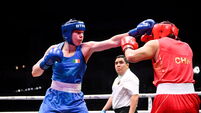
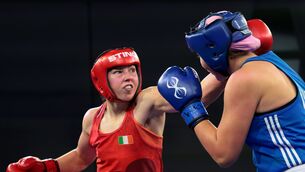
New dawn for women’s sport in Ireland
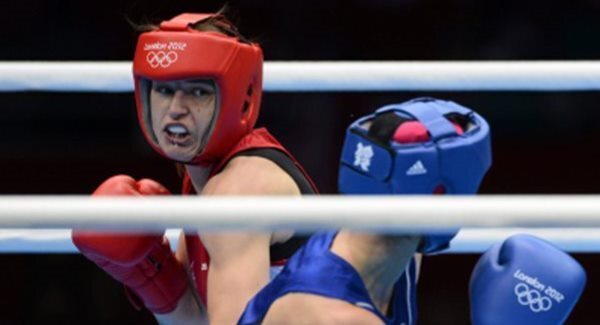
Being Ireland’s greatest female Olympian has brought its rewards and returns but the Cork legend was always keen for company.
Katie Taylor’s gold medal success yesterday means O’Sullivan will at long last have some company in her exclusive club. And she is delighted with the development.
“I am happy to share it. It is a heavy burden to carry,” smiled O’Sullivan, Ireland’s Chef de Mission at the Olympic Games. “You need as many inspirational people as possible, and people for the kids to look up to.
“ I saw pictures and videos from back home and it was just brilliant to see the reaction to Katie’s fights. In most of the pictures there were a lot of kids and young people. This is what it is all about — getting young people involved in sport, and getting them out there to chase their dreams and make dreams come true.”
Sarah O’Connor, chief executive of the Federation of Irish Sports, was amongst the fans cheering on Taylor in London yesterday. She is convinced Ireland has a rich female sporting talent whose efforts often don’t receive the respect and reportage which they deserve.
O’Connor reasoned: “Irish women have actually being doing really well internationally if you look at the Maguire twins, Lisa and Leona, in golf or Derval O’Rourke in athletics, or even Annalise Murphy coming fourth at these Olympic Games on Monday. But perhaps as a country we have never made the most of those successes.”
However she is adamant that yesterday’s dramatic eight minutes of boxing action could change a nation’s attitudes towards women in sports.
“I think Katie in particular is bigger than all of that put together in terms of what has happened.
What Katie has done, dominating a sport like boxing on the international stage, has traditionally been very much a male achievement.
“Her win is a real opportunity to showcase that sport is for all Irish people, male, female, boys and girls. There probably has been a tendency in the past to focus on sports for boys or sports as a man’s realm. But it is hugely important that we have women involved at all levels from partaking to administration.”
O’Connor is one such high flyer in terms of administration and points to the examples of Mary O’Connor — the acting chief executive of the Camogie Association and Sarah Keane at the helm of Swim Ireland.
“We are lucky in Ireland to have a lot of females in high positions. Guys would often underestimate the passion, the interest and the knowledge that is there in Ireland amongst the female population. It is about maximising that passion and utilising to get more girls involved in sports.”
But to achieve that ambition will require a change of attitude. The obvious example is Taylor’s own route to success in boxing, predominantly the reserve of males. O’Connor agrees.
“Traditionally maybe we haven’t offered the full range of sports to girls in Ireland. I firmly believe that there is a sport out there for everyone and people should be allowed to try out as many sports as possible and find the one that suits them. Instead of pigeonholing girls into specific sports like hockey, tennis or basketball, they should be allowed try things like boxing or rugby.
“We are in the early days of trying to maximise the involvement of females in sport. Research in recent years has shown that female participation is increasing. But there is still a lot to be done. In a recent survey it was shown that somewhere in the region of 40% of males are members of a sports club or organisation while the figure for women is 17%.
“But there is a lot of work still to be done to make sport more accessible to females. There was a lot made about Katie’s training environment when she was younger and the fact that she had to change alongside the boys. For Katie that wasn’t a problem but for plenty of other girls it would be. We need to have those things in place to make sport accessible to everyone, male and female.
Former Cork camogie star Mary O’Connor has been stunned by the reaction to Taylor in Ireland over the past week. But such exposure is long overdue she feels.
“In terms of actual ability and technical efficiency, Irish sportswomen are up there with the very best. We are now seeing that more and more girls are taking up an active lifestyle and what Katie is doing is making girls believe what can be achieved with hard work. It has been fantastic. Not since Sonia O’Sullivan has the entire country ground to such a standstill. How many people would have websites crashing when they compete? But Katie is such a role model. Not alone is she such a wonderful sportsperson but she is such a humble character, that she is just so appealing to the general audience in Ireland. She is the ultimate role model not just for girls but for boys as well.”
And the camogie boss is convinced that Taylor’s performances this week in London, and the media exposure it has generated, will lead to more girls considering sporting activities. “It shows young kids that if you have talent and are willing to work hard then you can achieve your goals in life. She is a real home grown heroine, a girl next door. She had no luxuries growing up in terms of training and preparation. She is incredible and someone to look up to.”
Katie Taylor joins a select group of Irish athletes who have won Olympic Gold medals. Dating back to 1896 and the first Games of the modern era in Athens, the Bray woman yesterday became the seventh Irish sportsperson to win a gold medal.
They are:
1. John Pius Boland: Men’s singles and men’s double tennis, Athens 1896.
2. Pat O’Callaghan: Men’s hammer throw, Amsterdam 1928 and Los Angeles 1932.
3. Bob Tisdall: Men’s 400 metres, Los Angeles 1932.
4. Ronnie Delany: Men’s 1,500 metres, Melbourne 1956.
5. Michael Carruth: Men’s welterweight boxing, Barcelona 1992.
6. Michelle Smith: Women’s 400m freestyle, 200m IM, 400m IM, Atlanta 1996.
7. Katie Taylor: Women’s light-flyweight, London 2012.