Could AI finally make you a better golfer?
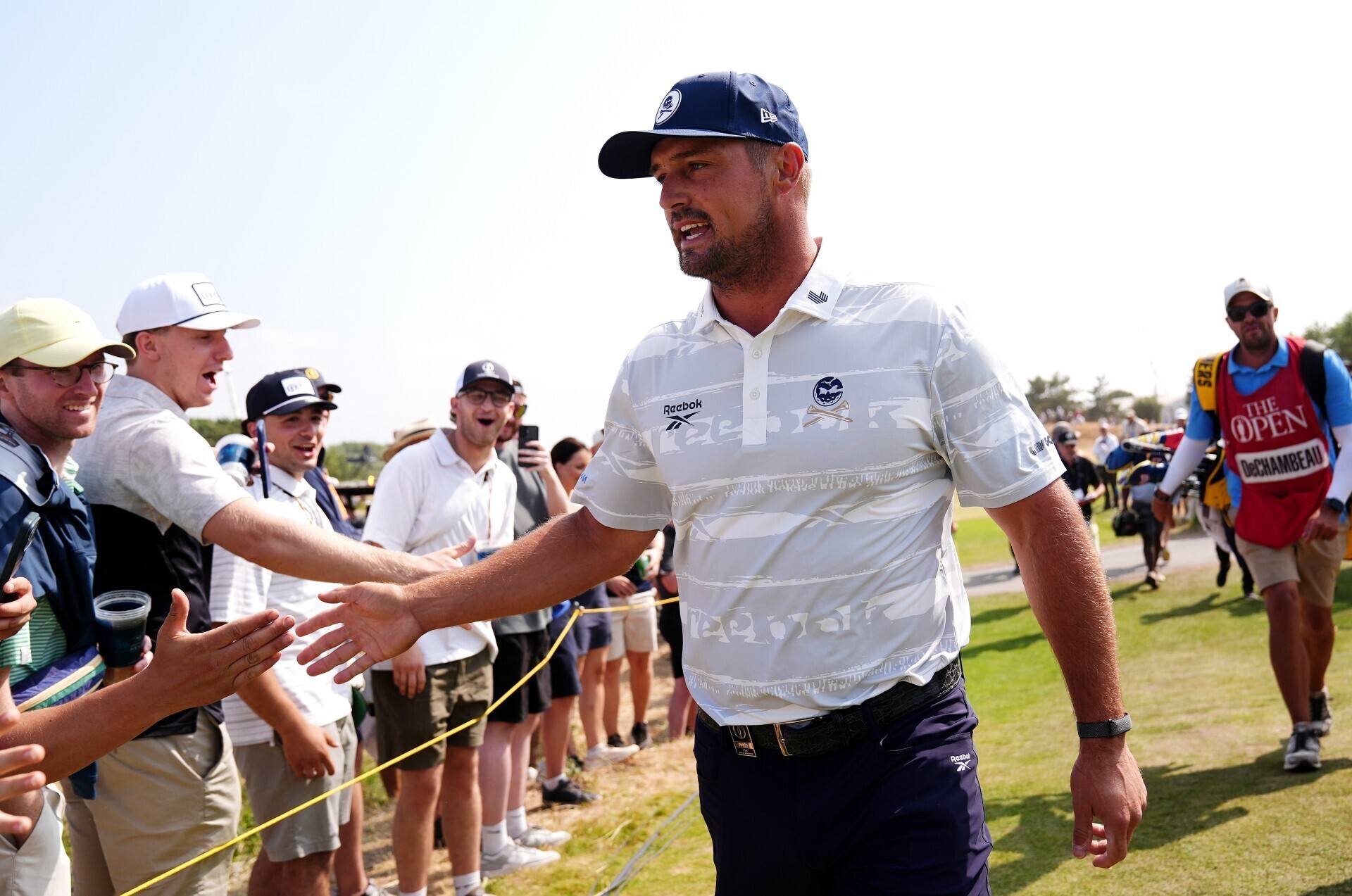
Bryson DeChambeau: The US golfer is no stranger to experimentation. Pic: Jacob King/PA Wire.
No sport is as susceptible to fads as golf. It is a game defined by margins, where the pursuit of an uncatchable perfection is the entire point. That makes it forever vulnerable to the promise of an exciting new solution.
Everyone craves the eureka moment. Some even find it. That sensation never lasts.
After Bryson DeChambeau’s team Crushers GC came first at LIV Golf Korea last May, the notorious golfer revealed that he used Gemini, Google’s artificial intelligence assistant, before the final round in a last-minute bid to fix his swing mechanics.
DeChambeau is no stranger to experimentation. He uses single-length irons and recently used a club he fabricated with a 3D printer. When he encountered problems getting the club to “turn over” or release properly, he took to the range to work it out. The fix only came later that night in front of a pixelated screen.
“I was talking to AI quite a bit last night trying to go through some different physics principles that makes the club turn over, having some alpha torque and gamma torque put in there,” he said in a report on Golf.com.
Talking to AI. This is the world we live in now. A sport with an insatiable appetite for the latest technology was always going to dive headfirst into this frontier. There are already a host of AI coaches and caddies. Does that mean the human ones are just another profession worried about eventually being replaced by the machine?
“I’ve seen it all come and go,” says pro coach Shane O’Grady, who has worked with the likes of Leona Maguire and Gavin Moynihan.
“No, I’m not worried. AI will not teach someone how to drive a car. You won’t learn how to swim with it. How to stroke, breathe, do that and move on to the next step. Golf is the same. It hasn’t changed in 150 years. You can’t fast-track.
“You have to learn a half-decent grip. Then the next part. You can only learn two or three things at a time. If you overload the brain, it doesn’t work. It takes reps. It means making a mess of it, being successful at it and all the things that make it a drug you are addicted to. Golf gives you a sniff of how good it can be and then it takes it away. You need to be guided along the way in a proper programme. That is teaching.”
Currently, AI’s uses vary from club fitting to swing analysis. Everything from the clubhead at impact and the player’s position at address to the takeaway can be analysed, accompanied by a catalogue of recommended practice videos.
In the professional ranks, the search for an edge really does matter. It has tangible value. Ever since the last Ryder Cup, Edoardo Molinari has developed a reputation as the data whisperer of the sport. Europe’s vice-captain is renowned for studying historic data on course strategy and simulating matches to find the best European pairings.
Lately, he has teased a new level of analytics for the select group of pros and NCAA players he works with. It included a striking image. Imagine being able to stand over any tee or approach shot on any golf course in the world, in any conditions, and identify the optimal target simply by looking at your phone screen.
In an interview with The Times earlier this year, captain Luke Donald once again heralded Molinari and the new possibilities AI has afforded the European team.
“I think having great people like him around you is a skill in itself. Statistics will play an even bigger role in the next 16 months with the evolution of AI. There’s already been a few ideas floated about how we can move with the times and keep progressing. My job is to find those edges that can give us an advantage. Certainly, through statistics, through Edoardo and AI, we’d be silly not to tap into some of that.” For the vast majority, the path forward has not changed. Walk before you can run.
“When I started playing golf, you weren’t allowed to use a driver until I could use my 3-wood,” recalls O’Grady with a laugh. “Get it on the fairway 200 yards and then you might move to the driver. People go out now and buy €600 drivers, yet they can’t even hold the club.” He is not averse to using technology himself. TrackMan, indoor and outdoor studios, a simulator and a putting green are all part of his coaching. He can still remember buying a VCR in Dubai as an assistant pro in 1993, when it was a significant technological development.
All that said, what is the real impact of new developments? He can still remember travelling to a conference at West Palm Beach in 2003. Butch Harmon was the guest speaker. The most revealing contribution came from somewhere else.
“A guy at the conference was talking about the world handicap average: men 20, ladies 36, based on the data they had. They said with all the video technology, the men’s average would be down to 15, the ladies’ to 28.”
He went back four years later and the same speaker was on the bill. Someone from the audience asked about his prediction, pointing out that the men’s handicap had gone to 22 and the ladies’ to 39.
“Simple is best. If you can communicate something complicated and turn it into something simple, that is the task. Fads come and go. You realise it isn’t working and move on to something else.”
Ultimately, every new wave is still just a tool. The value is knowing what to do with it. Donald was heralding an operation where AI helped Molinari. It didn’t replace him. In the same report that detailed DeChambeau’s AI-assisted swing fix, there was even speculation about whether the breakthrough might give him momentum ahead of the 2026 US Open at Shinnecock Hills.
He missed the cut.

CONNECT WITH US TODAY



Be the first to know the latest news and updates