US Open Letter: LIV and let LIV for breakaway players in future US Open fields?
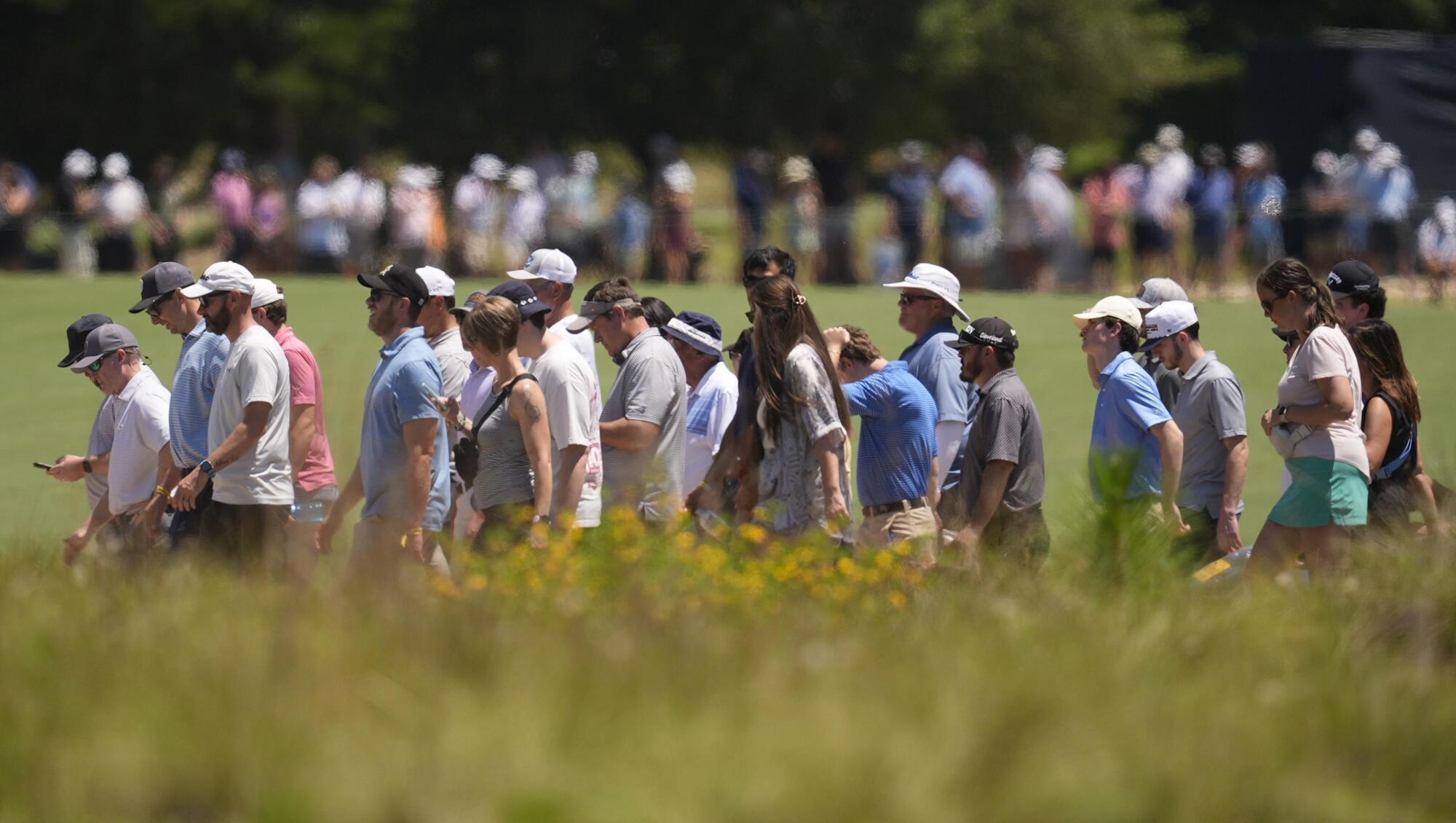
OPEN DOOR: Fans walk on the 12th hole during a practice round for the U.S. Open golf tournament in Pinehurst, North Carolina. Pic: AP Photo/Mike Stewart
During the USGA’s very long annual press conference, executive director Mike Whan revealed two interesting items: a direct pathway for leading LIV golfers into future US Open fields and paying amateurs who make the cut are both on the consideration table.
Coming to terms with the reality that LIV Golf doesn’t seem to be going away in the near future, Whan said that the USGA will discuss the possibility of adding some kind of exemptions for leading LIV golfers into the 2025 U.S. Open.
“We’re going to talk about it this off-season, whether or not there needs to be a path to somebody or somebodies that are performing really well on LIV that can get a chance to play in that way,” Whan said. “I think we are serious about that.
“Now I think the reason we’re being more vocal about looking at that for next year is maybe this is the new world order, and if that’s the case, we wanted to take a look at that. I think it’s feasible. I don’t think it’s a huge pathway, but we do offer other pathways through DP (World) or Korn Ferry, so we know that there’s an option to get there.”
The US Open currently offers exemptions to the points leader in the previous season’s Korn Ferry Tour standings as well as several spots to DP World Tour leaders not otherwise exempt (top two players from previous season’s rankings and the current season Race to Dubai points leader through PGA Championship).
The primary route into the field, however, will remain open qualifying. Of the 30 LIV golfers who attempted 36-hole qualifying for a spot – and 35 were exempted into final qualifying – only four ultimately made it through: Spaniards Eugenio Lopez-Chacarra, David Puig and Sergio Garcia as well as South Africa’s Dean Burmester. That gave LIV 13 players in the 156-man field at Pinehurst No. 2.
Before several alternates were added to the field late, PGA Tour players had a qualifying success rate of 24.4 percent (22 of 90) while LIV’s success rate getting through was 10 percent (3 of 30).
“About half this field is filled open, and I think we had 35 players from LIV that were exempted right into final qualifying,” said Whan. “So if they really wanted to be here, they could go play 36 holes and qualify, and some did, to their credit.
“I think we have 13 or 14 LIV players in the field, and that’s essentially what we’ve had in ’22 and ’23. There is no out-of-bounds stakes on our field criteria. In other words, this major is probably different than some others, you can get in. It’s not a closed field. It doesn’t require a committee or an invitation. If you want to play in this field you’ve got an opportunity to play in this field, and we’re proud of that.”
Regarding paying amateurs out of the purse as they do professionals, Whan admitted that reality might come “sooner rather than later.” Golf has long resisted going the way of Olympic sports, where the rules of amateur status were long ago blurred to the point of being unrecognisable.
The last five years have seen a sea change regarding the rules of amateurism in the collegiate athletic realm in the US, with litigation and legislation making it legal for college athletes to benefit financially from their name, image and likeness (NIL). More and more star college athletes are making more money remaining in school than peers who sign rookie contracts to play professionally.
Star athletes are also free to transfer from one school to another without consequence in eligibility – a sort of free-agent market of its own.
The USGA got ahead of the curve in allowing amateur golfers to accept money, equipment and gifts. Currently, all players who miss the cut in the US Open receive $10,000, but amateurs are paid only as off-setting expenses up to $10,000.
But it has thus far drawn the line at paying amateurs who compete in majors or tour events to earn money based on how they finish. Nick Dunlap won the American Express as an amateur in January – the first amateur to win a tour event since Phil Mickelson – but the full share of the winner’s check went to runner-up Christiaan Bezuidenhout.
Whan said that the USGA will look into changing that as well, meaning the low amateur at the US Open would get more than just a silver medal.
“We’ve tried to evolve NIL and amateur status,” said Whan. “We as the USGA kind of created an NIL and amateur status angle before the NCAA (National Collegiate Athletic Association, the governing body of U.S. college sports) did, so golf was kind of ahead of that time.
“I’m not sure. You may be right. We may be heading to that path sooner rather than later.”
CONNECT WITH US TODAY



Be the first to know the latest news and updates