Letter from Augusta: Great White Shark returns to Augusta, but is buying his ticket
The CEO of LIV Golf is at the Masters to support his players, he says. 'Hey, you know, the boss is here rooting for you.’
Letter from Augusta: Great White Shark returns to Augusta, but is buying his ticket

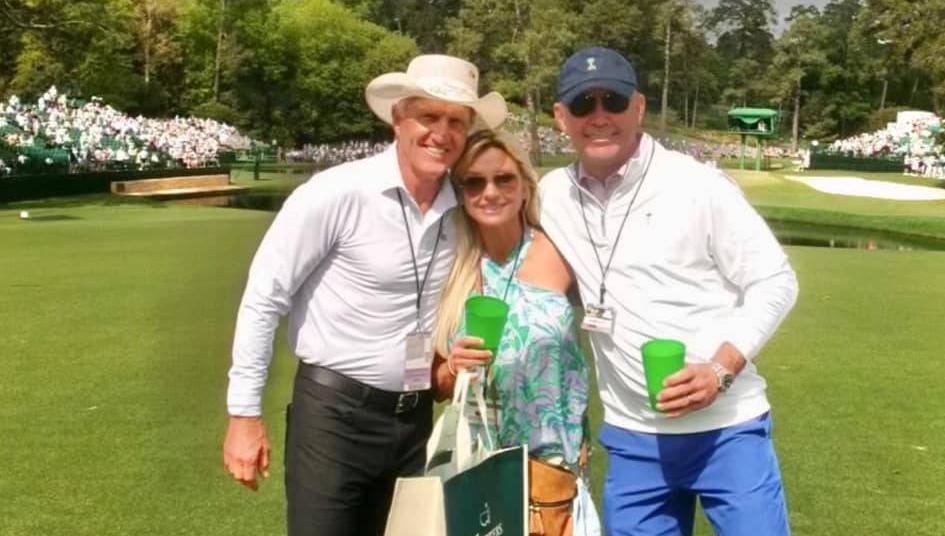
Stacy Donaldson and John Donaldson of Aiken, South Carolina, posing with Norman on the 15th fairway crossing (Courtesy of the Donaldsons)

It was 43 years ago here, when a young and dashing golfer from Down Under showed up at the Masters and received a new nickname in the pages of The Augusta Chronicle.

Greg Norman was just 26 years old in 1981 when he played in his first of 23 Masters, not yet scarred by repeated calamities and near misses at Augusta National. He spoke that year about “shark shooting” back home near Brisbane, Australia, in Moreton Bay, a breeding ground for sharks.


“I have a friend I normally go pig hunting with, so we decided to take our hunting rifles out with us on the boat and shoot sharks as they came to the top. It’s a nice little sport,” he said in 1981. “I believe I’m the only one who does it.” 

The tale, his aggressive game and his striking figure and blond hair got Norman branded “the Great White Shark,” a nickname he embraced as his brand.

On Wednesday, Norman returned to Augusta National for the first time since he divided the game as the CEO of LIV Golf. He did not return as an honoured champion, of course, nor as an invited guest. Instead, Norman walked around as a regular ticketed patron, sporting a trademark white straw hat and a LIV Golf logoed polo shirt. A reporter for the Washington Post spotted his distinctive frame stalking the course on the course and scored a brief interview.

“I’m here because we have 13 players that won 10 Masters between them,” Norman said. “So I’m here just to support them, do the best I can to show them, ‘Hey, you know, the boss is here rooting for you.’”

Augusta National patrons are among the most polite in the game, partly because of the reverence the venue instils upon fortunate guests and partly for fear of misstepping and never being welcomed back. Norman was once revered himself in Masters circles, a victim of repeated misfortunes and trauma in a place he seemed destined to don a green jacket. Nobody was ever going to confront him because of his heel turn into one of the game’s most divisive figures.

According to Norman’s account to the Post, however, the patrons he encountered Wednesday were beyond just courteous.

“Walking around here today, there’s not one person who said to me, ‘Why did you do LIV?’ ” he told the Post. “There’s been hundreds of people, even security guys, stopping me, saying, ‘Hey, what you’re doing is fantastic.’ To me, that tells you that what we have and the platform fits within the ecosystem, and it’s good for the game of golf.” 

Naturally, Norman also lobbied for more than the 13 players from his breakaway circuit in the Masters field. He thinks his bought-and-paid-for stars deserved a greater presence at Augusta.

“There’s probably a couple that have been overlooked that should be in,” Norman said. “What is that number? I’m not going to give it a definitive number, but they’re definitely quality players that have done incredible performances over the last six to nine months that are worthy of it.” 

Norman was not invited to the press building to hear Masters chairman Fred Ridley declare that LIV golfers will get no extra consideration when it comes to qualifying exemptions. The Masters Committee deemed Joaquin Niemann’s global play worthy of a special international invitation, and Ridley deemed that the probable avenue for any worthy LIV golfers who slip through the cracks of OWGR top-50 and other exemption categories.

“I think it will be difficult to establish any type of point system that had any connection to the rest of the world of golf because they’re basically, not totally, but for the most part, a closed shop,” Ridley said.

“But I don’t think that prevents us from giving subjective consideration based on talent, based on performance to those players. Our goal is to have, to the greatest extent possible, the best field in golf, the best players in the world. Having said that, we never have had all the best players in the world because of the structure of our tournament. It’s an invitational. It’s limited field, it’s a small field.” 

Norman, of course, knows that. He was one of two special foreign invitations in that 1981 field who would not have qualified via any other exemption category had they been Americans. He took full advantage and finished fourth, announcing his presence to a wider audience that hadn’t yet been introduced to his outsized talents that would eventually make him No. 1 in the world for 331 weeks (second only to Tiger Woods’ 683).

But a year after prominently not receiving the courtesy of an invite as a past major champion (“I want the focus this week to be on the Masters competition, on the great players that are participating,” Ridley said last year of the snub), Norman paid his way in to put the focus where he prefers it most – on himself.

When asked by the Post reporter about any progress toward reuniting the professional game he divided, Norman had nothing to offer.

“LIV is completely autonomous to that, to be honest with you,” he said. “I’m not even privy to any of the conversations, which I’m happy about because we’re focused on delivering what we’re promised the world we would deliver.” That deliverable is debatable. At least this week, the Masters is delivering what it always promises – a great championship with the mixed field of the game’s greats.

x

More in this section

Sport

Newsletter

Latest news from the world of sport, along with the best in opinion from our outstanding team of sports writers. and reporters

Cookie Policy Privacy Policy Brand Safety FAQ Help Contact Us Terms and Conditions

© Examiner Echo Group Limited