Letter from Augusta: Golfing at the Masters a generation game for the Strafaci family
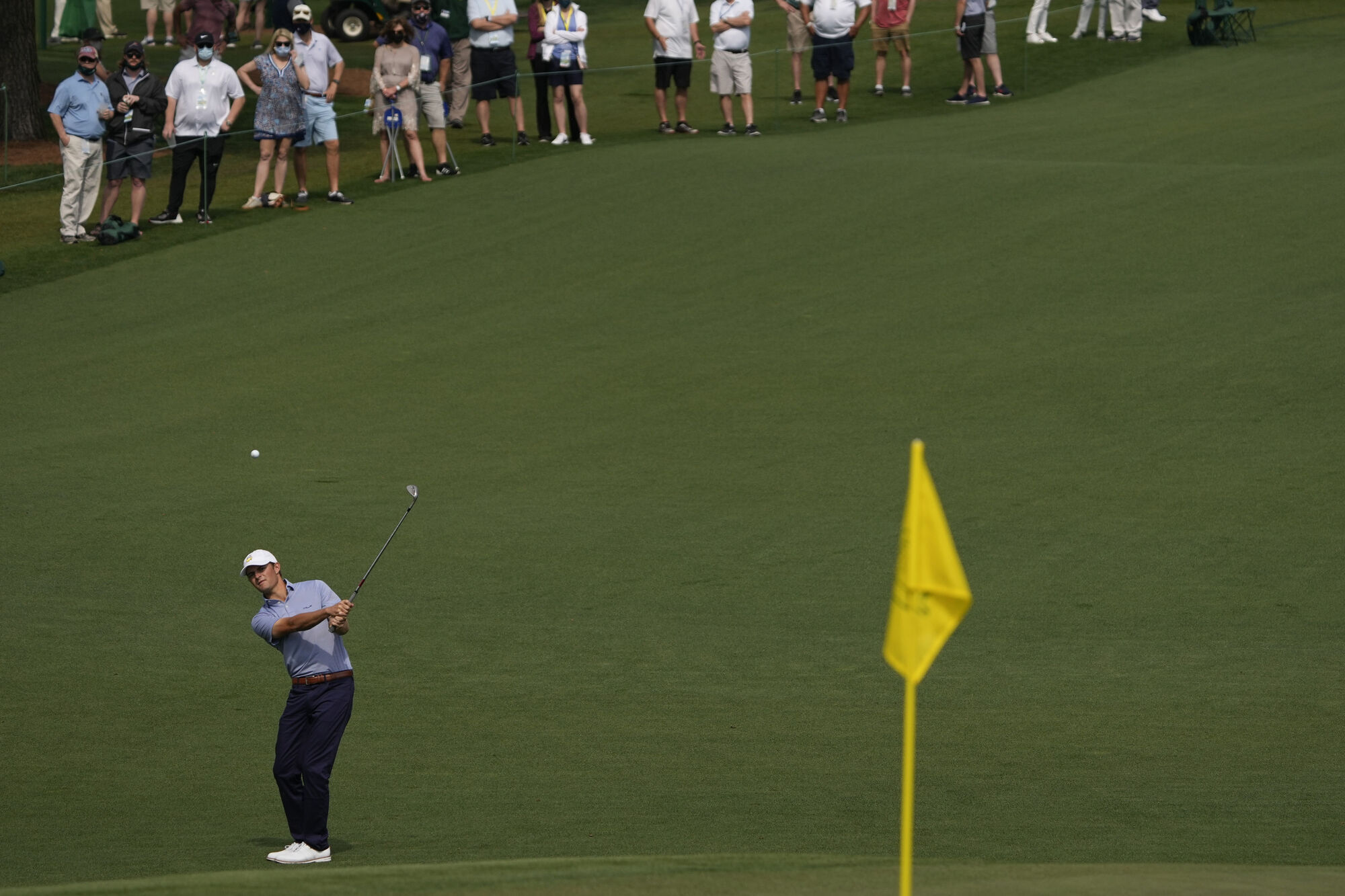
Amateur player Tyler Strafaci spent the week walking in his grandfather Frank Strafaci’s footsteps in Augusta.
It's been a rough Masters on the limited group of three amateurs, with none of them making the cut to claim the silver medal for low amateur.
But it was still an historic week for US Amateur champion Tyler Strafaci, who spent the week walking in his grandfather Frank Strafaci’s footsteps.
“I never got to meet my grandfather (who died in 1988), but he’s been a very integral part of my life,” said 22-year-old Tyler. “My grandfather came from nothing and he built a great career, became a great amateur golfer. Played in two Masters, won the Public Links, finished ninth in the US Open.
“So he had quite the unbelievable career coming from no money. He was very inspirational. So just being in the Masters and playing a tournament that he did, it’s a dream come true.”
Frank Strafaci Sr grew up in an immigrant household on a farm in Brooklyn, New York, adjacent to a nine-hole military course that eventually became Dyker Beach Golf Club. He dominated the Metropolitan amateur golf scene and ended up a ubiquitous figure in pictures with celebrities and in historic moments.
“Being in that area he played with presidents, he played with mobsters, he played with just a lot of characters and historical figures through the years and characters in and out of golf,” said Frank Strafaci Jr, Tyler’s dad. “His connection with golf and its history started in middle 30s and went through the day he died.”
The elder Strafaci was dear friends with Babe Didrikson and also played with Babe Ruth. He played with golf-obsessed President Eisenhower and in Australia with John Wayne. He played with generations of golfing giants from Walter Hagen to Bobby Jones to Ben Hogan to Arnold Palmer to Jack Nicklaus.
Stationed as a sergeant in the Pacific theatre during World War II, his golf prowess made him a friend of generals, which is why he’s the only enlisted officer seen in newsreels traipsing through the jungle of Leyte with General Douglas MacArthur when he famously returned to the Philippines.
It all amounts to a pretty good life for a slightly built 5-foot-5 insurance salesman.
“He had an unbelievable life. He just did,” said his son. “He never considered himself better than anybody and certainly never considered anybody better than him.
Frank Strafaci Jr was born in 1957, too late to see his father play in any Masters (1938 and 1950) or US Opens (1937 and ’46) or his numerous US and British Amateurs, including the 1954 US matches at the Country Club of Detroit when he pushed eventual champion Arnold Palmer to the 18th hole in what Palmer said was the toughest match of his final amateur victory.
In 1938, the elder Strafaci shot a pair of 74s to start the Masters just five behind eventual champion Henry Picard. But he was also in contention to be picked for the Walker Cup, so instead of finishing after a third-round 82 he withdrew to go to Pinehurst, North Carolina, to compete in the North and South, which he won in both 1938-39.
“At that time he deemed that more important for his chances to make the Walker Cup,” his son said.
If withdrawing from the Masters seems hard to fathom, his tale from the 1940 US Open is even more remarkable. Strafaci qualified for the national open held that year at Canterbury Golf Club in Ohio. Strafaci had met a struggling young professional in the New York area named Ben Hogan and found out that Hogan had failed to qualify and was the first alternate. A few weeks before the US Open, Strafaci sent Hogan a letter encouraging him to show up in Cleveland to prepare. “I’ll see to it that you get in,” he promised.
Hogan did go to Canterbury to prepare, and when nobody else had withdrawn, Strafaci withdrew himself on June 6 to allow Hogan to play. The Hawk contended and tied for fifth, sparking his Hall of Fame career that included his first three professional wins as an individual in consecutive weeks shortly after that US Open and nine majors including the career slam.
“He never told me that story about Hogan; I never understood how a man in his prime in his life would pretty much make decision not to play,” Frank Jr said. “I heard it from somebody else who sent me a copy of articles from three different papers about it and it confirmed what I heard.”
The elder Strafaci moved to south Florida in the 1957 with his pregnant wife. He met and befriended a man named Alfred Kaskel who founded a golf resort he named after himself and his wife, Doris. Kaskel asked Strafaci to be director of golf at Doral and run the Doral Open golf tournament, played on the course that Strafaci nicknamed the “Blue Monster”. The association gave him access to more celebrities like Jackie Gleason, Mickey Mantle, Joe DiMaggio, and many others.
“That gave him the opportunity to have golf be his entire life without turning professional,” his son said.
The only thing the elder Strafaci never got to do was play for the US in the Walker Cup. “My father should have been picked for Walker Cup in 1938 (at St Andrews) and was devastated,” his son said. “It stuck with him the rest of his life. He wrote a letter to his friend Bill Campbell and said that was the greatest disappointment of his life.”
Tyler will play for US team next month at Seminole Golf Club, close to their home in South Florida.
“That was one of my grandfather’s goals and kind of his biggest letdowns of his life that he didn’t make the Walker Cup team. Whether he deserved it or not, that’s in history,” Tyler said.
CONNECT WITH US TODAY



Be the first to know the latest news and updates