Thrilling Els victory a triumph for golf
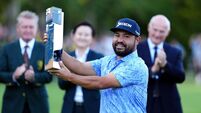
As Tiger Woods flew back across the Atlantic last night, Ernie Els was marvelling starry-eyed at his own name etched into the famous Old Claret Jug.
And you couldn’t help thinking after one of the most thrilling final days to The Open in the tournament’s history that the sport of golf had been the biggest winner.
That might sound like a cliche, but it happens to be true.
For a sport which was in danger of being strangled by the sheer flawless majesty of Woods, the extraordinary happenings on the final day of a compelling Open championship were like an injection of lifeblood.
It is not Woods’ fault that he has dominated for so long and in such processional fashion.
The world number one, with eight major championships already to his name, has taken the game to a higher plain and we have duly acclaimed his genius and marvelled at his superiority.
He has attracted billions of sponsors’ cash into the sport and his influence has been felt on driving ranges and courses around the globe. In the ghettos of Los Angeles and the leafy lanes of English suburbia. Across nations, races and creeds where kids just want to ‘‘swing like Tiger’’.
But latterly it had begun to reach a point where we also wondered whether his domination was killing golf as a spectacle - ruining the thrill of competition which is the oxygen of all sporting action.
Perfection is to be applauded but too often the Woods brilliance robbed us of compelling drama and pathos and momentous afternoons of sporting cut-and-thrust.
Woods served up history, the debate raged, but didn’t lift the television millions on to the edge of their seats or stir them to rise - father, son and sleeping dog - as one to punch the air in wonder and excitement in their own living rooms.
All that changed this last weekend and if we must thank Els for a sudden-death play-off win of nerve-shredding dimensions then how important was the three-hour Muirfield squall on Saturday afternoon which stripped bare the most proficient game in golf?
But for that storm, a genuine Scottish howler, Woods might have packed away in the hold of his private jet the Old Claret Jug and with it the keys to unlocking his ambition of a Grand Slam of majors in the same calendar year.
Golf, a game of excruciatingly difficult technical precision, can do without such dominance.
Which is why the sport privately rejoiced back in 1972 on the same Muirfield links when Jack Nicklaus’s dream of a third straight major triumph of the year was hijacked by the one-shot triumph of Lee Trevino.
Just as it had done a dozen years before when Arnold Palmer’s Grand Slam bid was also derailed at the third hurdle by Ken Nagle at St Andrews.
A similar sense of relief pervaded at Muirfield, though Els reckons Woods will have more chances to complete all four majors in the same year.
‘‘I think the weather stopped the slam here,’’ said Els. ‘‘But Tiger is probably going to have another opportunity to do it. He’s the only player that probably can do it.’’
Few would argue with that verdict even if Tiger’s slipstream out of Muirfield was full of doubts and questions after his invincibility had been punctured by that humiliating third round of 81 on Saturday when his game disintegrated in the teeth of the storm.
Could he really be the greatest player of all-time if he failed to manage his game, albeit in horrendous conditions, as well as some of the more journeymen professionals on the golf circuit?
Frenchman Thomas Levet, who eventually lost out in the sudden-death play-off, and Ireland’s Des Smyth, both went out within minutes of Woods that afternoon and each shot seven shots better.
It was a legitimate question considering the manner in which Woods appeared to lose his patience along with the fluidity of his swing and the precision of his putting during that ill-fated round.
Too often the exasperation of being unable to control the elements led Woods to rip into the Muirfield turf, alleviating his anger but also disrupting his concentration.
Greatness demands sportsmen produce of their best in adversity, not just when the sun is shining, the elements in their favour and the trophy gleaming in readiness. As such Woods’ third round was not an exhibition in course management.
Rather it threw doubt on the mental toughness of the man who has so long been universally regarded as the world’s most resilient sportsman as well as its most talented golfer.
It would be wrong, however, to castigate Woods. Greatness also demands character and magnanimity and no-one exhibited those particular traits quite as graciously as Woods this last weekend.
His final round 65 was a perfect example of how he has pushed back the frontiers of his sport. His equable demeanour in defeat an even more salutary lesson for the grumpy Colin Montgomerie whose paranoia only matches his self-delusion.
Woods will be back, probably to win the USPGA at Minneapolis next month, and no-one would bet against him one day adding that calendar Slam to his list of achievements.
But on a surreal afternoon at Muirfield we were thankful for his absence.