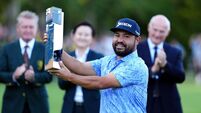
The show always goes on at Masters
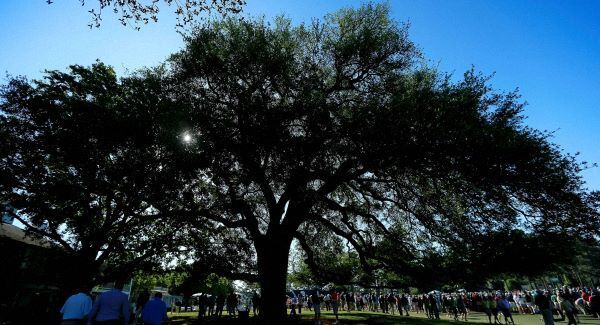
It was a tree, for goodness sake.
Ah, but at Augusta National and the Masters, even a tree — in this case, the ‘Eisenhower Tree’ is afforded such a passionate embrace that it’s like one of the family.
A phenomenon, this Masters, one that is difficult to explain to folks who have never been here. But the traditions are so coveted that when you check in at the registration desk you are extended a reminder as to which anniversaries can be duly noted. This April, it was the 60th anniversary of the epic 1954 play-off win for Sam Snead over Ben Hogan and the 50th anniversary of the last of Arnold Palmer’s four green jackets.
Iconic names each of them, but these anniversaries serve to do more than ignite warm, nostalgic feelings. This year, given the public’s astute awareness of Tiger Woods’s absence and some media reports suggesting he is too big a void for the Masters to overcome, these particular anniversaries are well timed.
Why? Because 1954 and 1964 signify the passing of eras, in some small measure, which can be applied to what’s going on in the game right now. When Woods announced that he was going to skip the Masters for the first time in his 19-year professional career, choosing microdiscectomy to address a pinched nerve in his back, speculation was that Phil Mickelson was big enough to carry the interest.
Then the left-hander made two triples and a double, shot five-over 149, and missed his first cut at the Masters since 1997.
For the first time since 1994, when Mickelson was sidelined because of a skiing accident and Woods was just 18, the weekend of the Masters was contested without either of this generation’s best players.
Strange, for sure, but recalling the glory of ’54 and the magic of ’64 helps one understand what is going on right now.
It’s called a natural progression.
Dynamic as they’ve been, what with seven green jackets between them, Mickelson and Woods are no match for Father Time. The left-hander will be 44 in June and when Woods next gets a crack at Augusta National, he will be 39. Study golf history and one thing is abundantly clear: While you can compete into your later years more so than footballers or baseball players, even golf eventually pulls the curtain down.
One would be naive to think that we aren’t seeing shades of ’54 and ’64 with this year’s Masters.
In 1954, Snead was 41 when he bested Hogan, who was 40, and while it was an unforgettable Masters, so, too, was it the last great hurrah. It was the last of Snead’s seven Majors, while Hogan, pretty much was done as a force, his legs too damaged, his putting nerves too fragile.
By the time the next era of superstars rolled around, the fierce Masters competition featured younger players. Palmer won his green jackets at 28, 30, 32, and 34, the latter in 1964 when he triumphed by six.
No one would have predicted it was the last of Palmer’s four Masters or the final one of his seven Majors, for that matter, but that’s the thing about golf. It leaves the window open for varying lengths, but never forever.
The final Palmer conquest at Augusta came during a glorious time for professional golf. Jack Nicklaus was 23 when he won the first of his six in 1963, while two years earlier, Gary Player was 25 when he captured the first of his three. From 1958 to 1966, Palmer, Nicklaus, and Player — the renowned ‘Big Three’ — combined for eight Masters wins.
Just as Snead and Hogan gave way to Palmer, Nicklaus and Player, and The Big Three conceded to the Johnny Millers and Tom Watsons and Greg Normans and Nick Faldos, it is as natural as day leading into night to watch Mickelson and Woods move closer to the edge of the stage to make room for Jordan Spieth, 20, Rickie Fowler, 25, and a healthy line of young talents.
Are Mickelson and Woods finished as Major threats?
It would be foolhardy to suggest as such. But it would also be naive to ignore that their time is preciously slipping away.
For proof, check your anniversary book.
CONNECT WITH US TODAY



Be the first to know the latest news and updates