Mary McAleese: 'Less than impressive' management committee 'lacked vision for future of GAA'
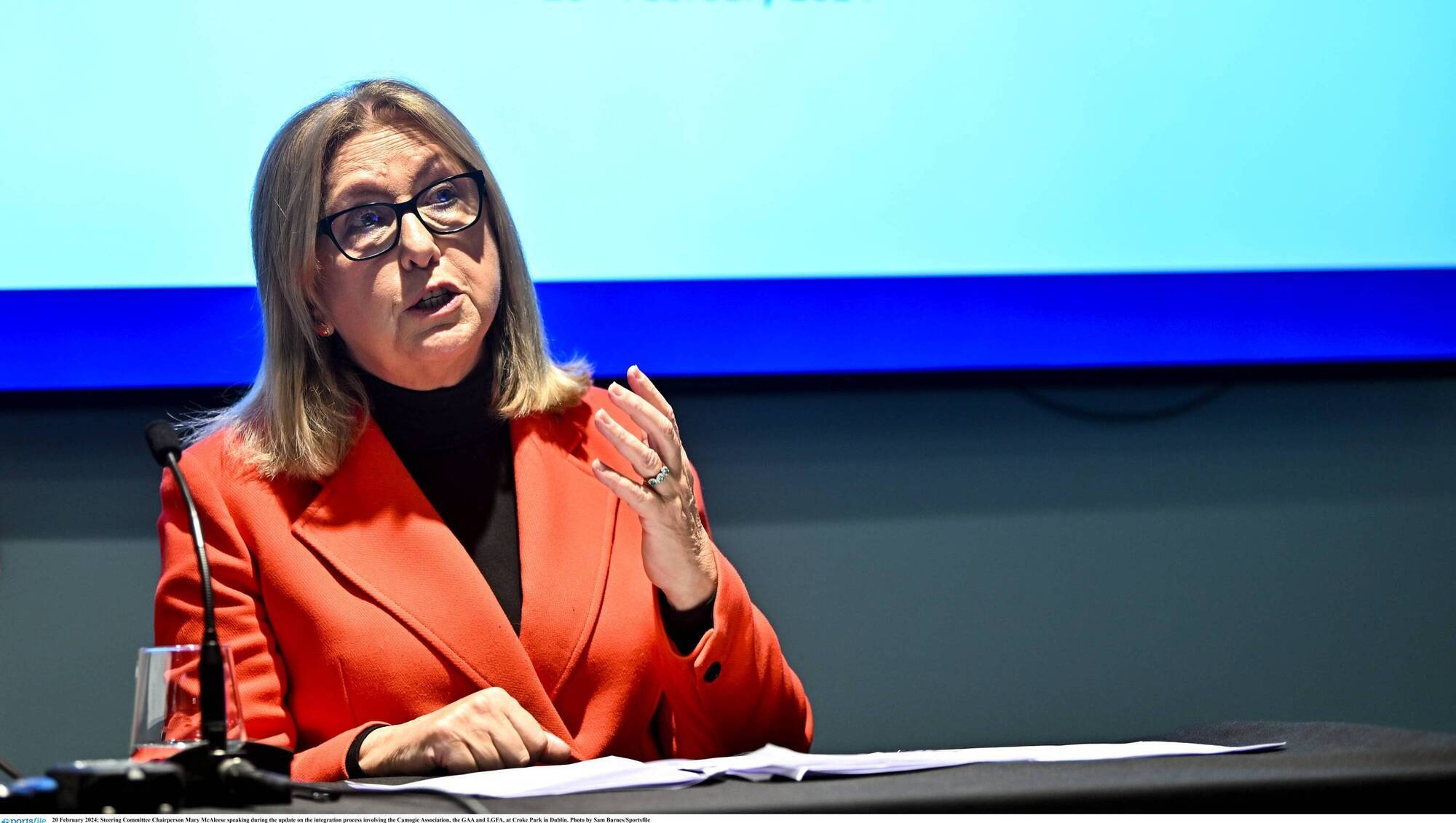
Mary McAleese speaking during the update on the integration process involving the Camogie Association, the GAA and LGFA, at Croke Park. Pic: Sam Barnes/Sportsfile
Former President of Ireland Mary McAleese has fired a parting shot at the GAA’s Management Committee following her resignation as chairperson of the steering committee on integration.
McAleese, who was appointed to the position in September 2022, stepped down from the role citing their lack of support for completing the integration process by 2027.
The Down native made her decision following a steering committee meeting on Monday when they received a statement from the GAA seeking more time.
There were concerns that Central Council would have to provide over €10 million per annum to cover the costs of female inter-county teams as per the Gaelic Players Association (GPA) motion passed at Congress in Mayo in 2022.
Last Sunday week, GAA leadership met in Croke Park to discuss integration.
They expressed their determination that there would be “equity” rather than “equality” in what inter-county teams would receive as a result of integration and the associations would have to “live within their means”.
The point echoed that made by former GAA trustee Niall Erskine at the 2022 Congress where he spoke of the need for “proportionality”.
Believing it to be “almost a betrayal of the women in our sporting cultures” and “a slap in the face of women”, a furious McAleese lay the blame for the stalled integration process squarely at the feet of Coiste Bainisti.
Read More
“The GAA management committee was quite frankly less than impressive, and very disappointing to me as a long-term GAA supporter to meet a body that was so lacking in vision for the future of the GAA,” she told
“It boils down in their view to finances, which incidentally we had taken great trouble to meet their concerns and have answers for them that were more than credible and workable.
"I hate to say this but I suspect when I see them that they have problems with equality that there are people who are not entirely happy about the idea of including women in decision-making at the top level of Gaelic sports."
McAleese accused Coiste Bainisti of blocking “our progress” and “our plan” and “they have no other plan currently. So, it looks like going back to the drawing board.
“Yesterday, I was shocked to hear the current president of the GAA (Jarlath Burns) say that in fact he didn’t really support the idea (of integration) having supported it up to now at all our meetings but that he was in favour of federation.”
The GAA’s Management Committee comprises 10 men and nine women. The females are Tracey Kennedy (GAA trustee), Keelin Kissane (Munster GAA nomination), Joan Kehoe (Leinster GAA nomination), Mary Judge (Connacht GAA nomination), Moyagh Murdock (Ulster GAA nomination), Fiona Joyce and Claire Aitken (nominations of the GAA president and director general), Helen O’Rourke (LGFA representative) and Hilda Breslin (CA representative).
Burns and GAA director general Tom Ryan are part of Management Committee as they were on the steering body on integration. She claimed leadership on the matter “is not evident” and “the commitment to integration has evaporated."
Asked if Burns and Tom Ryan were supportive, McAleese said: "I think you'd have to ask them and I'll leave it at that."
The Oireachtas committee on sport will “urgently invite” the Gaelic sports organisations to attend a meeting to explain McAleese’s decision. Chairman Deputy Alan Kelly stated: "Anything that delays the timeline for integration is a completely regressive step.”
McAleese’s committee themselves had come in from criticism from a number of quarters including the GPA for their lack of communication during the four years.
Reacting to McAleese’s departure, the GAA thanked her for her work and maintained it “remains firmly committed to building a single Association that honours the identity, heritage and contribution of each of our sports while creating a stronger and more inclusive future for the entire Gaelic games family.”
The statement from Croke Park explained the next stage of the process will be “to distil the substantial and constructive feedback received from a wide range of stakeholders into a refined set of key principles and structures, and to derive a detailed and sequential workplan, all of which will be advanced in 2027.”
CA president Brian Molloy said he shared the sentiments of McAleese. “Like Mary, I too was disappointed with the decision to step back from the agreed goal of one Association by 2027. I believe that while there were significant concerns, none were insurmountable.
"In 2024 the three Associations announced the timetable to deliver full Integration by 2027. It was lauded as a momentous step towards unity, equality and inclusivity.”
As late as last December, members of the GAA’s Management Committee had informed McAleese that the timeline for integration was “unrealistic”.
They had informed her “a phased implementation would represent a more measured approach, in order to better manage any risks and to accommodate any reasonable reservations that may be abroad in the Association”.
McAleese rejected their opinion and the steering committee had continued to work, arranging a roadshow around the country following which a more detailed timeline of events was published.
They included Special Congresses to commence the formal process of merging next month but talk of those gatherings cooled over the last couple of months.
Earlier this year, GAA president-elect Derek Kent had suggested the 150th anniversary of the GAA in 2034 would be a more realistic target to complete integration.
“A measured and phased approach would be the best, and would ensure stability, buy-in, and lasting success.”
In May, Munster GAA chairman Tim Murphy revealed the association and the LGFA and CA in the province favoured a more federal approach to aligning the three bodies.
“Having met with Lorraine Royle (Munster LGFA President) and Christine Ryan (Munster Camogie Chairperson), we collectively agree that a federal model would be the most effective framework to facilitate gradual integration.”
Speaking in June about the possibility of federation rather than integration, Burns said: “We're trying not to use the F word, if you don't mind, because we just would prefer not to use that particular word.
“But Lorraine and Christine are the two people who deal with, regard LGFA. They are all, if you look at the powerhouse of camogie in Munster, LGFA are very strong in Munster as well, so we would ignore those people at our peril. And they do have a particular narrative that might be at odds with other people.”

CONNECT WITH US TODAY



Be the first to know the latest news and updates