GAA needs GPS data to help tackle cruciate curse, surgeon warns
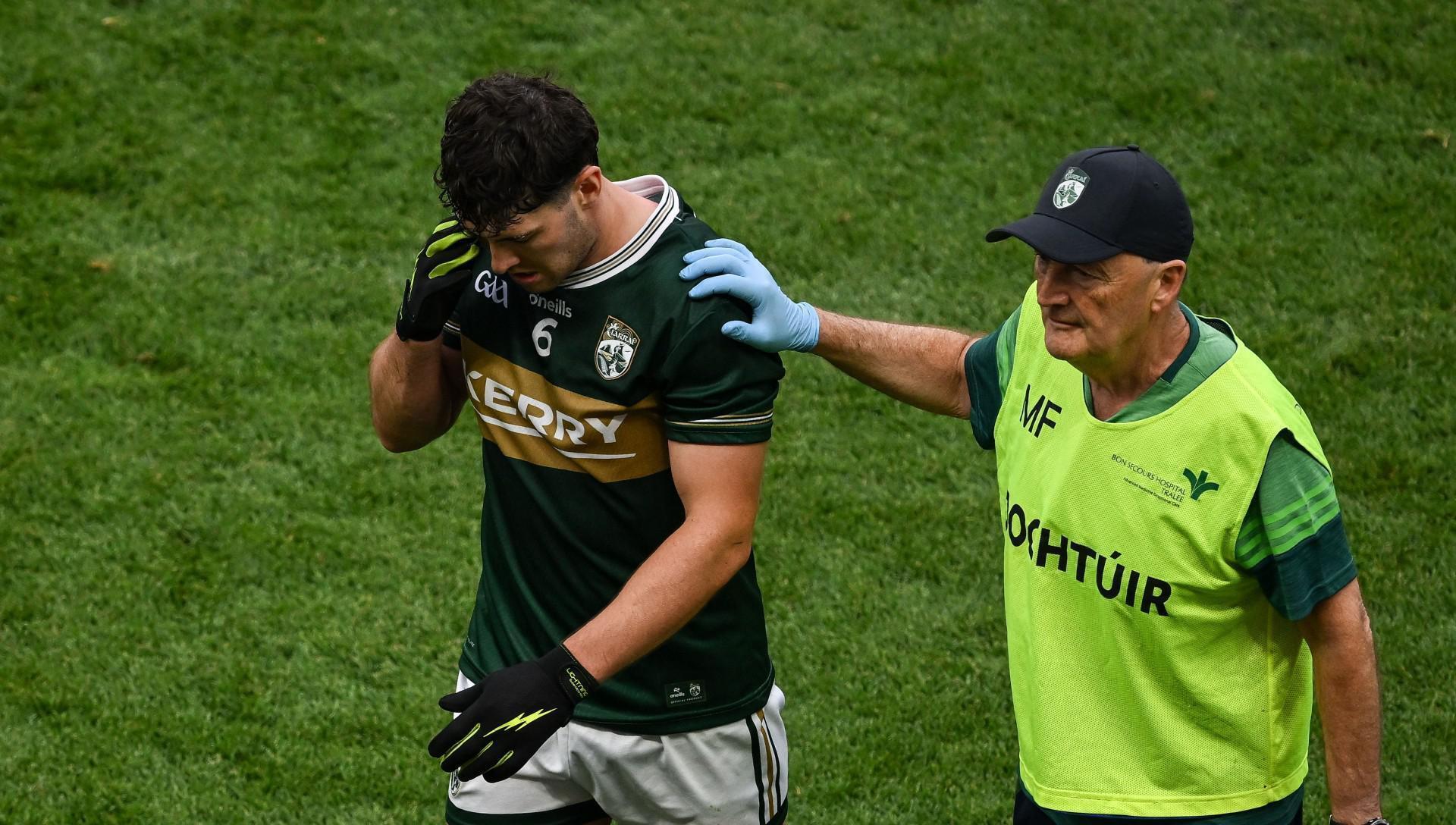
A leading orthopaedic surgeon says the GAA should invest in a comprehensive injury surveillance programme to help address the “epidemic” of cruciate ligament injuries. Pic: Sam Barnes/Sportsfile.
A leading orthopaedic surgeon says the GAA should invest in a comprehensive injury surveillance programme to help address the “epidemic” of cruciate ligament injuries.
Professor Brian Davitt of the UPMC Sports Surgery Clinic in Santry believes the organisation should make it compulsory for teams to provide their GPS data.
He also argues for a campaign to highlight the benefit of injury reduction exercises, which have been proven to lower the possibility of an anterior cruciate ligament (ACL) tear by as much as 50%.
The spate of such injuries in the Meath senior football camp – four players in two months – has raised wider awareness of the dreaded injury, although Davitt says the number of Gaelic players coming into their clinic has remained consistent.
“Whether the numbers are increasing or not, it's hard to say, because the one thing we don't have is we don't have a proper injury surveillance pathway across all levels of GAA.
“And that's what makes it really hard to actually compare our numbers this year to last year. We do know that the GAA players represent the majority of our athletes that we do ACL reconstructions on in hospital.
“(With an injury surveillance pathway) at least we would get a baseline that we can measure from. So, if we have a tracker for 2027 let’s say and we can see ’27 levels and they can be rated on the number of games played and the risk of injury, then we can start to process that and do injury reduction training programmes.
“If there’s a 15% to 20% reduction in injury rates, we can see that was instigated by what was implemented. Whereas now if something is introduced, we really don’t know what to measure.
“We don't have baseline data. So, I think that's a very simple level. We need to understand how prevalent this problem is, and then any means you do to try to reduce it is based on metrics.”
Davitt worked in Australia for 10 years where he saw better injury surveillance programmes. The GAA’s record of them relates to claims for surgery under the player’s injury fund. In their cover year (June 2024-May ’25), there were 2,346 claims for knee operations, 1,401 at adult football level. The total knee cases accounted for 32% of registered claims. In 2024, there were 2,247 claims, 1,393 of them at adult football level.
While the GAA’s medical, scientific and welfare committee have been conducting research into ACL injuries, figures such as those above only tell some of the story, says Davitt.
“We've produced a lot of papers looking at our return to sports rates and all these other factors, but they don't necessarily give us a full picture of the prevalence of the injury."
At a time when new rules have impacted the physical demands placed on footballers, Davitt agrees it strengthens the argument for injury monitoring. The Football Review Committee had sought GPS information from counties but were rebuffed by 28 of the 32 counties.
“There are unique ways of managing deidentified data,” Davitt stresses, “and I think it should be compulsory on teams to do it because it's going to help us all in the long run. They should just be told to ‘cop on’, for want of a better expression, and share.”
A father of three young children who are involved in sport, Davitt is as passionate about preventing ACL injuries as he is curing them. He notes the likes of the “GAA 15” warm-up, an initiative that was launched by the GAA 12 years ago aimed at curbing lower limb injuries.
“You get a flurry of information initially when it comes out and it’s done with great gusto but it’s about maintaining it. It’s one thing promoting it, it’s another thing getting the coaches to do it. These exercises are so trusted and trusted and proven to reduce the possibility of ACL injuries by 50%.
“I don't say prevention because we're never going to prevent this injury, but these exercises and surveillance should be done together. I think that really needs to be a priority because when you have an epidemic of this nature, we just don't know how long it's going on.
“People injure themselves, but with the advent of MRI, we can diagnose it easier. We've always had ACL injuries in GAA, we’re just more aware of them now because of high-profile cases. Really, they’re just the tip of the iceberg.”
ACL reconstruction has advanced in Santry where patellar and quad tendons have been used for the tissue grafts as part of a controlled trial.
An athlete in his or her mid-teens has a 30% chance of experiencing a second rupture or a fresh one on the other knee. “They are the patients that we really need to focus on,” says Davitt. “A lot of them may not get to inter-county level because they have had a subsequent injury and they lose that window of opportunity.”
To assist them, Davitt and his colleagues conduct a supplementary procedure called a lateral tenodesis. “We take the iliotibial band, we pass it under the lateral ligament and reattach it to the femur. That helps control rotation of the knee. The ACL is good at controlling the forward-backward motion, but not good at controlling rotation.”
CONNECT WITH US TODAY



Be the first to know the latest news and updates