Éamon O'Shea: Munster an impossible puzzle but look to Leinster for All-Ireland winners
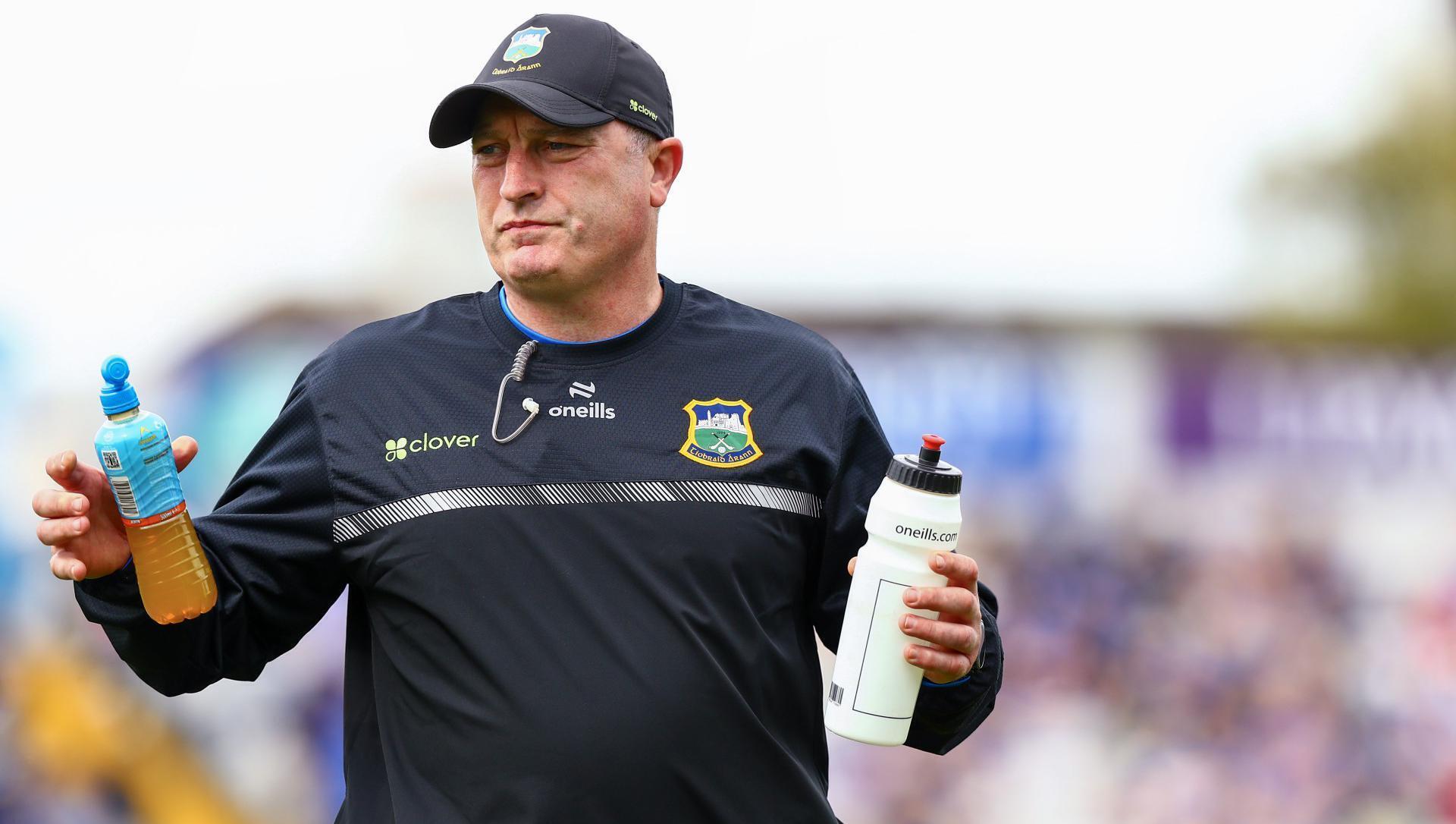
GO FIGURE: Tipperary manager Liam Cahill. Pic: INPHO
It started with an innocuous text that read ‘how are you reading Munster now’?
My very much off-the-cuff reply ran something like this: ‘Tipp are a puzzle right now, playing in quarter tones; not yet convinced about Limerick’s current iteration; Clare are really good up front, especially Rodgers and O’Donnell; Waterford are still standing tall; and that leaves Cork, where the pressure to win will continue to ramp up and may eventually become unbearable’.
A big mistake to reply to that text. The sports editor casually, but cunningly, replies ‘sounds like there is a column in that’. Surely a test and not what I wanted to hear. The time had come, because that is what time does, to say something concrete and insightful – isn’t that what redundant managers and coaches are supposed to do – to give an opinion on future events that they have absolutely no control over?
Readers had obviously grown tired of my vagueness and deflection and wanted more useful stuff like who is going to win the big games in Munster? But readers can be wrong too - can you say something like that in a newspaper column any more? No one can predict who will win Munster after a handful of games. Making forecasts on a small number of observations mid-championship is not science, it’s sorcery. And I am no fortune teller.
That said, I have been known in my immediate circle of family and friends, to blindly and wildly make positive pronouncements, as a fan of course – in complete contrast, I see danger everywhere when I am on the line - on Tipperary's chances every time they play. So much so that fact-checking has become a thing in my house in relation to Tipperary hurling games nowadays. Specifically, fact-checking on how many times my predictions have been wrong.
At half time in the recent Waterford Tipp match in Walsh Park, I engaged in a familiar and disturbingly recurrent row with my travelling companion when I prematurely predicted a similar pattern to the second half as had occurred the first half – that was continued Tipp dominance.
In response, my companion forensically went through other games where Tipp did not continue to dominate in the second half, most notably against Limerick in 2021 when I was directly involved and therefore, in her words, ‘might, and should, have actually done something about it’.
So even if I were to make predictions about likely winners and losers, I don’t even take them seriously myself. To make accurate predictions you need a lot of data as well as knowing a lot about many things. Stuff you can never fully know from the outside. You cannot sometimes even know that stuff from the inside. You look for patterns, rational explanations, scrutinise the data and are still left with randomness.
I envy those hurling scientists who retrospectively confirm that they saw a performance coming from the simple act of observing the warm-up. I even succumbed to that behaviour recently in Walsh Park, admiring Tipp’s use of the ball and adherence to choreographed movement and striking patterns before the game. What I did not see was that accuracy was obviously time dependent, as it only lasted to half time.
Those of you who have read Daniel Kahneman’s book , will by now have identified that my judgement heuristics, while seemingly useful (and mostly self-serving - see my opening paragraph), sometimes lead to systematic errors and incorrect reasoning.
System 1 thinking, as set out by Kahneman, is, by and large, automatic and instinctive, operating with little or no effort and no sense of voluntary control. It is no wonder, therefore, that such fast thinking can lead to errors arising from multiple forms of bias.
In contrast, System 2 thinking is more controlled and allocates significant attention and energy to the mental activities required for thinking, including complex computations requiring concentration and effort. In short, when we plug into System 2 we pay more attention and work much harder at thinking.
Take the lead up to last year's All-Ireland hurling final. Most of us succumbed to System 1 thinking, like my glib text response above on the current state of the teams in Munster. Firstly, we anticipated that what you see is all there is, ignoring what may not yet be visible, but is just as likely to occur. When you add in other biases such as: over-reliance on the weak evidence of small numbers; recency bias linked to Cork’s big semi-final win over Dublin; availability bias – Cork’s wins over Tipp earlier in the season; anchoring bias – perception in the media and among influential commentators of a big Cork win; and the perennial regression to the mean problem, it is not difficult to see how most of us got it so wrong.
Tipp probably did not cover any of these in their pre-match planning, but their management and players were savvy enough, tapping into System 2 thinking, to be aware of the potential for an upset and adjusted their behaviours accordingly.
As indicated by the Lucas critique in relation to economic policy interventions by governments – no I do not expect that you should know what the Lucas critique is - behavioural changes from key actors in the economy may cause observational data from previous periods to be inadequate for predicting future economic outcomes following a policy change.
People are rational, and when things change, so too do their behaviours. Be very careful, therefore, how you think about the future, especially if you are in government and planning a policy change. Losing a hurling game is one thing, but damaging the economy is a lot more serious.
And so where does this all leave us now? Are we any the wiser about potential Munster Champions in 2026? As indicated earlier, I cannot help you on that. You will have to work it out yourself.
What we can say with some certainty is that teams are rarely as good or bad as they seem, even within games, and ultimately, they revert to their mean performance over the course of the season. Luck plays its part and you need to acknowledge randomness before making definitive judgements on overall performance.
In truth, that is why people come in their thousands to watch five teams play in the Munster hurling championship. We simply do not know from one minute to the next what is going to happen. In a world where most of us live ordinary and orderly lives, the hurling championship, at least in Munster, takes us to a different galaxy where nothing seems to make sense, except maybe John Mullane’s radio narration of sublime striking, near misses and gladiatorial combat. The radio is always the second-best place to watch the Munster championship.
But beware, this year the All-Ireland hurling champions will come from the Leinster championship. I will explain why in due course - retrospectively of course.
CONNECT WITH US TODAY



Be the first to know the latest news and updates