‘They came down with a plan’ – Dublin’s road back
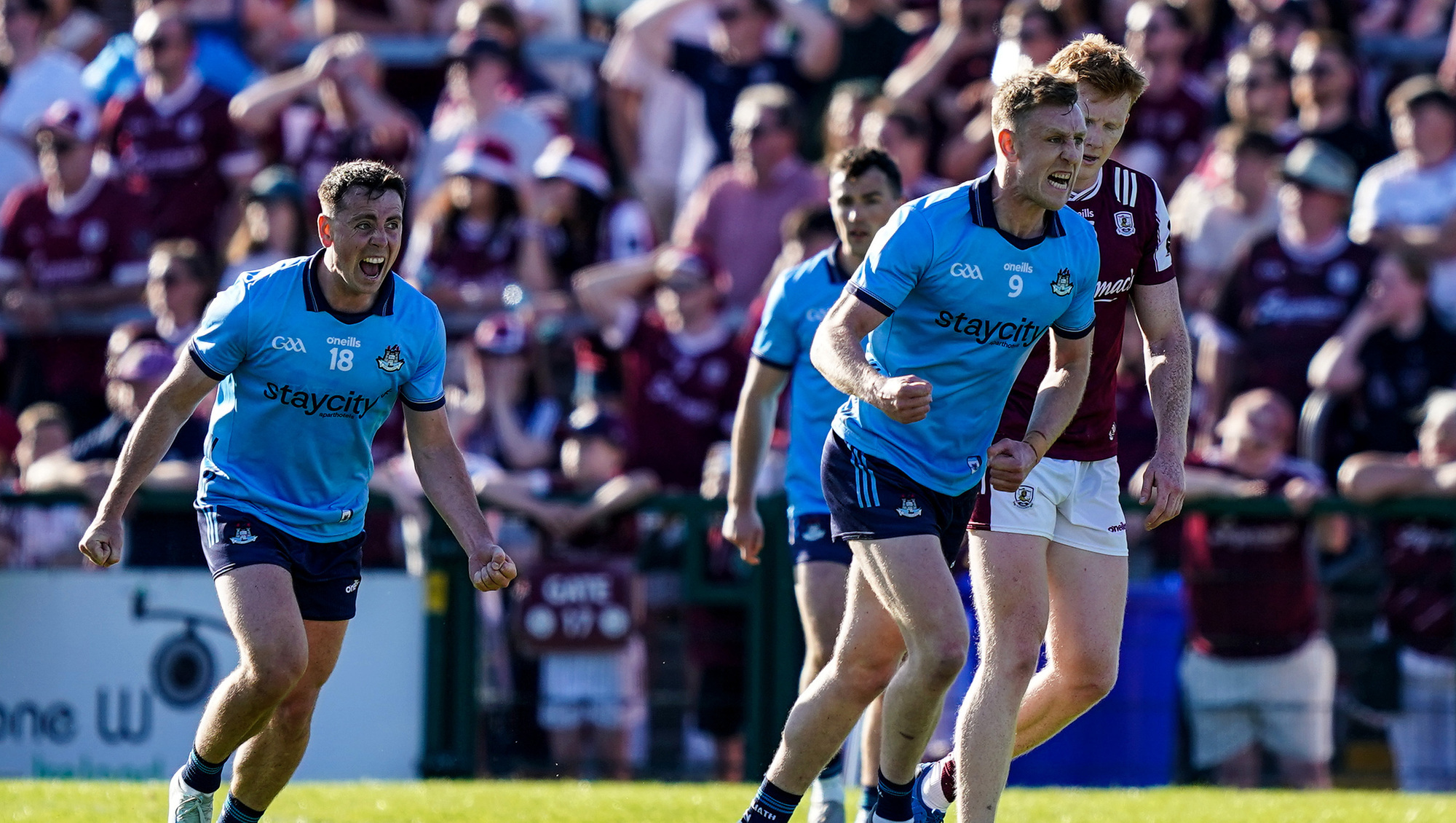
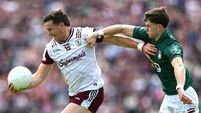
LATE POINT: With the last kick of an enthralling game, Dublin’s Tom Lahiff sealed a remarkable victory over Galway in front of a packed Pearse Stadium. Pic: ©INPHO/James Lawlor
With half-time approaching and his team struggling to gain a foothold in centre field, Galway goalkeeper Connor Gleeson opted to change tack with his kick-out. He skipped up, tapped right and kicked the ball to himself.

It was a shrewd bid to take advantage of Rule 2.7 (a), which clearly states that the player taking a kick-out may kick the ball more than once before any other player touches it but may not take the ball into the hands. Gleeson’s second kick found Johnny McGrath. Dublin’s furious protests were rightly ignored.
Just before that kick-out, Cillian McDaid dropped deep inside the Galway arc but wasn’t tracked. That made it five versus four close to goal. It was still a brave move, given that Cormac Costello’s goal came from a short restart. A slight push by Con O’Callaghan on Liam Silke saw possession spilt and the ball ultimately slide underneath Gleeson and into the net.
If you’re going to deliver a backlash, you may as well deliver it right. Dublin fully deserved their triumph in Salthill. The smile on Stephen Cluxton’s face after his game-clinching kick-out to Tom Lahiff, who started and ended the winning move, said it all. 43 years young, nine All-Ireland medals already in the boot bag and still driving it. This was a sweet one.
A hill on tour behind his back declared them ‘alive, alive, oh!’ He posed for pictures beside the post that he’d failed to leave for Cillian McDaid’s dropping shot, eventually punched across the line by Robert Finnerty. That was a theme throughout. Endure. Take a blow, rise and go again.
“Hard one to take in the end there,” summarised Galway manager Pádraic Joyce.
“Fair play to Dublin, they came down with a plan for the game.” Their approach to Galway’s kick-out was one of many elements Dessie Farrell’s management team nailed in Salthill. They arrived determined to demonstrate what occurred last time out was not their level. First, Dublin announced five changes from the team named during the week. Seán Bugler returned and slotted into the half-back line. Paddy Small went down in the warm-up to force them into a sixth swap, with Brian O’Leary taking his place.
To counter Galway’s enormous middle third, Dublin dragged one of their full-forward line out the field and offered Gleeson one of his corner-backs. When he went there, they pressed aggressively. Nothing quite reflected that strategy like Colm Basquel hounding Galway’s best line-breaker Dylan McHugh in the second half. Nothing quite reflects Gaelic football like Basquel’s performance.
Basquel kicked three wides and didn’t score from play. The very first attack of the afternoon saw Dublin surge forward from the throw-in only for his effort to sail wide. All of that is tolerable. Gaelic football is a form of organised chaos. Blunders happen. What defines games, what earmarks great teams, is their reaction.
Basquel was there feasting on breaks under Peadar Ó Cofaigh Byrne. He pressed like a demon. He laid on points for Killian McGinnis and Bugler. He wasn’t flawless. He didn’t need to be. That’s not the bar.
This is what any comparison with the greatest team the game has ever witnessed and the current side fail to realise; Dublin don’t have to be what they were. They just have to be better than what they face. So Con O’Callaghan can be penalised for steps with his first attack. He can be bottled up and hurled to the floor minutes later. He can fail to realise you can’t solo and go after a 50m advancement or stop and protest in a misunderstanding at Gleeson kicking the ball to himself. His direct marker, Johnny McGrath, can score from play first.
And the Dublin captain can still be absolutely awesome. He was. Right up until the moment he dived on a Peter Cooke cross-field pass for a crucial interception. A hamstring was part of the occupational hazard. Even still, O’Callaghan got up and limped around with his hand in the air as a mock defender, desperate to make a minor impact while he still could.
Man of the Match Ciarán Kilkenny can be the cause of a momentous Galway roar. After substitute Kieran Molloy bounced the ball off him to win a sideline, he turned to the open terrace with two defiant fists aloft. He’d gone into a contest with Kilkenny and not been bested in it. He was one of the rarities.
Kilkenny finished the game with two points and six assists. Between fouls, breaks and clean catches, he claimed six kick-outs. The current trend of zonal defensive systems means he wasn’t specifically man-marked in the tie. His first point came against Cillian McDaid. He bested Paul Conroy for his second. He always was a generational talent. He still is.
“He was a warrior and got cramp early enough in the second half,” said Dessie Farrell post-match.
“Generally, when a player gets cramp, there is only one thing happening and he is coming off in a matter of minutes. We had a slip written for him, but he was able to dig it out and keep going and keep going.” They all did. Dublin started expertly but were pinned back by a burst of two-pointers. Yet before the turnaround, they waited for the hooter and expertly worked a final score to make the margin four. It was finished by Kilkenny, obviously. The half-time score was 1-9 to 0-8.
At which point, enter: the chaos. A throw-in set play and long ball saw the outstanding Matthew Thompson smash a goal. Suddenly Pearse Stadium was lifting. Again, Dublin pushed clear. Again, they were hit with a sucker blow.
Cillian McDaid’s short shot was the source of that second green flag. By that stage, Dublin had abundant cause to settle. Lee Gannon, John Small, Eoin Murchan, O’Callaghan and Paddy Small were not on the pitch. The performance was already credible. Anyone who doubted their contending credentials had already been disproven. They were on the road. They found a way.
For Galway, the same is true. Despite the outcome, this was a strikingly similar performance to the one that earned them a fourth Connacht title in a row. In fact, they finished with an identical number of shots and the exact same total, 20 points.
There were errors. Just two of their six two-point shots were accurate. Two late two-point free opportunities were spurned, perhaps because Paul Conroy and Walsh were long gone from the action. Cooke had two late wides.
But the beauty of this hectic pursuit, the peculiarity that had the guts of 20,000 scorched supporters restless under the taxing sun, is that it was never about perfection. It is about resilience. The virtue of this dying Sam Maguire series system and the most important element for any side that will climb the Hogan Stand steps in July isn’t avoiding mistakes.
It is how you rise after them.
R. Finnerty 1-6 (1 tp, 1f); M. Thompson 1-1; M. Tierney 0-2; S. Walsh 0-2 (tp); C. McDaid, J. Maher, J. McGrath 0-1 each.
C. Costello 1-3 (2f); S. Bugler, C. O’Callaghan, L. O’Dell 0-3 each; K. McGinnis, C. Kilkenny 0-2 each; B. O’Leary, T. Lahiff 0-1 each.
C. Gleeson; J. McGrath, L. Silke, S. Mulkerrin; D. McHugh, S. Kelly, C. Hernon; P. Conroy, J. Maher; C. D’Arcy, S. Walsh, C. McDaid; M. Tierney, R. Finnerty, M. Thompson.
: P. Cooke for Thompson (41-53, temp), K. Molloy for Conroy (53), P. Cooke for Seán Kelly (53-60, temp), D. O'Flaherty for Hernon (55), P. Cooke for Shane Walsh (60), T. Culhane for D'Arcy (65), J. Daly for Silke (67).
: S. Cluxton; D. Byrne, T. Clancy, S. MacMahon; S. Bugler, A. Gavin, B. Howard; P. Ó Cofaigh Byrne, K. McGinnis; C. Basquel, L. O’Dell, C. Kilkenny; C. Costello, C. O’Callaghan, B. Leary.
: T. Lahiff for O'Callaghan (45-inj), N. Scully for O'Leary (50), C. Murphy for Clancy (53-55, temp), C. Murphy for Gavin (55), G. McEnaney for McGinnis (60), L. Breathnach for Bugler (62).
: D. Gough (Meath).