Football Review Committee considering alternative way to decide deadlocked games
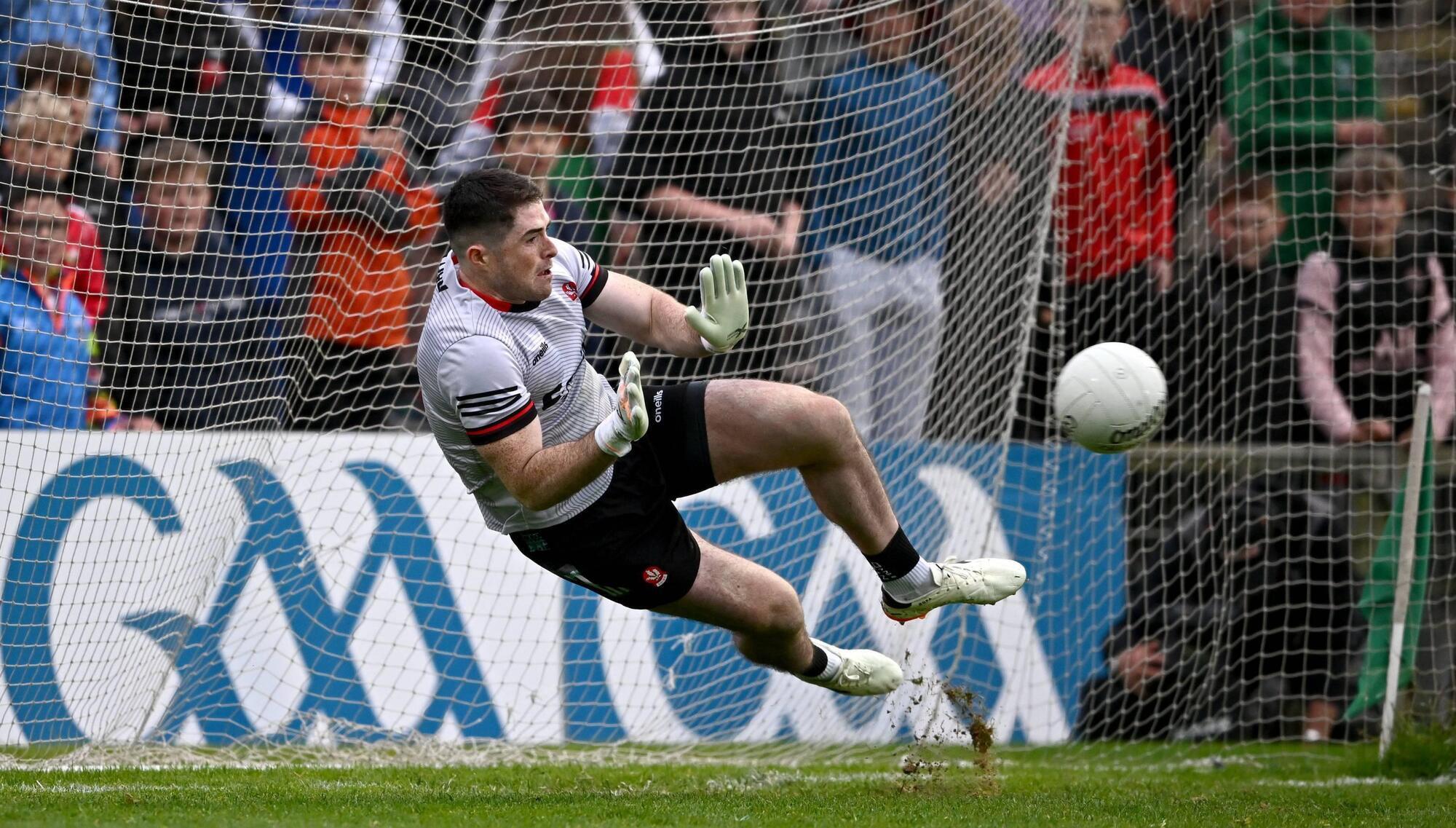
Derry goalkeeper Odhran Lynch saves a penalty from Mayo's Ryan O'Donoghue in a penalty shootout during the 2024 All-Ireland SFC preliminary quarter-final. Photo by Seb Daly/Sportsfile
The Football Review Committee (FRC) are exploring the possibility of replacing extra-time or penalty shoot-outs with a "overtime showdown".
At a briefing with the media in Croke Park on Tuesday morning, the body’s chairman Jim Gavin outlined the “rule enhancements” they are considering ahead of being voted on at November 30’s Special Congress and introduced on a trial basis for the 2025 season.
That will be preceded by the interprovincial tournament in Croke Park on October 18 and 19 where the long-list of playing rule changes will be put in operation over four matches.
Among the “emerging themes” currently being debated by the FRC include an overtime period where the team who has conceded a score will have a chance to match it after the subsequent kick-out.
If they fail to do so, the side that has scored can ensure the full-time whistle by putting the ball dead. However, if there is an equaliser, the team who scores next will be declared the winner.
The FRC have not decided if the idea would apply either after normal or extra-time but there is a sense it would be a better fit than penalty shoot-outs that are the last resort in separating teams in “winner on the day” fixtures.
Across the past three seasons, All-Ireland SFC champions Armagh lost four penalty shoot-outs and there is support to find a more equitable means of deciding such tight matches.
Gavin feels the proposals the FRC eventually put forward will be “interdependent” and “stand up on their merits”. Several of them, such as each team keeping three outfield players inside each 65-metre line, all kick-outs being taken from the 20m line, the four-point goal and the two-point score outside or on a new 40m arc, are already known.
Converted frees kicked from outside the arc will also be awarded two points. The body have yet to decide if the new two-point score will be signalled with a new colour flag or by the referee who is best placed to call the worth of the kick.
For the kick-outs, no player can enter the area between the 20m line and the 40m arc, but would be permitted to go behind the goalkeeper beyond the 20m whitewash should they wish. They don’t see a purpose for the current semi-circle “D” in their deliberations, which continue with their 32nd meeting this Friday.
By refining the passes a goalkeeper can receive to the parallelogram and beyond the halfway line, the FRC are attempting to strike a balance in the role of the goalkeeper. At the briefing, Gavin revealed there wasn’t a single shot on goal in this year’s Armagh-Galway All-Ireland SFC final and it is felt a goalkeeper’s chief duty is now to kick out the ball.
Disciplinary-wise, the FRC’s definition of contributing to a melee is any player who enters a row between two players and is not seen to be diffusing the incident, i.e. taking a team-mate away from it. In that event, they would be sent off. A player guilty of a head-to-head collision would also be red carded.
A fifth black card foul has been identified as preventing an opponent from going forward by holding them up while not bringing them to the ground. Currently, a black card is issued for a player cynically being brought down.
As a means of engendering respect, the FRC want players who commit fouls to hand the ball to the opposition. If they don’t, it will be considered a delaying tactic and the free will be brought forward by 50m.
The clock/hooter could also be incorporated to ensure there is no time-wasting by the team of a sin-binned player in the 10-minute period in which he is off the field. The FRC are weighing up whether to allow teams to play until the ball is dead after the half-time and full-time hooters have sounded or full-time being announced on the sound of it. To reflect the added load on players, they remain keen on increasing Gaelic football’s number of substitutes from five to six.
Next month’s interprovincial matches will be played by inter-county players whose clubs have exited their respective county championships. There will be a training session available to them on the rule changes the previous Saturday, October 12. The games in Croke Park will be open to the public and some, if not all are expected to be televised.
Gavin did not offer an opinion on Central Council’s decision to disband the preseason competitions next year, which might have provided counties with more opportunities to put the new rules into practice.
The 1995 All-Ireland SFC winner is a member of the GAA’s main playing rules committee, which could choose to extend some of football’s trial rules to hurling.


CONNECT WITH US TODAY



Be the first to know the latest news and updates