Enda McEvoy: Summer brought to life by red wave and Cork's wet sail
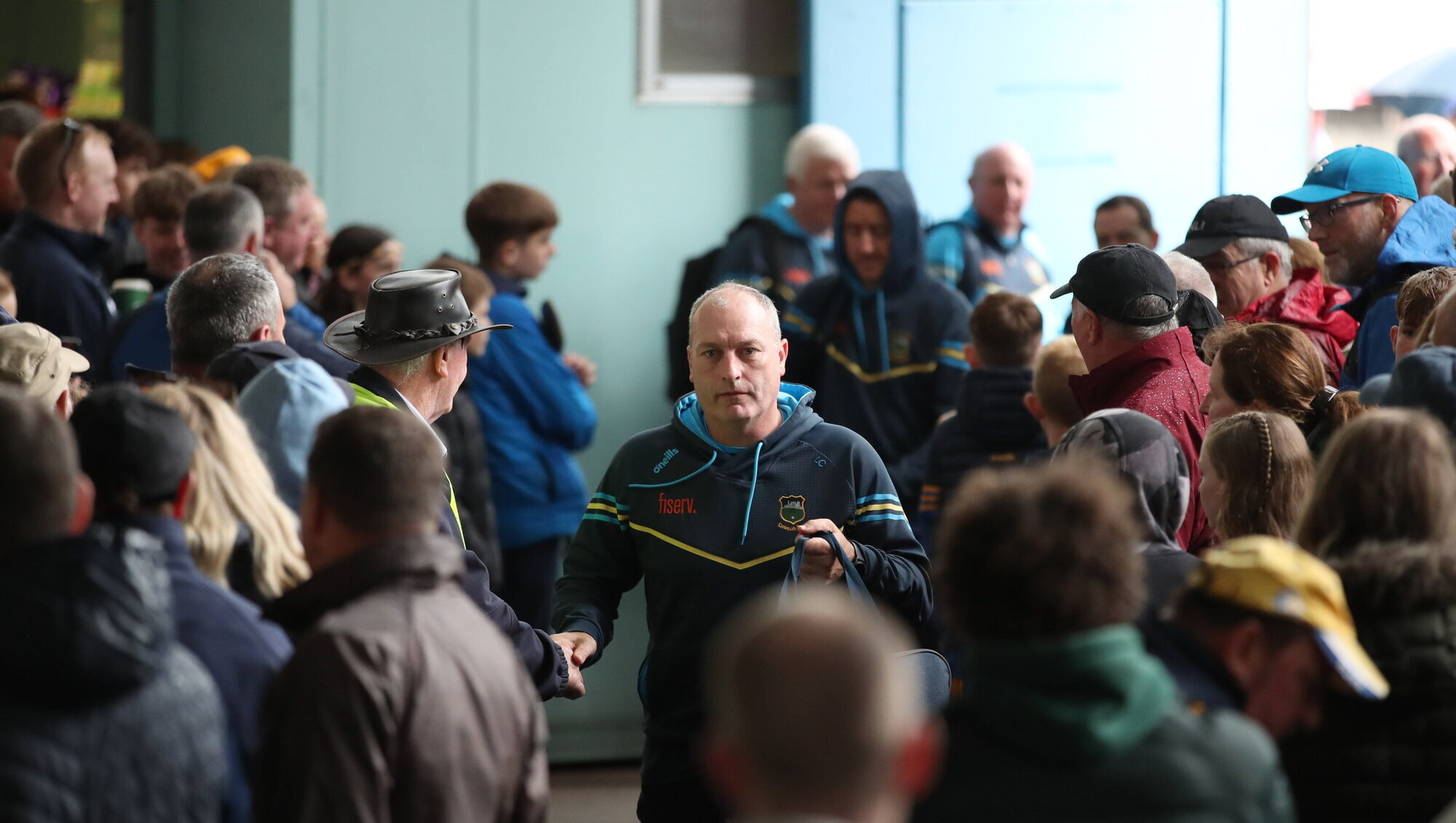
Tipperary manager Liam Cahill arrives at Semple Stadium in Thurles. Pic: Michael P Ryan/Sportsfile

At the end of the National League final two months ago one of the spectators left Semple Stadium and headed back to his car in downtown Thurles. En route he was buttonholed by not one but two sociable locals.
Both conversations hummed along predictable rails. Had the stranger been to the match? What did he make of it? How did he reckon Clare and Kilkenny would fare in the championship? Who did he reckon would win the All-Ireland? And then the same unprompted ex cathedra declaration delivered in the same weary tone: “Tipp are going nowhere anyway.” One thing about Blue and Gold folk. They may have illusions, or even delusions, when Tipperary are good. They have absolutely none when Tipperary are not good. If on championship eve in any given year a Tipp fan says they’re not going to win the All-Ireland, they’re not going to win the All-Ireland. The end.
Would Colm Bonnar have fared any better had he been allowed to stay? It is a moot point and, though he couldn’t have done much worse, an irrelevant one. Nor was it that Liam Cahill, so successful with the u20s and a National League winner with Waterford, was anything other than the obvious replacement for Bonnar.
Sometimes, as Unai Emery has demonstrated at Aston Villa, a team and a manager are just the right fit, the kicker being that one can never be certain beforehand. Every managerial appointment, even of the most screamingly sensible variety, is to some extent a shot in the dark. Perhaps the wonder is that clubs and counties, far from getting it wrong so often, get it right so often.
At least the Tipperary county board don’t have to agonise over what happens next. Only one course of action lies before them and it has the virtue of being the simplest one imaginable. Do nothing.

Give Cahill next season, or the next two seasons, to demolish the remains of the bomb site and allow him be about his business with no heed given by any of the relevant stakeholders to results. A project manager for a long-term project. If he’s not the man to bring success, let him be the man to lay the foundations for the man who might.
It is the managerial equivalent of a glass of lurid and disgusting green medicine, yes, but it is not a goblet of poison. In any case homegrown managers are by definition patriots.
Regression in order to facilitate progression will similarly be the order of business in Galway. In this instance a new site manager will surely be sought and found. Failure to make the All-Ireland series, never mind the Leinster final, could have been explained away in Henry Shefflin’s first year in the job. Not in his third.
He walked into it in a big way, yet to dilate upon the topic of what the hell he was thinking of in the first place is to seek to be wise after the event. If the apparently productive nature of Galway’s under-age talent pipeline served as an obvious incentive to cross the Shannon, another trigger was his own championship experiences. The most bemedalled player in the annals of the game failed to finish on the winning side against the Tribesmen on no fewer than five occasions.
Facing Cork and Tipp was straightforward. Kilkenny invariably saw them coming. They didn’t always beat them but they were never caught cold by them. Galway on the other hand… well, where do you start?
The 2001 All-Ireland semi-final? The ’05 semi-final? The 2012 Leinster final? Even the first 2012 All-Ireland final, which the holders entered with open eyes and still couldn’t win? Galway demanded a degree of wariness because it was impossible to tell which Galway would turn up on the day and the very fact there were one or two days when they barely turned up rendered them more dangerous, not less. The buzzing they produced in Noreside heads never ceased.
Times changed. Ultimately Henry’s biggest failing was to possess a higher opinion of the potential of 2020s Galway than was merited.
Jeffrey Lynskey, admittedly not an impartial witness, asserted during the week that the next manager has to be a local. It was never hard to imagine Davy Fitz there at some stage. But, again, not yet.
As for Davy’s current team, they unquestionably punched their weight, producing much attractive hurling along the way, in the 2024 championship. For the first time in three summers no postmortem in Waterford is compelled. It will have to suffice.
Excitement about the lineup for the provincial finals would be greater had Wexford found their way to Croke Park. The Leinster Council’s beancounters would be considerably happier too. But Wexford, along with Dublin, have been the big winners there to date, resurrecting themselves with brio after their initial travails. They sail into the All-Ireland series in good heart and with one clear and easy area for improvement: 1-12 of the 1-24 they shipped in Nowlan Park last Sunday was for fouls.
The real steamers are, of course, the guys in red. The team who’ve brought Championship 2024 to life.
They were the highest scorers in Munster and second-highest conceders, a recipe for all kinds of fun. They’re live and dangerous. They’re entering the All-Ireland series with a wet sail. They’ve avoided an undesirably speedy rematch with Limerick and if they have to face the green monster again they’re better off doing so in an All-Ireland semi-final than a final.
But here above all is the thing about Cork. Whereas Clare and Kilkenny offer nothing new, they constitute a fresh item on the menu. They’re not merely fast and exciting, they’re fast and exciting and different. And Limerick are not going to be taken down by opponents purveying the same old same old, as Clare and Kilkenny are purveying.
Neither of the pair will impose their game on Limerick on a big day. They’ve tried and failed. There is a chance that Cork . It may equally turn out that there’s less to Pat Ryan’s team than meets the eye. The small matter of the soundness of the form of the Tipperary match scarcely needs to be raised. The question of how much space they’ll manage to create for their forwards in a close, cramped affair does need to be raised. And goalkeeping looks an issue.
Sometimes entering the All-Ireland series via the back door is about self-reinvention, as it was for Tipperary in 2010 and Kilkenny two years later. Other times it entails nothing more exotic than keeping doing what you were doing but doing it a little better, as it was for the Limerick of 2018 and the Cork of 2004.
Twenty summers ago Donal O’Grady’s charges were short-headed in the greatest Munster final ever and were denounced for their temerity in losing a classic when, as the former Clare manager Cyril Lyons noted at the time, they ought to have been praised for their rich and unstinting contribution to a game for the annals.
Their finishing tally of 1-21 was comfortably ahead of the norm for the era on an afternoon where they did little wrong bar taking too long to switch Seán Óg Ó hAilpín across onto Dan Shanahan in the first half and getting caught by a Paul Flynn knuckleball in the second half. For the umpteenth time: somebody has to lose an epic match and when they do so it is almost invariably through minimal fault of their own. It is what happens in sport, it always will and it cannot not happen.
Anyway Cork went home, cleared their heads and honed their possession game. Come the All-Ireland quarter-final they hit Antrim for 2-26 before taking Wexford for 1-27 in the semi, humongous returns for the era. (The latter afternoon saw Liam Griffin in Athens watching his son Niall in the Olympic equestrian arena. As Cork piled on the scores, text messages of an increasingly Stygian nature kept pinging on his phone. “You’re near enough,” one of them read.) You know what happened in the game after that.
Tadhg Coakley fretted here lately about the prospect of Cork folk becoming insufferable in the event of them finally winning an All-Ireland again. It is not a scenario that need detain us just yet and in any case Tadhg was being unduly apprehensive. Cork folk being full of themselves at any time, the return of the MacCarthy Cup will make them only slightly more so. The rest of the world will probably cope.
And all the while Limerick create 49 scoring chances in an afternoon. To repeat, let us not get too far ahead of ourselves.
CONNECT WITH US TODAY



Be the first to know the latest news and updates