The two radical rule changes that can fix Gaelic football
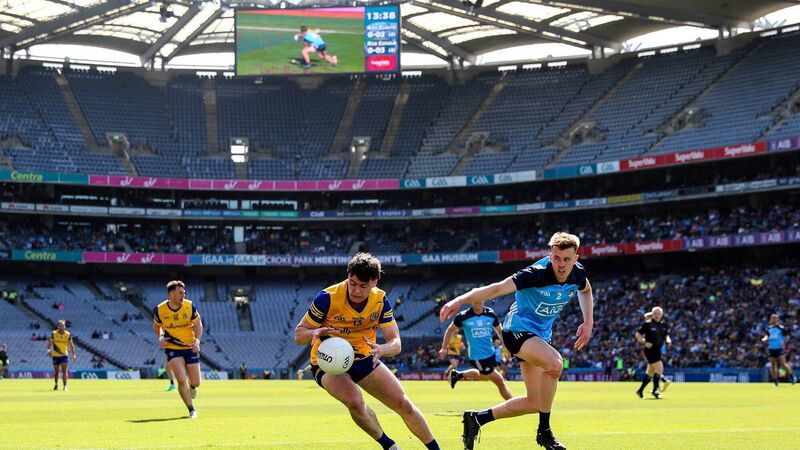
KEEP BALL: Roscommon's Ben O’Carroll with Daire Newcombe of Dublin in the sides' championship meeting. How do we incentivise more contests in the game?
Five years ago, they determined enough was enough. Change was required and it needed to be road-tested. DIT Freshers played Maynooth with new experimental rule trials for Gaelic football. The assessment of then DIT manager Stephen O’Meara? “A complete failure.”
In 2011, 90% of kickouts crossed the 45-metre line. That figure had fallen to 50%. The GAA’s Standing Committee on Playing Rules could point to this specific data as cause for concern and reason for a trial.
That is O’Meara’s industry. He has been involved at every level of the game, including previously working as a performance analyst with Galway and Donegal. He is the current coach of Carlow club Tinryland and host of analysis podcast, .
O’Meara read the proposed playing rules that will soon be trialled in H.E. Freshers 1 football later this year with interest. Kickouts to travel outside the 45m is back on the agenda. The other experiment is that free kicks, sidelines or marks must go forward between the two 20 metre lines.
He is adamant they will not resolve the problem. This is not the classic case of a manager castigating every element of change. The flaw is in the ongoing practice, not the theory.
“The biggest problem with bad statistical analysis is the confusion between cause and effect,” he explains. “Most people are not trained analysts.
“Someone is asked to provide data. They are not asked to interpret data. Stats can lead to the wrong conclusions. A classic example, there was a manager who came in with this stat, ‘the more you go sideways, the less you score.’
“So, players were told to go forward all the time. They lost 25 of their next 26 matches and were relegated. If Kerry go out and play a Junior B team, they are so much better that they can run straight all day right through them and score 5-25.
“The next day they come out and play Tyrone. They can’t go straight against Tyrone because they are better, their tackling is better and they’ve bodies behind the ball. What do you do? You go sideways to flush out their defence and pick them apart. What do the stats tell us? They scored more when they went forward. The cause and effect are completely misunderstood.”
Previously, O’Meara wrote analytical articles and introduced new concepts with his website, Grassroots GAA. He popularised concepts like the tagging of ‘breaches,’ (when a player was directly or indirectly beaten) and married this data to coaching.
What do we want to address? He points to Roscommon’s infamous six-minute keep ball against Dublin as a classic example. 77 passes, 30 by the foot. How do we introduce contests, chaos and collisions into a game like that?
“The rhetoric is they want more kicks forward. They want 50/50 balls, more fielding. It was more enjoyable to watch. I’d rather watch that. But if you bring in oppressive rules they will still be circumvented by smart players and smart coaches.
“Look at what Roscommon did to Dublin. Tactically, it is a masterclass. Dull as dishwater for a lot of people. Carlow tried to do it to Dublin in 2017. They didn’t have the players to pull it off but were still 10-6 down standing over a scoreable free when there was a red card after 47 minutes that was ultimately rescinded. How do we get a cornerback to kick a ball forward where it will be contested instead of going back or sideways? Two rules can do that.
“Ban the back pass to the goalkeeper. You can’t all of a sudden play 4 v 3 or 5 v 4 at the back. It is the basic theory soccer or hockey are founded on now. If you can’t go back to the goalkeeper, the intelligent, athletic teams press man-on-man. Now the smart option is bang it long out of danger. ‘We will worry about what happens 50 yards down the road.’ Or do what Corofin do with runners from 45 degrees coming off the shoulder and run it out. Whatever you do, you are going forward if a team press you. That leads to more turnovers, more collisions, more kicking the ball.”
There is broad agreement there is an issue. There is no agreement on what the specific issue is. Roscommon’s goalkeeper was involved 19 times during that spell. It is part of the bold move towards goalkeeping innovation. And it is innovative. O’Meara stresses that. He uses it readily as a manager. However, there is a bigger picture. The best coaches will adjust accordingly.
That is his first step. The second is a bid to encourage end-to-end play. In an era where set defences have never been better, the turnover has never been more important. Too often, attacks from turnovers are halted illegitimately.
“We now have a game where coaches are coaching to foul strategically,” he says. “If you are not doing that, you are naïve. There are teams with strategic fouling as a KPI.
“Basketball confronted the same problem. Teams realise fouling stops a counterattack. It was fine to concede a free from the spot where the foul was committed or the sideline. They introduced personal fouls and free throws.
“In Gaelic football two-thirds of counterattacks are spoiled by strategic fouling. You have to disincentive personal fouls. Not a technical foul, steps or picking it off the ground. Now intercounty coaches will go mad and not want this voted in, but it will help the game.”
No drastic measure can happen in isolation. The specific fouls would have to be clearly defined as there is heightened scope for poor officiating to influence outcomes.
The obligation of coaches is to make their teams as competitive as they can. At the same time, this debate cannot be twisted by self-interest. O’Meara loves the modern game as a tactician. He also accepts he is in the minority. Administrators need to drive change, but their record of reactive measures tells a tale.
“They come out and ban the back pass from the kickout. What did players do straight away? We will orchestrate one more pass before going back. If you bring in rules about effects rather than the cause, they will find a way around it.
“Coaches and managers with a holistic understanding of the game won’t be afraid of changes because they can adapt regardless.”


CONNECT WITH US TODAY



Be the first to know the latest news and updates