Eoin Cleary's Clare exit a sign of worrying times for Munster football
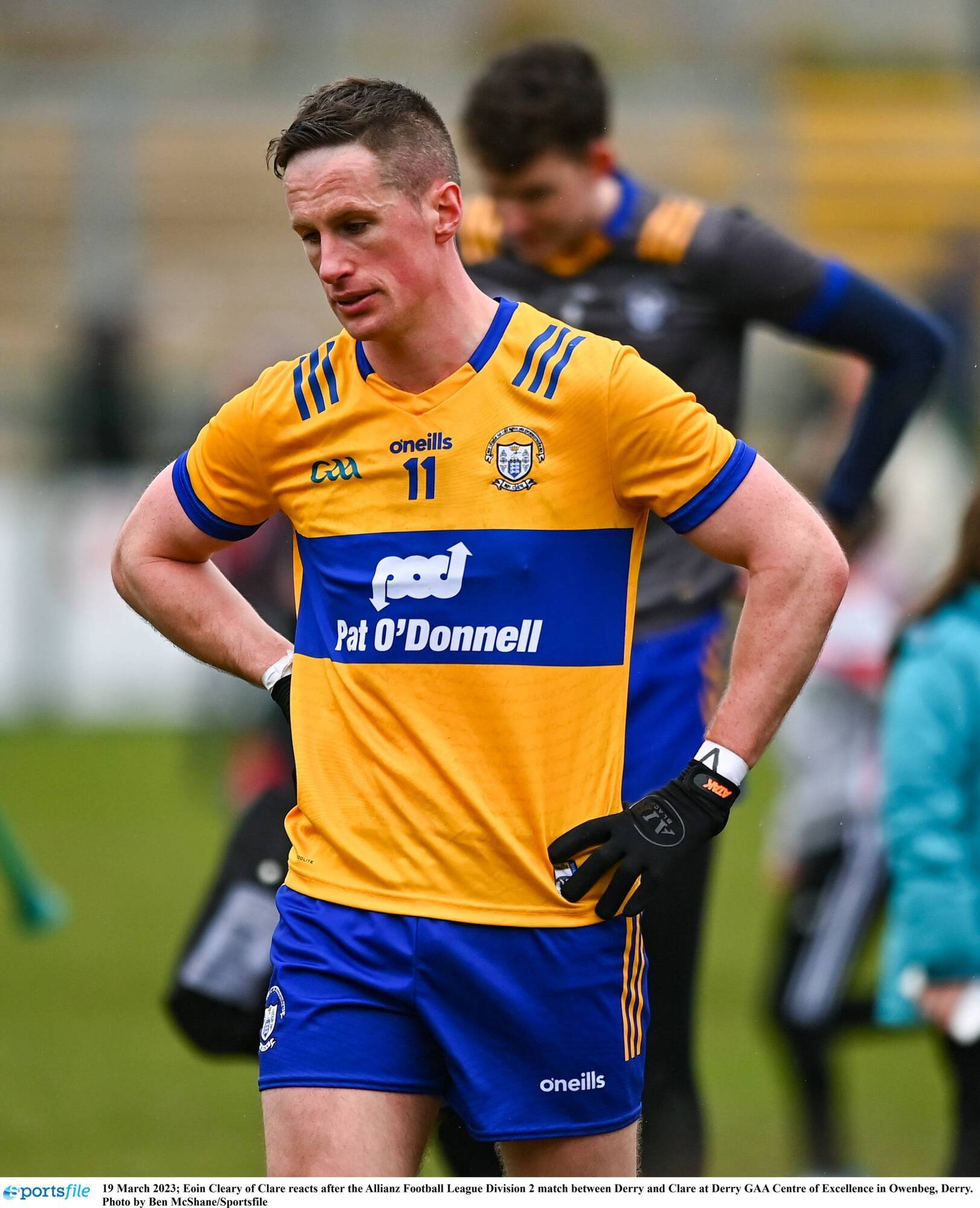
TESTING TIMES: Eoin Cleary will be just one of a number unavailable to Clare in 2024. Picture: Ben McShane/Sportsfile
Eoin Cleary’s announcement over the weekend that he is taking a year off the inter-county stage in 2024 is not good news for Clare football. Neither is it good news for the competitiveness of the Munster football championship.
Cleary’s departure from the Clare set-up serves as further evidence of the likely fall off of the province’s lesser football lights. It's the latest piece of evidence that the Munster football championship is about to revert to its long-held pecking order of Kerry, followed by Cork, followed by a sizable gap back to the remaining four.
Competitiveness and the Munster SFC haven’t happily co-existed for a long number of years now, not when it comes to the prize-giving anyway.
Kerry have finished as champions in 10 of the last 11 editions. On only three occasions — 2013, ‘15, and ‘19 — was their winning margin not in double-digit territory. Nothing competitive there, says you.
But on the step below the Kingdom, a step typically occupied by Cork and Cork alone, there has never been as much pushing and shoving for second position.
In the seven finals from 2013-19, all bar one was a Cork-Kerry decider. But in the four finals since, there was involvement from five of the six Munster counties. Even if Kerry dominance continued for all bar one of those, the province has never known such a healthy spread of finalists in such a short period of time.
In 2020, and what was their second final appearance in four years, Tipperary won a first Munster since 1935.
In 2022, Limerick recorded a first pair of back-to-back Munster championship wins in 13 years to reach a first Munster final since 2010.
Not content at seeing all the neighbours taste provincial final involvement, Clare got in on the act this summer when beating Cork in championship for the first time since 1997 and then backing up that result with semi-final victory over the Treaty.
At different points over the last number of years, all three pulled up alongside Cork. In the case of Clare and Tipperary, they went past them for a spell.
But the progress of the three, a progress that added an element of intrigue to a provincial football championship long maligned by its complete lack of suspense, has not so much stalled as slightly receded.
All three were Division 4 castaways at some point in the last decade. All three climbed as high as Division 2. Clare and Tipp went so far as to challenge for top-tier promotion.
All three, though, suffered relegation this spring. Clare fell out of Division 2 after a seven-season stay. Limerick fell alongside them. Tipp plunged into the basement pit.
Moreover, all three have lost continuity as well as form, what with new faces set to drive their respective buses in 2024.
Colm Collins, after 10 years on the Clare sideline, stepped away two months ago. In his weekend interview with the , Cleary, an All-Star nominee in 2021 and ‘22, revealed that he had been contemplating stepping away for a number of years. What kept him coming back was Collins.
But with the bainisteoir’s bib now idle, how many of those who soldiered during Collins’ decade-long tenure of progression will not hang around for the rebuilding project under whoever succeeds him.
As well as Cleary, Cian O’Dea, Pearse Lillis, and Jamie Malone could also be unavailable next year. Returning to Division 2 or, indeed, Munster final afternoon will be incredibly difficult without such key figures.
There are similar sabbatical concerns in Limerick. After the climb put in under Billy Lee, his brother Jimmy is the fourth man to hold the Treaty reins in the space of a year.
And while the man who managed Newcastle West to last season’s Munster club final is massively respected within Limerick football circles, might some of the panel adopt the same attitude as Cleary and take the opportunity to step off the treadmill for a time?
In Tipperary, it was the sheer number stepping off in recent years that precipitated their slide all the way down the ladder to Division 4. In June, manager David Power became the latest to step away.
Kerry native John Evans served as Tipperary boss from 2008 to early 2012. What’s happening now with the province’s traditionally weaker counties reminds him of his own time with the Premier County.
“Tipp were down in the doldrums, Limerick had come to the end of a good run and were ebbing down a bit, and Clare were trying to find their feet again. There's rebuilding to be done again now, and you are trying to rebuild in counties where hurling is very attractive,” Evans remarked.
“Being up the divisions was great Munster Championship preparation for Clare, Limerick, and Tipperary. But at the moment, they look to have dropped off the pace and Cork have come again after a few years of being down. It appears as though we are back to Kerry and Cork.”
Evans said the underage work that did or did not take place in Limerick, Tipperary, and Clare while their senior graphs were rising over the past decade will now prove telling.
“Clare have produced a couple of good minor and U20 teams. They are the ones with a nice sprinkling of youth coming in. And these newcomers could benefit from a clean canvas and take on more responsibility in the place of absent senior figures.
“To get to where these counties did in recent years takes a serious amount of work, organisation, and a huge amount of committed personnel,” Evans continued.
“The likes of Billy Lee, the late Liam Kearns, and Colm Collins gave their life and soul to developing football in the county they were in. They foraged brilliantly.
“During my own time with Tipp, Noel Morris and Joe Hannigan fought tooth and nail to push Tipp football on. Trying to redo all that will be difficult.
“There is hope, but there is also a good bit of work to do, and that is the bottom line.”


CONNECT WITH US TODAY



Be the first to know the latest news and updates