Christy O'Connor's Talking Points: Key stat that shows where the All-Ireland final was won and lost
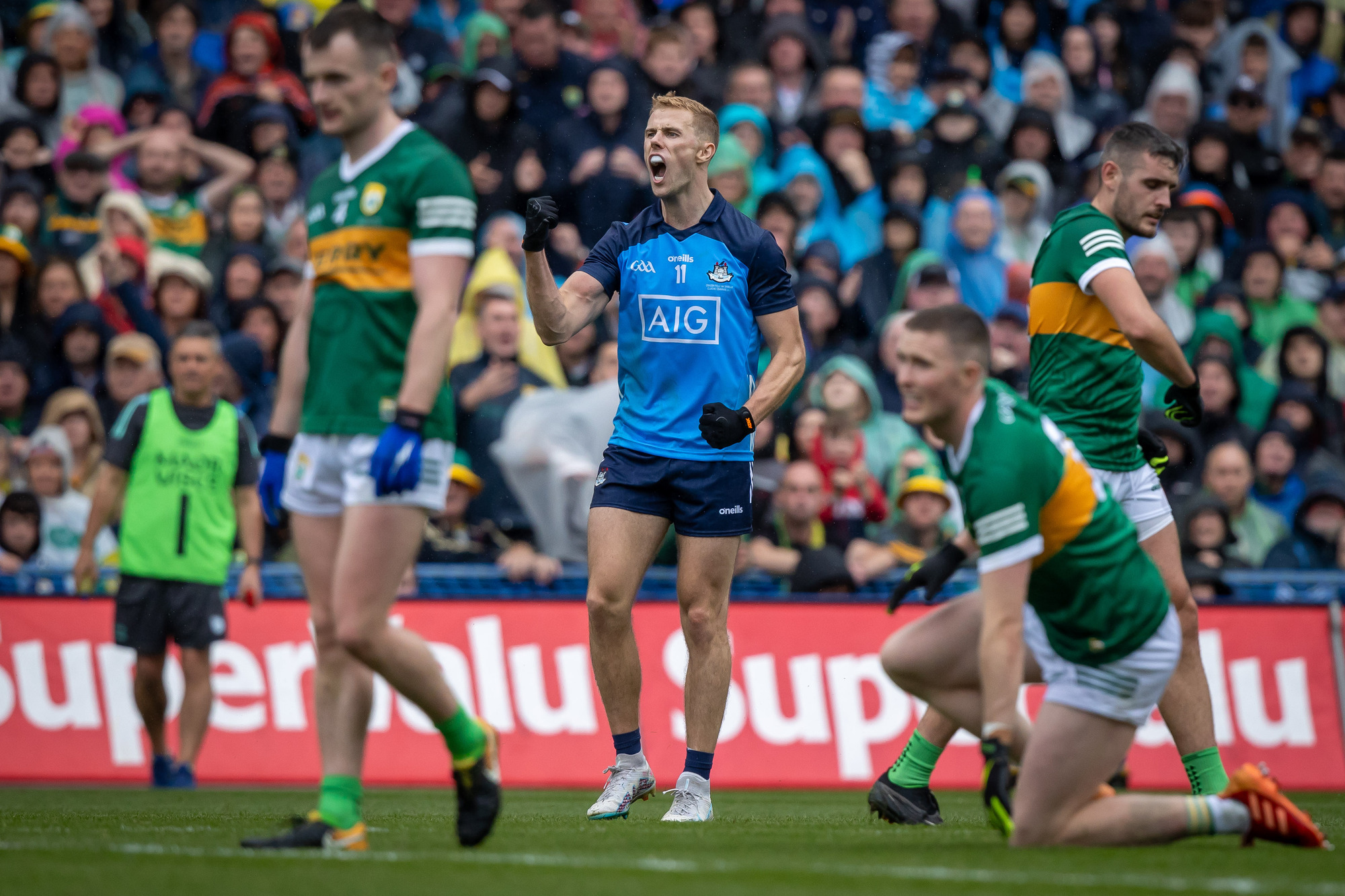
BLUE'S CLUES: Dublin’s Paul Mannion celebrates scoring a point. Picture: INPHO/Morgan Treacy
In the first half yesterday, when instinct was overridden by a more clinical thought process, when defensive shape and attitude was governing the percentages, when both sides were guarding against risk, especially Dublin, a clear pattern was emerging. Dublin were only pushing so far. So were Kerry. Who was going to leave themselves most exposed on the counter-attack? Who was going to blink first? Who was going to do the most damage off the possession the other team coughed up, or were forced to cough up?
A consistent wave of bodies filtering back enables more players in the middle third to drop off and back into more of a protective shield. Once the ball is turned over, Kerry and Dublin have the pace and kicking ability to shred teams on the counterattack. Conversely, when both teams are turned over on their own counterattack, they have the pace and power to slow down the opposition and get into their default position of flooding big numbers inside their own 45.
When Dublin look back on this match, they will realise how much ball they cheaply turned over, even allowing for the conditions. In total, they turned over the ball 25 times, coughing up 0-9 from that possession. One of those scores off a turnover does carry an asterisk as it stemmed from Con O’Callaghan’s rocket off the crossbar, but ten of those other 24 turnovers were forced from Kerry heat in the tackle, with the rest given up from kick-passes, unforced errors or shots.
One of the biggest contributions Paddy Tally has made to Kerry is the damage they do in transition play off turnovers. In last year’s All-Ireland final, Kerry scored 0-8 off turnovers. Being able to score more from that source yesterday was even more impressive against Dublin.
And yet, despite turning over the ball more often than ever before in a big game, Dublin still managed to punish Kerry more off turnovers, mining 1-7 from that source. In last year’s final, Kerry shipped just 0-2 off turnovers. In the second half yesterday though, Kerry coughed up 1-4.
That was where the game was won and lost.
At the final whistle, David Clifford dejectedly made his way towards the 45-metre line to try and find some kind of inner sanctum from the torment and torture ransacking his mind. Over the next 15 to 20 minutes, as team-mates tried to console him, as Jack O’Connor knelt down beside him, as Dublin players shared a quiet word, especially Brian Fenton, who lowered his frame down beside Clifford to show his respect, he was clearly living in a world of hurt he has rarely known.
Clifford has lost big games before, including an All-Ireland final, but few players in the history of the game – in hurling or football – have had to carry the hopes of a county on their shoulders as heavily as he has in a big game. Clifford fully accepts those terms and conditions but he would still expect his genius to over-ride them, especially when the pressure is at its absolute apex.
The conditions were extremely difficult but it will still haunt Clifford that he failed to convert his last five shots from play, one of which was called back for a free which was scored. From 18 possessions, Clifford got off eight shots but only nailed two. Six of those possessions were out around or beyond the 45 metre line but Clifford was still inside the red zone – well, what would be considered his red-zone – on more than enough occasions.
Clifford did have a brilliant assist for Paul Geaney’s goal, while he had another point assist, as well as being fouled for that late free. For any other player, having their fingerprints smeared across 1-4 in an All-Ireland final, especially on such a wet day, would be a monumental achievement - especially when they are being man-marked by one of the most decorated and wily players in the game in Michael Fitzsimons. But David Clifford is judged by such a merciless standard where more is never enough.
And nobody will know and accept that more than the man himself.
When Dessie Farrell had the humility to ask Pat Gilroy, who managed Dublin to the 2011 All-Ireland, to come on board with Dublin earlier this year, nobody was in any doubt as to the wider impact Gilroy could have, especially around getting Stephen Cluxton back on board.
Cluxton has always remained extremely tight with the playing group. He was still in close contact too with Josh Cullen, Dublin goalkeeping coach. Cullen and some of the players were in Cluxton’s ear, but Gilroy’s words were always bound to ring the loudest.
The management had a legitimate reason to go after Cluxton too. Evan Comerford was injured. So was Hugh O’Sullivan, the Dublin U20 ‘keeper. David O’Hanlon had an excellent league but was still unproven at championship level. And yesterday proved just why Dublin needed Cluxton back.
As well as nailing two points from placed balls, his kickouts were excellent, with Dublin retaining every one of their 23 restarts, which is an incredible achievement in such tricky conditions. Sixteen of those restarts were short but Cluxton’s mid-range kickouts were outstanding, while Dublin won their three long kickouts, mining 0-2 off that possession. In total, Dublin sourced 0-7 off their own restarts.
It was late on though, where Cluxton really showed his icy temperament, with Dublin scoring 0-3 off their restarts after the 60th minute. Kerry were pressing high and hard at that stage but Cluxton was still able to thread his kickouts to their intended targets.
In the history of Gaelic football, there has never been a more influential player. Returning to win an All-Ireland at 41 underlined that influence and brilliance. And yesterday absolutely cemented it.
A Dublin-Kerry final will always trade heavily on tradition, especially around perception, but the modern game has eroded a lot of that reality. Neither team wanted this to be an open, free-flowing shootout, which meant this was always going to be tight and cagey until late on when Dublin and Kerry really had to go for it.
By that stage, tradition was always going to be distilled into bravery and sheer force of will. And being more clinical. In the end, Dublin had a marginally better conversion rate (53%-51%), but some of their biggest names came up trumps when it mattered most.
Paul Mannion nailed four points from seven shots from play but his late point was massive. In the second half, Colm Basquel scored 0-2, had the assist for Paddy Small’s goal and was fouled for a converted free. Jack McCaffrey won two frees and had a late assist. Fitzsimons did a brilliant job on Clifford. Cluxton was Cluxton. And Brian Fenton was Brian Fenton.
In his previous five games, Fenton had the highest shot involvement of any Dublin player with six shots. Fenton had 31 possessions in total yesterday but, again, he had a huge last quarter, which included a massive point from play.
When it mattered most, Dublin just had more players who produced more when the need was greatest.


CONNECT WITH US TODAY



Be the first to know the latest news and updates