'There is a mental side to the game this team might be close to cracking'
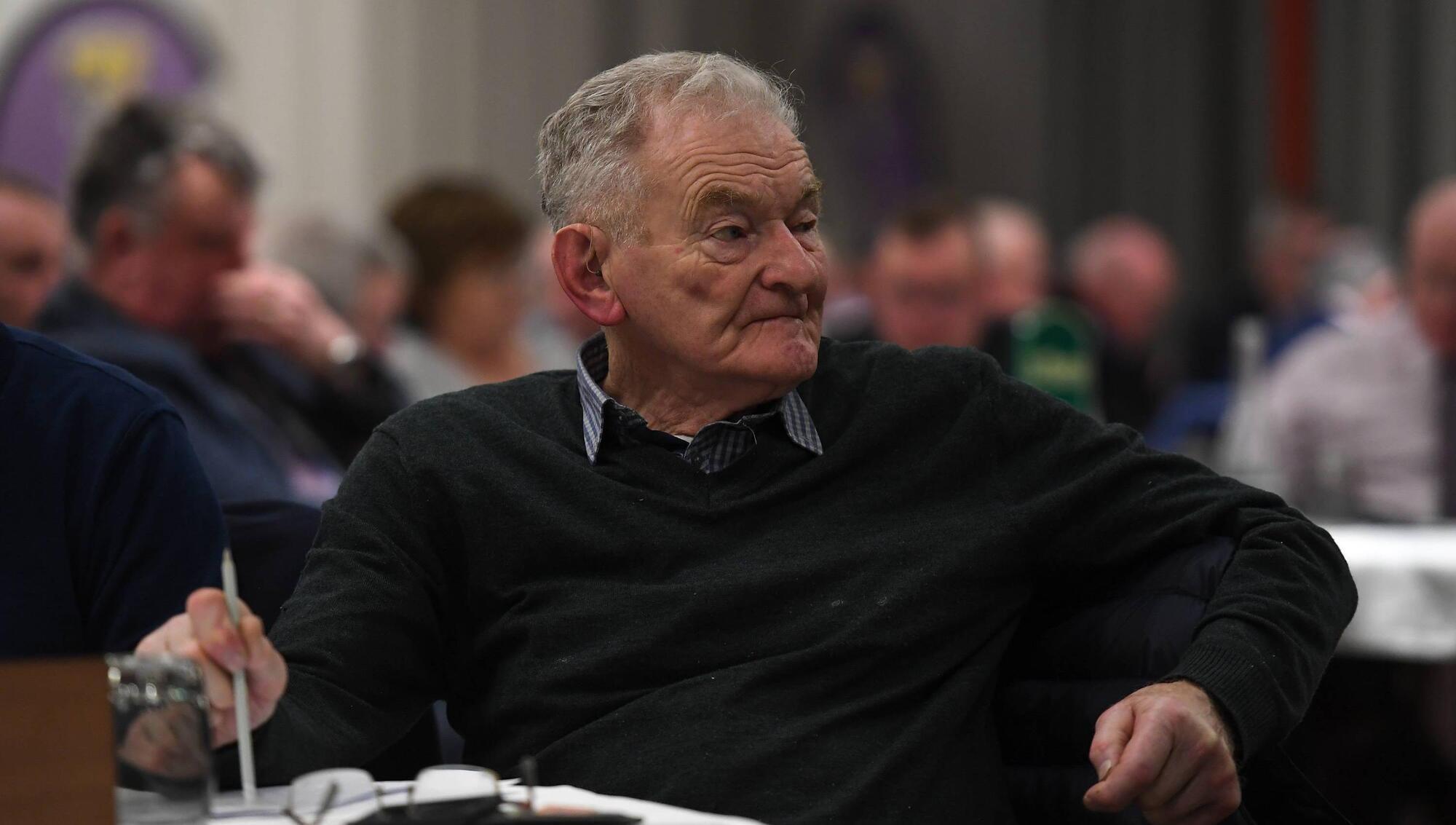
Kilkenny delegate Pat Henderson during the Leinster GAA Convention at Clayton Whites Hotel in Wexford. Photo by Ray McManus/Sportsfile
Came a knock on Pat Henderson’s door.
The autumn of 1978. Kevin Fennelly Sr and Seán Walsh have come in from Ballyhale. Henderson still has the same house in Talbot’s Inch and a smile takes over at the memory. “They were sitting where you are now,” he notes. “I took them into the sitting room, because I could see they meant business.
“They just came in and took right over. And said: ‘This is what we want you to do.’ The Shamrocks had just won their first Senior title. Back then, the County Champions had a big say in who was over the Kilkenny Seniors.
“And I said back: ‘Do you mean you want me to manage Kilkenny?’ At the time, the whole word ‘manager’ was prevalent, probably because of the Dublin footballers and Kevin Heffernan. ‘What are you talking about?’ says Kevin to me. ‘We want yourself and [Eddie] Keher to look after the Senior team. Ye have enough experience between ye, and ye can call the job whatever ye want. Now, will ye do it or won’t ye?’ And that was it.”
Pat Henderson was launched as Kilkenny’s not quite manager. He was officially trainer/coach, with Eddie Keher as one of the selectors. Henderson fulfilled this role for 1979 and 1980, stepped out in 1981 and stepped back in between 1982 and 1988. Three Senior All-Irelands were won: 1979, 1982 and 1983.
Born in 1943, this man is one of his native county’s central figures. And doubly so, onfield and sideline. Before the managerial moment, he had been a brilliant and commanding defender between 1964 and 1978, winning five Senior All Irelands (1967, 1969, 1972, 1974-75). He represented how Kilkenny hurling likes to see itself, brave and unshowy and highly skilful. He was all of those qualities and more.
But no hurler that accomplished enjoys becoming a former hurler. Henderson had landed as a sub into 1978’s Senior Final loss to Cork. “I felt I should have started in that final,” he states. “But that’s beside the point. Still, I was in great shape at the time. I continued to play on after that, right up to Christmas in the first rounds of the league. I think the last match I played for Kilkenny was away against Offaly. I was marking Pádraig Horan and we had a right battle.”
Push went taking a bead on shove. As Henderson details: “So we closed down for Christmas and I remember Pat Delaney, who had remained on as a selector, rang me. He was my own clubmate with The Fenians and not long retired from hurling with Kilkenny himself. Pat said to me: ‘What are you doing?’ I kind of took the hint. So I moved to the other side of the camp, and took on training the team. I was gone from being a player.”
Serious success followed. Immediately in 1979, when Galway were beaten on the ultimate day. Three years later, Kilkenny overcame Cork with a scintillating display as underdogs. That title got retained in 1983. But frustration ensued at not being able to add another victory between 1984 and 1988, when the talent lay to hand but not the execution.
Henderson turns philosophical: “I think you just grow that bit too loyal to the players who have done it for you in the past. It’s a natural thing to happen, but the dynamic is always there and difficult to handle. We probably needed to freshen things up more after 1983. We weren’t far away in any season, but maybe a bit more freshness would have made the difference for us.”
Between the two peaks of success lay a significant trough. Offaly defeated Kilkenny in 1980’s Leinster Final and Pat Henderson was relieved of sideline duties for 1981. Was he resentful? “Not at all,” he emphasises. “That was the system at the time. It was a year-by-year system. I had no problem with [Phil] ‘Fan’ Larkin being asked to take on training the team for 1981, and I had no problem being asked to go back in for 1982.
“That was the way it worked. Later on, the system completely changed, and the manager now picks his own selectors and so on. But you can only work with the tools you have at a given time.
“I was never a selector, funny enough, which suited me fine because I had two brothers involved [Ger and John] with Kilkenny at Senior. I had influence, you could say, but I was never a selector. Anyway, I considered it a serious honour to be involved with Kilkenny in any way.”
He remains involved, a supremely capable behind the scenes man. Brian Cody, Ned Quinn and Pat Henderson count as the three most influential people in Kilkenny GAA over the last four decades. The day I visit Talbot’s Inch, Henderson is organising All-Ireland Final tickets for the schools.
Some people consider Pat Henderson aloof and reserved. My experience is very much the opposite. He always seems incisive and in possession of admirably dry humour. He went out of his way to make time for me because he is due in Ardmore, County Waterford for a few family days away. “We have had the caravan for 40 years or more,” he explains. “We love it there. West Waterford is a well kept secret. I suppose the one thing Kilkenny doesn’t have is a coast.”
Fifty years ago, Pat Henderson hurled at centre back when Limerick defeated Kilkenny in 1973’s Senior Final. “I will say what I have always said about that day,” he stresses. “Limerick beat us when we were short a few. Fair enough. But if we had won in ’73, I doubt very much we would have won in ’74. I think if an understrength Kilkenny had won that first year we would have been far too complacent the following year, and would have got caught by Limerick.
“But I’m glad we did bounce back in 1974 and 1975. We had a tremendous team at the time and we probably needed to get those other two wins to underline that team’s quality.”
Pat Henderson came to consciousness in North Kilkenny with the men who won 1957’s Senior Final as heroes. “I grew up with the Seán Clohoseys, the Mick Kellys as the big childhood names,” he relates. “I came from outside a small village, Johnstown. While it had a proud record of being involved in GAA, won Junior Championships and so on, it wasn’t one of the really prominent hurling places in Kilkenny at that time.
“I remember in a back room of our house there were pen pictures of all those Kilkenny hurlers up on the wall. There was always a great interest in hurling in my family. The previous generation were cricketers, in fact. I suppose my ambition, from a very young age, would have been to wear the black and amber jersey.
“My ambitions probably didn’t go much further than that, in the sense that usually in the parish lads who were good at hurling went to Tullaroan to hurl at Senior level. Any decent player around Johnstown and Urlingford tended to head for Tullaroan. There was no parish rule at that stage. So lads moved around freely.”
He elaborates: “A neighbour of mine won an All-Ireland with Kilkenny in 1922, John Holohan. He was the full back. He was our next door neighbour, the closest neighbour. We were in Folkscourt and he was in Ballyspellan. There was only a little lane between us. I didn’t know the man. He died when I was only a few years old, but I knew of him.”
Childhood sequed into young adulthood, with hurling as a constant: “I was lucky enough to go to Thurles CBS, where there was a lot of hurling. I was also lucky enough to get on the Kilkenny Minor team. So in that way I got my face in front of whatever it was. My career with Kilkenny progressed from there.
“After Minor with Kilkenny, I played Intermediate for two years. We didn’t win anything but it was experience at adult level, and I got one or two trials with the Seniors, prior to 1964. I just wasn’t good enough at the time. Didn’t make the 1963 panel but got on the team in 1964. Beaten by Tipperary in the All-Ireland Final. We got an awful hiding that year. Played in 1966, against Cork. Another bad day. Two losses in a row in the All-Ireland Final. Not good at all, which sort of grounds you pretty well.”
Dawn was bulging behind that dusk. Victory over Tipperary for the first time since 1922 arrived in 1967. Perhaps Kilkenny’s finest half back line (Séamus Cleere, Pat Henderson and Martin Coogan) took shape over that season. Henderson sketches: “The first game I played at centre back beside Séamie Cleere was down in Wexford. Before the match, he said one or two things to me. He told me: ‘You go for it, and I’ll drop in behind and cover.’
“He nurtured me on to the team, if you know what I mean. I came in, fortunately, beside great hurlers, beside absolutely brilliant players. Séamie Cleere had every skill in the book. Absolute poetry in motion.” He continues on the influences that abided: “Fr Tommy Maher was, I suppose, my mentor. He looked after the Minors the year I was there. Fr Maher was a serious man. A very serious man. Took no prisoners. You could say he had a will of steel.
“He studied the game closely, in terms of the technicalities. He studied other sports for guidance. He was looking at golf and at tennis, for tips on how a hurler could improve, like the follow through when you are hitting the ball. He would instance a good golf stroke.”
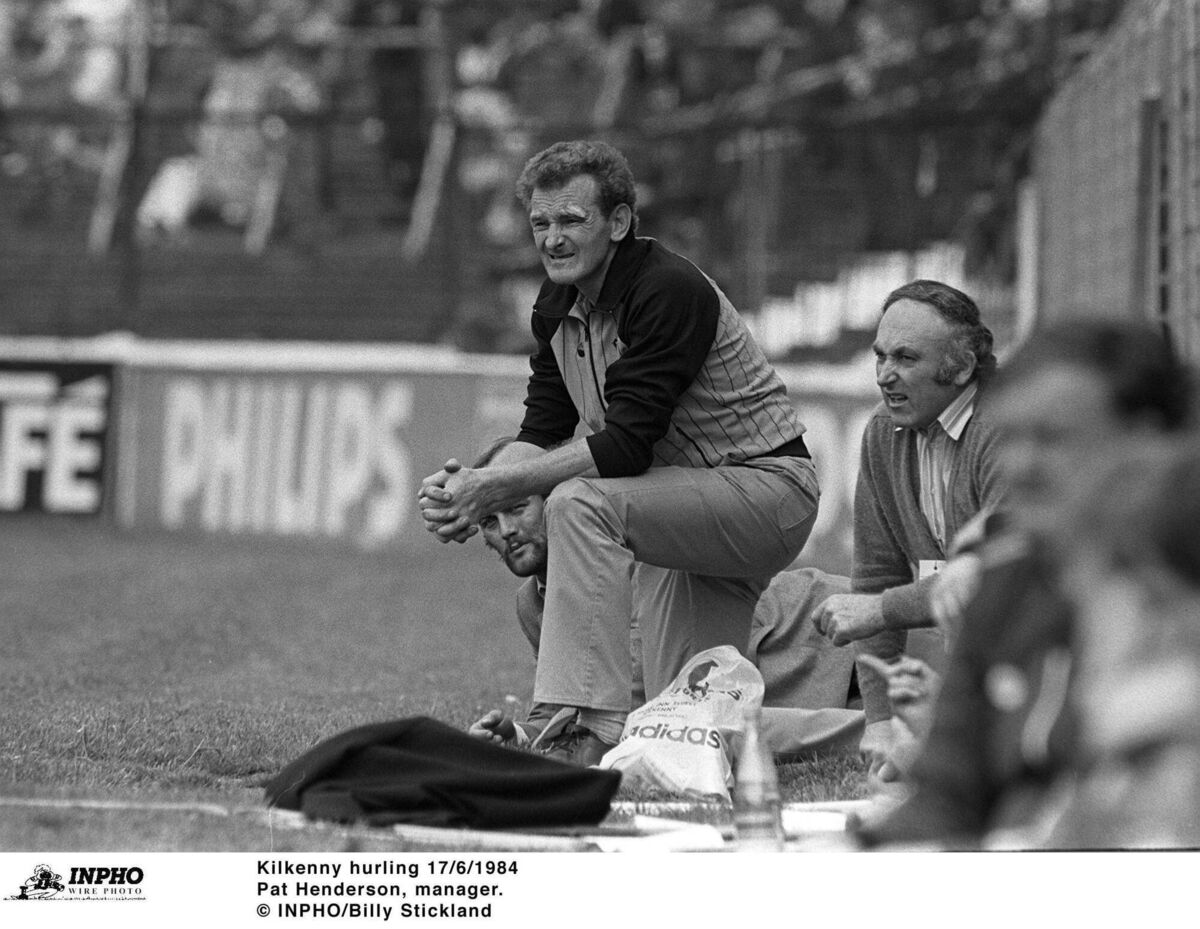
Once 1967 was achieved, the road broadened. “We had a good run after that,” Henderson acknowledges. “We ran from 1967 to 1969, and then on into five All-Ireland Finals in a row, 1971 to 1975. Every year in that period we believed we could win the All-Ireland. A puck of a ball separated us nearly all of the days we lost in the championship over that period. I think that team was as good, for its era, as any of the teams that followed.
“I think a lot of us were learning our trade in the middle Sixties, before 1967. Getting beaten by Tipperary in 1964 and Cork in 1966 was all part of the learning. But there was experience there the whole time. It’s the knowing how to win. And you don’t pick that up off the street. It’s inculcated in the Kilkenny psyche. And I think the great belief they have in themselves is showing itself this year so far.”
Henderson is now of the Kilkenny tradition’s sinews. A lovely bonus of being an intercountry hurler? Meeting former holders of the jersey. As he explains: “Jim Langton was a selector one year. So you had a link right back to the win in 1939. Mattie Power was a legend so far as anyone in Kilkenny was concerned. He was spoken of with reverence, and he was one of the main men when Kilkenny won in 1922. I met Mattie quite often in latter years. He was at every Kilkenny hurling match and function.
“Kilkenny is a relatively small and very tight knit county. Very united in terms of hurling. When people don the black and amber jersey, it doesn’t matter whether they are from Ballyragget or Ballyhale. They all back each other. I think there is a great unity of purpose between the clubs. You’d have to say, looking at the odd county here and there, if they could get their act together on that front, they’d be nearly unbeatable.”
This hurler never lost sight of origins: “My background would have been that I came from a Junior club. And I felt that there was always a guy out there somewhere that you maybe didn’t know about but they hadn’t got the opportunity to be exposed properly. So you’d always be looking around for that guy. He’d be very raw, obviously, but there was no one rawer than I was when I came from playing Junior into Senior intercounty with Kilkenny.
“The Fenians started in 1968 and became a highly successful Senior club, winning five County titles. There was an opportunity there, in Johnstown, and The Fenians was our way of trying to capitalise on it. The one parish rule came into Kilkenny GAA for 1954. But it probably took the guts of 15 years for people to properly realize you can’t win anything, in a small parish, if you are divided.”
His perspective remains plumb: “We’ve good hurlers, both physically and skilfully and all the rest of it, but there is a mental side to the game that I feel the current team might be close to cracking. I’m happy that this team seem to have that. Whether it gets them over the line against a brilliant Limerick team remains to be seen. We were within a puck of a ball of them last year.”
So he is hopeful about Sunday’s outcome: “There is a freshness to Kilkenny’s hurling at the moment. I was worried when I saw them go down badly to Tipperary in that league match last spring. I was worried leaving Nowlan Park, because I thought the Kilkenny public was still making its mind up about this team. Looked a bit shakey, at that point.
“But things afterwards went in a better direction. [Derek] Lyng is putting his own stamp on matters. And he is trying to bring through some of the young fellas, which cannot happen overnight. The most encouraging aspect about Kilkenny this year is that they have started winning close games again. Winning that type of game is a huge part of the Kilkenny tradition. We should never lose it.”
So he will be seated in Croke Park, hopeful. He will be among many of the county’s former hurlers, those sinews to the past, watching the present make the future.
But first Pat Henderson must see the Atlantic.


CONNECT WITH US TODAY



Be the first to know the latest news and updates