Talking points: Clare have long believed they are Munster's second best
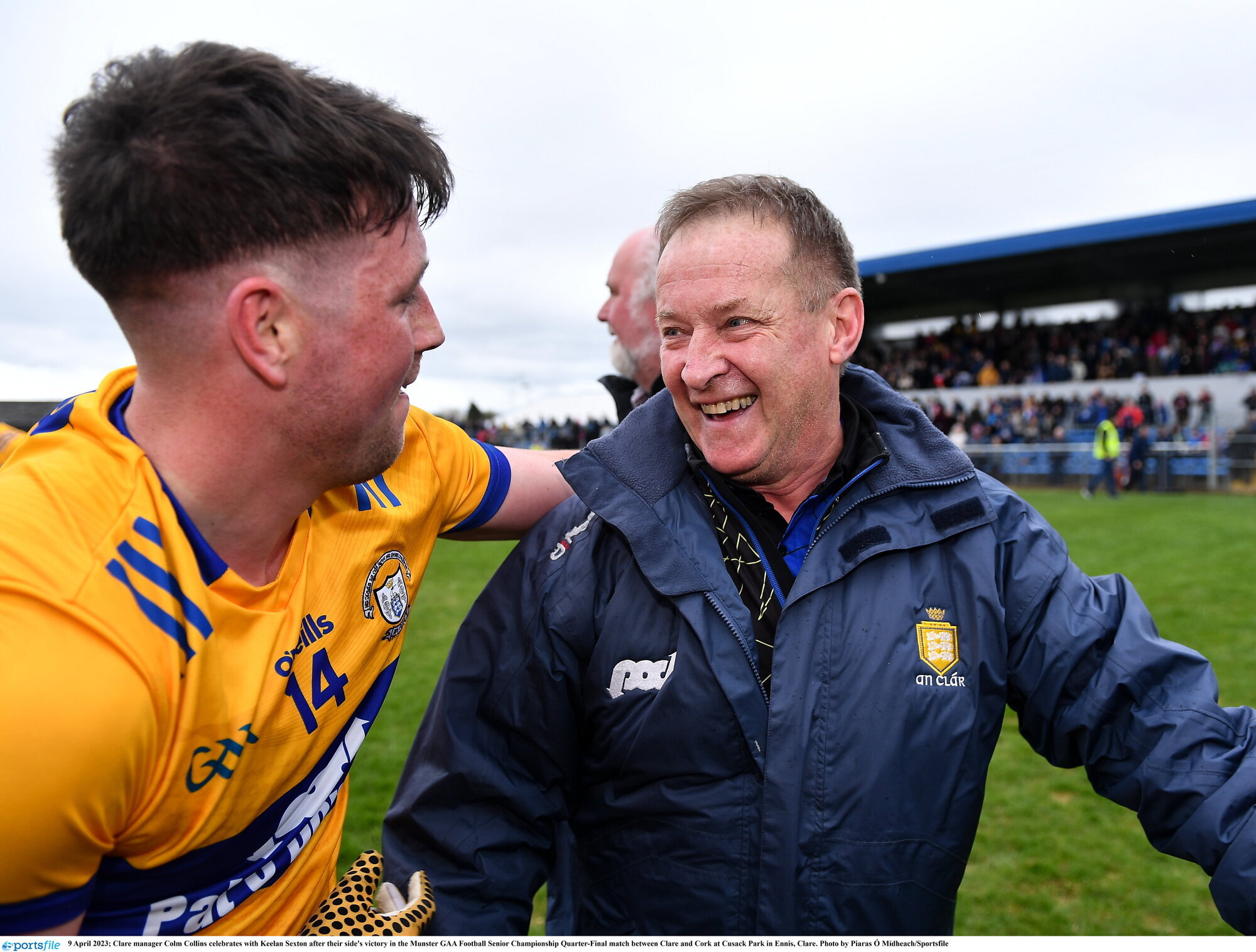
LONG-TIME BOND: Clare manager Colm Collins celebrates with Keelan Sexton. Pic: Piaras Ó Mídheach/Sportsfile
AT the final whistle in Cusack Park on Sunday, after the initial explosion of emotion and elation, the Clare players made their way to the endline to complete their warm down.
The Clare supporters making their way out of the ground from the North Stand stopped to applaud and cheer the players. A slow, steady trickle began to make their way onto the pitch from the main stand but nobody was getting carried away. The unused subs were already running down at the other end of the field.
Twenty-six years after Clare last beat Cork in a championship match, there was no mass pitch invasion or crazed hype. There were far less supporters in the ground than there were in 1997 but the supporters took their cue from the players. Because this win has been coming.
Although Clare should have beaten Cork in Cork in 1996, this win was still nowhere near as seismic as the 1997 victory because Clare have long felt that they would have Cork’s number if they met them in championship. It also proved to them what the Clare players have long believed – that they have been the second best team in Munster for years.
Clare emphatically proved as much here. Before Cork came with a desperate late surge, Clare had absolutely dominated the last quarter, having five more shots than their opponents in that period. They had six more shots in total. The game would have been over a lot earlier if Clare’s conversion rate was better than 50%.
The game completely turned in the second half on the Clare kickout, with Clare scoring 0-8 off restarts, with 0-6 coming from their own kickout. Yet it was the manner in which Clare strangled the Cork long kickout that altered the tone and complexion of the match.
After Cork had completely dominated possession in the first half, Clare owned the ball after the break. Once Cork lost control of possession, they lost control of the match because they didn’t have the same clarity of thought once they were forced to go chasing down Clare runners. The game was being played on Clare’s terms but Cork were too pedestrian. The hard direct running from the first half half slowed down and dried up.
And Clare just took over - as they always believed they would in this situation against Cork.
At half-time in the Armagh-Antrim Ulster preliminary quarter-final on Saturday evening, ‘The Championship’ TV anchor Thomas Niblock posed a question to Michael Murphy about some of Armagh’s shortcomings. “Some of the things we’ve seen you wouldn’t expect from a team that’s been playing in Division 1,” said Murphy.
Armagh were always in control, winning the game by nine points, but they only had five more shots than Antrim (35-30). Armagh only created two goal chances. Their failure to raise a green flag means that Armagh have now only scored two goals in their last eight matches.
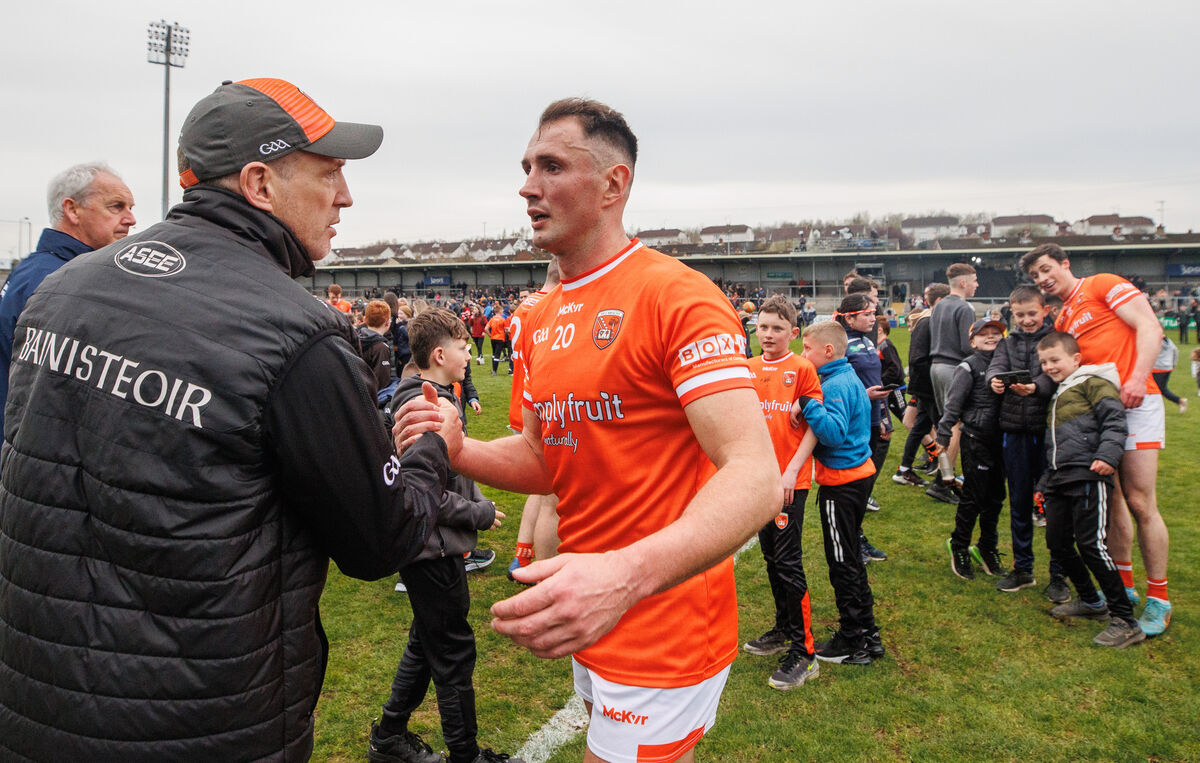
Even those two green flags come with an asterisk; the goal against Galway was a long ball launched by goalkeeper Ethan Rafferty that ended up in the net; their goal against Monaghan on the opening day of the league came from a short kickout from Rory Beggan that was gratefully intercepted by Tiernan Kelly.
Antrim did create four goal chances but some of the other numbers underlined the gulf in class between both teams; Armagh’s conversion rate of 57% was far better than Antrim’s 30%; Antrim had double the amount of turnovers than their opponents (24-12).
Armagh got the job done without some key players, including Rian O’Neill, Andrew Murnin and Jarly Óg Burns. They were ultra-competitive in Division 1 and were unlucky to be relegated so is everyone expecting too much from this side?
“For the last 2-3 years, Armagh played go-forward, swashbuckling football but they have changed a little bit,” said Oisin McConville to Niblock. “Fans recognise that and I think a lot of that comes down to what personnel they’ve had available. Sometimes people are afraid of a change but I don’t think there is any panic. Armagh have stability and continuity and they have the players that can challenge right at the end of the All-Ireland championship.”
A memorable and landmark victory always ignites a fireball of emotion but for years now there has been a feeling that a New York victory in the Connacht championship was only a matter or when, not if.
The difficulty was knowing when exactly to pinpoint that moment of possibility, especially when nobody outside the camp had any idea how they were going with New York not playing in the National league.
In their first four Connacht campaigns between 1999-‘02, their average losing margin was 10 points before Leitrim only beat New York after extra-time in 2003. That certainly put Mayo on high alert in 2004 when they hammered New York by 26 points.
The beatings continued throughout that decade until Galway escaped with their lives in 2010. Once again, that result ensured Roscommon went into their 2011 meeting devoid of any complacency, winning by 16 points. Between 2011 and 2016, New York lost their five championship matches by an aggregate margin of 102 points. And then Roscommon only scraped past New York by one point in 2016.
Sligo took care of business in 2017 before Leitrim needed extra-time again in 2018 to advance. Mayo annihilated New York again in 2019.
The trends were obvious but New York were building and a good performance against Sligo last year meant that New York were well set coming into this championship, especially when the draw was made. The trends showed that if New York were to ever get a win, the likelihood was that it would be against Leitrim, especially having taken them to extra-time twice in the past.
It took penalties this time around but New York finally got it done.
CONNECT WITH US TODAY



Be the first to know the latest news and updates