Relegation battle could yet claim an unlucky victim
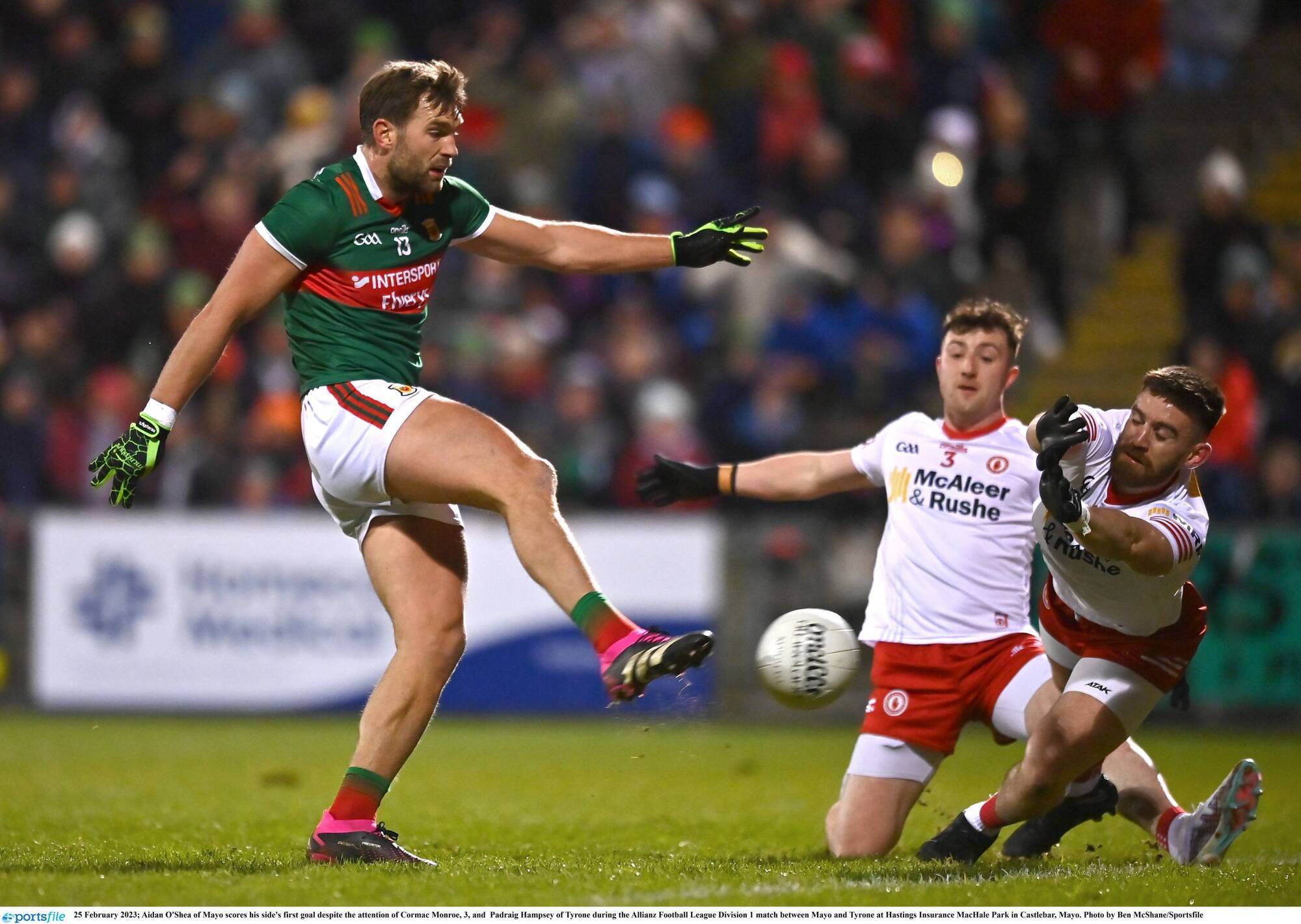
Aidan O'Shea of Mayo scores his side's first goal against Tyrone despite the attentions of Cormac Monroe and Padraig Hampsey. Picture: Ben McShane/Sportsfile
Round 5 is always a good time to take the temperature of Division 1. By that stage, everybody has long accepted that the absolute ferocity and intensity often evident in the first two rounds, particularly what was on show in the Galway-Mayo contest, is unsustainable.
After so long without inter-county matches, some of the novelty has worn off for supporters by Round 3. Most of the players too are probably a little fed up from trying to manage that difficult balance between the demands of hard training with consistently trying to perform at the weekend.
By Round 4, the competition has hit that dull state where the relegation battle isn’t clear-cut enough yet for general agitation and unrest while the championship is still too far away – even if it’s closer than ever before – to start worrying about form, style of play and the squad’s health. Of course, everyone is still always on some of kind of an edge but that’s just the GAA mentality – there is always something to be done, always somewhere to look for improvement.
Mayo burned it up in Castlebar last weekend, even if Tyrone were atrocious, but nobody else did. Despite hitting four goals, Mayo’s 14 scores was still the joint-highest number of scores registered (along with Monaghan) by any of the eight Division 1 teams. Galway and Donegal only managed ten scores. Armagh and Roscommon bagged 11. Kerry and Tyrone hit just 12 points. The three previous rounds were exactly score-fests but the 14-score barrier was still exceeded on 12 occasions in those 12 matches.
A tricky cross-field breeze was a factor in some of those low-scoring games, but it was still an underwhelming weekend of football in the top division. The big question now though, is what happens next? Are teams going to back off even more with the championship only around the corner?
Every team wants to start generating momentum and form by this stage but nobody can really back off now either because of the complexity of the potential relegation battle. Mayo and Roscommon are more or less safe but there are still only three points between the 1st and 7th placed teams, with just one point between 3rd and 7th, and two points between 3rd and 8th.
Everyone has their eye on the championship but every team in Division 1 wants to make sure they stay there. After Round 4 last year, Kildare were on three points, the same as Armagh and Donegal are now. But Kildare were relegated and look where they are at the moment? If their form doesn’t pick up, they may end up playing in the Tailteann Cup this summer.
Assessing trends and numbers over the last 11 seasons (the 2021 league isn’t taken into consideration because of the condensed four-team formats that season), matters appear grim for Tyrone. In eight of the last ten seasons, the team which was bottom after Round 4 ended up relegated.
Monaghan in 2019 and Kerry in 2013 were the only notable exceptions but they still needed a serious slice of good fortune to stay up. Monaghan won only one of their last three matches but Cavan and Roscommon, who were above them after Round 4, both failed to win any of their last three games.
Pointless after Round 4 in 2013, Kerry showed huge leadership and resilience to win their last three games of that campaign, but they still needed a favour from Dublin to bust them out of jail. A point from Paul Mannion in the third minute of additional time against Donegal in Ballybofey not only relegated the then All-Ireland champions but also performed a late deliverance for Kerry.
Despite having played some quality stuff at stages of this season, Armagh will still be looking over their shoulders along with Donegal as two of the bottom three teams after Round 4 have gone down in eight of the last ten seasons (excluding 2021).
There is still a lot of football to be played but, this relegation battle could yet turn out like the freak of 2016 when four teams ended up on six points, and Cork got squeezed out on a slim margin on scoring difference ahead of Monaghan.
Although Cork lost their last match to Kerry in Tralee that year, they were still in Division 1 at the final whistle. Yet Monaghan made every second of their last five minutes of additional time count above in Castleblayney against Donegal. A combination of full-back Drew Wylie and corner-back Colin Walshe scored late points to secure a one-point win and Monaghan’s status by the skin of their teeth.
Cork were the first team to be relegated on six points since Roscommon in 2003.
Six points should be more than enough this year to ensure safety. Or could it?
When Donegal and Armagh met in the league in Letterkenny last March, the game was marred by an ugly brawl and a raft of suspensions. The bad blood from the past was boiling and bubbling again. Just like the old days.
So much of what happened that afternoon was an echo back to a time when Armagh and Donegal couldn’t stand the sight of each other. Most of that animosity came from Donegal because they had been under Armagh’s thumb at a time when Armagh were such a dominant force.
In eight championship matches between 1999-2006, Donegal failed to beat Armagh. Donegal finally staunched the bleeding in 2007 in Ballybofey, but when Donegal arrived at their nadir three years later it was Armagh who floored them in the qualifiers in Crossmaglen.
The caricature of the relationship portrayed an austere and unbreakable Armagh consistently breaking the will of a talented, fractured and consistent Donegal. After Jim McGuinness took over though, both sides veered in totally different directions.
By the time Donegal met Armagh in the 2014 All-Ireland quarter-final, the whole dynamic and culture of the relationship had been radically altered. Donegal had been All-Ireland champions two years earlier. They’d won three of the previous four Ulster titles. Armagh were floundering.
Armagh resented that reality, and their seriously reduced status in the relationship, but they also couldn’t deny how Donegal’s dominance had gradually infiltrated their subconscious. Armagh should have won that 2014 All-Ireland quarter-final. But not enough of their players believed that they could, which was evident late on.
After Armagh had owned Ulster in the 2000s, Donegal dominated the province in the last decade with six Ulster titles in nine years. Armagh’s record in the province has been abysmal since their last Ulster title in 2008 and, while they have been making up lost ground outside Ulster, Donegal have remained their nemesis within it. When Armagh went to Ballybofey for last year’s Ulster quarter-final, Donegal whacked them by seven points.
Donegal have a brilliant record in MacCumhaill Park but when the sides met again in June in Clones in the last game of the All-Ireland qualifiers, Armagh completely turned the tables, winning by nine points.
There is always something at stake anytime the sides go toe-to-toe, but Saturday night’s clash in the Athletic Grounds is another high-stakes duel because both are so desperate for points to ease any relegation worries.
The spice is added to the fixture with Aidan O’Rourke, the 2002 All-Ireland winner and former Armagh assistant manager alongside Kieran McGeeney during the last decade, now coaching Donegal.
With Armagh-Donegal, there’s always an added angle and edge somewhere.
When Dublin were turned over by Monaghan in Clones in January 2019 in their opening league game, the usual caveats about Dublin in late January were trotted out; being down a host of bodies; having just returned from another team holiday; being months behind other teams in their training. None of those excuses mattered. Any win against Dublin back then was one to be cherished.
The locals were thrilled for a number of reasons. As well as turning around a six-point deficit with a win, Monaghan also became the first team to post back-to-back victories over Dublin under Jim Gavin, having also beaten them in the 2018 league. However, it was also the first time Dublin had failed to win an away game since March 1st 2015, when they lost to Kerry in Killarney by two points.
Dublin responded to that 2015 Kerry defeat with a vengeance on the road, thumping Mayo and Monaghan in Castlebar and Clones in their next two away games by margins of 14 and 11 points respectively.
In that unbeaten 15-game away run between 2015-’18, which included 12 wins and three draws, five of those wins came against Ulster opposition.
Since that Monaghan defeat in 2019 though, Dublin’s record on the road is nowhere near where it was, which is understandable considering where Dublin are now compared to where they were. Dublin have lost to Kerry in Kerry twice in the last four years but the majority of their away league struggles have come against Ulster opposition – twice to Monaghan and once to Tyrone.
Dublin lost three of their four away league games in 2022, the last of which – against Monaghan – saw them relegated. They have won their first two games on the road this year in Limerick and Cork, but going up to Derry on Saturday evening will present a whole new challenge for Dublin.
Derry are flying. And they’re gunning for the visitors.
CONNECT WITH US TODAY



Be the first to know the latest news and updates