Keith Ricken: 'I don't think what the GAA asks of an inter-county manager is possible'
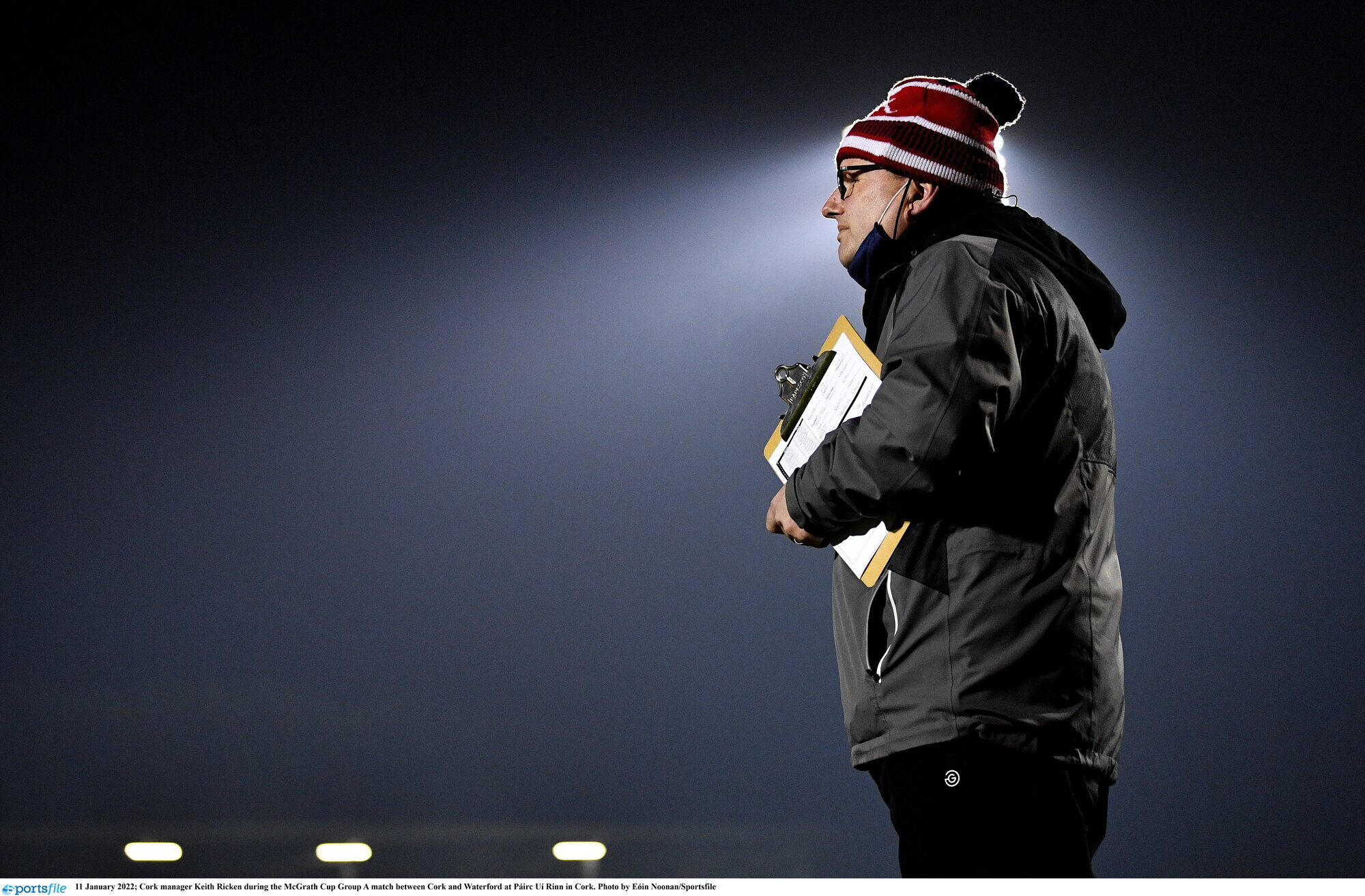
ILLUMINATING: Then Cork manager Keith Ricken on the sideline. Picture: Eóin Noonan/Sportsfile
It’s been six months since we sat down for a cuppa with Keith Ricken. To start anywhere other than his health would be inconsiderate.
When last we met in August at Bramley Lodge in Carrigtwohill, Ricken - never short or shy of a colourful comparison - likened himself to a 1970 Ford Capri. The reg number should be self-explanatory.
Anyway, Ricken’s Ford Capri was not built for driving beyond 80 kms an hour.
In the early months of last year, as he juggled the role of Cork senior manager and his then day-job as MTU Cork GAA development officer, while also battling ill-health, the Capri found itself tearing up and down the road seven days a week at 130 kms an hour.
It was an unsustainable pace. Oil was leaking and smoke started to creep out from under the hood.
Eventually and unsurprisingly, the car conked. On Sunday, the Cork footballers make for Ennis in Round 5 of the Allianz League. The county’s Rd 5 fixture away to Meath last year was Ricken’s last on the sideline.
He subsequently stepped back because of worsening health. There followed an almost two-week hospital stay. A couple of months further on and he announced he was stepping down.
The Capri, we’re glad to report, is out of the garage and back on the road. The 80km/h limit is being strictly adhered to.
He’s back on the pitch as Cork U15 development squad manager and is coaching the St Vincent’s intermediates one night a week. There’s planning and organisation in both, but nothing that will stretch him.
At work, there’s been change too. After 22 years, he’s blown the whistle on his time as the college’s GAA development officer.
His new title at the Bishopstown campus is Student Services Officer. His new office, just down the corridor from his old dressing room, is absent of bibs and water bottles. Graduation gowns, hanging neatly from a rack, have replaced gearbags full of jerseys.
“I am managing it much, much better,” he says of his health. “But then again, because I am doing this job, that's it. I am not rushing from you out to the pitch to someone else and so on.”
Has he a different perspective of the GAA after his time as Cork senior manager?
“No, I love the organisation. I love its flaws and all the good things about it.”
Having done three years as Cork U20 manager, he had the smallest taste of how demanding the senior gig might be. It’s why he didn’t immediately put himself forward when expressions of interest were sought.
Time spent in the role confirmed his thinking beforehand.
“I don't think what the ask of an inter-county manager is is possible. I don't think it's possible that a man can do two jobs, outside of his family and all that. Truthfully, I don't know how they do it.”
He offers an example. The day after Cork were well beaten by Meath, Ricken was on the road up to UCD for two freshers games involving MTU Cork. He’d already been up to Dublin for third-level games twice in the four days previous and so a friend offered to take the wheel for this latest journey.
Before they began the return leg, Ricken showed his phone to his friend. From the time he left Navan on Sunday to sitting in the car on Monday evening, he had received 120 emails and text messages regarding the Cork seniors.
“They were all about things that had to be sorted and organised. That’s a job in itself. And that’s not even including phone calls.
“I am still glad I tried it, but it is like having 14 drinks lined up in front of you and can you down them all in one go? I don't think I can do this, I don't think anyone can do it, but we'll have a crack off it anyway. It was a bit like that.
“So, from that point of view, I was disappointed with myself that I kinda landed myself into it knowing my health.”
And yet his tone tells me that had he the time back, he’d still choose the same route. “It is an honour to be asked. Everything I have done in life, even the stupid things, the wrong things, the things I didn't complete or do to the best of my ability, it is still an honour that I got to do them and an honour that I learned loads.”
During his campaign to become president of the GAA, Jarlath Burns said that if inter-county managers are being paid, let’s do it in a structured way. Let’s not be hypocritical.
Ricken’s take is similar.
“As an association, we can’t be talking out of two sides of our mouth. We have inter-county managers that are being paid and that is their job. Then we have other inter-county managers that are trying to be straightforward.
“We have to be clear in what we want from inter-county management and an inter-county set-up. If we want it to be as professional as we want it to be, then we need to allow the person to do that job and allow for that.”
Hypocrisy and the GAA raises its head elsewhere during the cup of tea. The association talks a big game when it comes to being player-centred.
“I don't see it often enough to be convinced that that really is their value. I have no doubt that their intention is that it is.
“It's like the fella below in the club who says, ‘winning isn't everything, so long as we beat the shower down the road’.
“By our human nature we are hypocritical. We have to accept that we are hypocritical, but we don't have to accept what we are hypocritical about.”
Given the third-level environment he has been immersed in since the turn of the millennium, it’s no surprise to hear him lament how squeezed their competitions have become.
Every January he bears witness to endless examples of fellas playing three games within the space of a week. Often, the window is even smaller. There are examples too of lads playing on consecutive nights.
“The Irish Sports Council have recommended 72 hours of recovery between games. If you really felt the person was at the centre of it, then that would be non-negotiable. But we don't practice it.
“At a time when everyone else is packing up at 19, 20, and 21, third-levels have increased playing numbers year on year. And yet we can't find a place in the calendar for it, we can't promote it, and we can't have it synced with inter-county.”
From his first coaching gig looking after a bunch of 13-year-olds up in St Vincent’s in 1988 to his role as Gaelic football coaching officer for Cork GAA to two decades-plus in MTU Cork (formerly CIT), young people have taught him much of what he knows and passes on.
The job of Cork U15 development squad manager has him in the company of 220 teenagers every Sunday morning. It’s as educational as it is enriching.
“I probably am happiest in my life working with young people. When I go down to a coaching session, it is like going to school every day with the best teachers in the world. I know I am going to learn something I didn't know before I went down.
“From when I started coaching young fellas in the late 80s, the conversations have changed, the haircuts have changed, and yet there’s still the same enjoyment, same energy, and same sense of being part of something that is alive at that moment in time. And I don’t ever see that changing.”
Where he has observed change is the imbalance between technical proficiency and tactical awareness. It hardly needs stating that the focus of underage coaches should be on the former. At U12s, sweepers shouldn’t come before the basics.
“I have experienced it with the young lads I am coaching now, there is huge emphasis from their clubs on the tactical side.
“It is sometimes lost the need to award and acknowledge young boys and girls trying to do a certain skill right, then doing it right at times, and then doing it right more often. You have to be technically proficient before you get tactically aware.”
Ricken remembers as a kid when his mother bought a bunch of Britannica encyclopedias. There was no Google back then. He and his siblings marveled at having access to such an amount of information inside their own front door.
Nowadays, the tap of a screen will get you whatever you want on whatever subject you want. The All-Ireland U20 winning manager believes this has fed a lack of thought among aspiring coaches.
“Whatever is hot at the moment, he or she is going to take that as the given. It's like the emperor with no clothes. You don't want to go against everybody else, so you agree with them.
“When people are out there coaching, sometimes that happens. They see a great idea, they are inspired by it, it got on some channel and some fella gave an inspired speech, then it was on Twitter and Instagram, and so the coach says this is the way I want to go, forgetting that he’s coaching a group of U9s and maybe it is not appropriate. Sometimes we forget this is a reflection on me as a coach.
“In coaching, if I have any one job left, it is to get people to think. Not to think what I am telling them, but just to think, even to think about who are they coaching and who is coaching them.
“If I had my choice, that's how I would like to spend out my days.”
The tea is long drank. Ricken should be long home. The conversation winds on. The GPS trackers will show we covered an amount of ground.
He knows it is easier to cast a critical eye over the association than to laud where it excels.
“The GAA is the glue almost that holds communities together,” he remarks. “When the shit hits the fan in the community, it is the source of energy, dynamism, and genuineness that arises.”
A lanyard hangs around his neck. It carries the colours of the pride flag.
He’s made his point that the GAA excels at community. But what of the LGBTQ+ parish? How come we haven’t got to a point where male players operating at the highest level feel they can be their full selves within the GAA community?
They are there, of course, a GPA survey last year finding that 10% of male inter-county players are aware of an LGBTQ+ teammate. But the openness on the female side of the house is sadly lacking in the male corner of the dressing room.
“I don't think it is as straightforward or as simple as the male environment is X and the female environment is Y. It is to do, in part, with how young players process their stuff. What’s the average age of an inter-county player, 23, 24, 25? So they are young men, and they are still processing.
“There is a sense of maybe there is a bit of bravado with men when they get together. As a man myself, I would have bought into and done that. When I think about that now, I often shudder. That is something we need to call out ourselves as we move along.
“Being here in college and seeing the various societies and people having a sense of who they want to be and trying to live it out, it is fantastic. They have taught me so much about the diversity of human nature. Certainly, I had a closed mind to so much stuff. But when you know better, you must do better.”
A couple of years ago at the college, they designed an inclusivity crest and had it printed on the back of their jersey. As an MTU student pulls the red shirt over their head on matchday, they see the crest and its message of ‘supporting diversity’.
“We are telling them we are becoming aware. We are saying that when you are here, you are here, and whoever or whatever you are, you are welcome. I always thought we did that, but we didn't say it.”
Keith being Keith, he broadens out the conversation.
“My issue within the association is that I'd like us to accept every type of player, good or bad, as opposed to gay or straight or whatever.
“If I walk down to the five-a-side pitches here, I'll see all ages and all abilities, whereas even in a Junior C hurling match there is a level of skill required to play it.
“We, in the GAA, still haven't developed a game for all.”
There’s enough food for thought there to fill a buffet. Time to point the Ford Capri for home.


CONNECT WITH US TODAY



Be the first to know the latest news and updates