Páirc tour was the Dub's 'greatest ever experience'
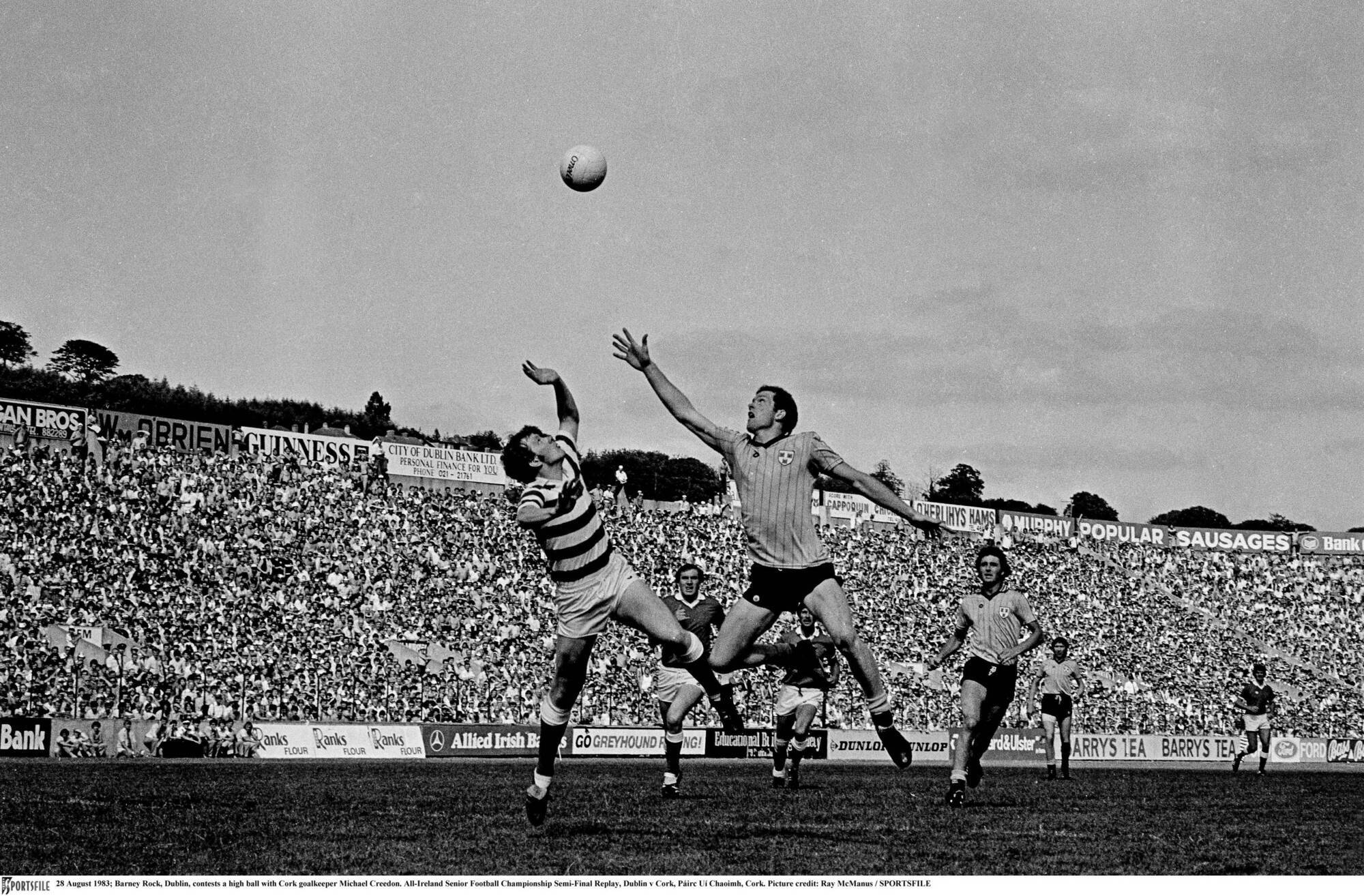
28 August 1983; Barney Rock, Dublin, contests a high ball with Cork goalkeeper Michael Creedon. All-Ireland Senior Football Championship Semi-Final Replay, Dublin v Cork, Páirc Uí Chaoimh, Cork. Picture credit: Ray McManus / SPORTSFILE
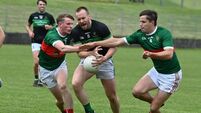
Barney Rock asks where might be a good spot for him to park for the match on Sunday – do you still have to go into the city or is he best using the Jack Lynch tunnel?
He didn’t make it down the last time Dean and the Dubs played in Cork, back in 2015; although that league opener in Páirc Uí Rinn was Dean’s first full start with the county after six seasons on and off the panel, dad was already committed to a trip to Barcelona that weekend to take in the majesty of Gaudi, Messi and Xavi.
He’s not going to miss this one though. It’s the first and probably only time Dean will get to play in Páirc Uí Chaoimh, one of Barney’s favourite two grounds outside of Croker as a player but one he has yet to see since it was redeveloped. And of course there’s the year that’s in it, it being the 40th anniversary of when Hill 16 went on tour and provided Rock and his teammates with what he claims was “the greatest experience we ever had as a team”.
In truth, he thinks Cork GAA and even its Dublin counterparts missed a bit of a trick this weekend; that instead of someone like himself making their own way to the game, the Dubs of ’83 should be heading to Cork as a unit just like they did that famous sweltering August weekend for an All Ireland semi-final replay.
“It’s a pity they didn’t invite and organise for the Dublin and Cork teams of ’83 to have a bit of a reunion,” he says, “especially with the fine new stadium they have down there with all its corporate boxes. It would have been just a nice way to mark those games and those players.”
Rock has always had a bit of a soft spot for Cork. The first All-Ireland he was ever at was ’73: Jimmy Barry winning matches, Jimmy Barry scoring goals. Rock’s father Will and uncle Christy used to work on the stiles of Croke Park, his uncle John on the scoreboard while Uncle Joe would attend to the dressing rooms. Often a young Dean would join him there after a game to help clean up (“There was nothing really else to do on a Sunday,” he says. “There’d be little to watch on TV. Some people hadn’t even a TV”).
After that final in ’73, he was able to secure a spot in the corner of the dressing room where a gracious Ray Cummins gifted the 12-year-old his shorts and Denis Long gave him his long socks.
A year later though he had wrangled his way in the Dublin dressing room while the Cork one was left vanquished, an experience that reaffirmed Rock’s desire to someday play for Heffo and the Dubs. And sure enough in the autumn of 1979 that dream came true; a few months after playing in a second consecutive All-Ireland minor final, he and Ciaran Duff were called up to the seniors and made their league debut against Cork in Croke Park.
He scored a goal and a couple of points, the start of a beautiful relationship or two: playing with the Dubs, playing against Cork. “I always liked playing Cork. Whatever it was about it, the battle of the cities and all that, you could always go out and play football against them. They were always good, lively matches.”
Lively they certainly were, for Rock and for the rest of us. Some he lost, like the U21 All-Ireland in 1980, the league final in ’89 and the All-Ireland semi-final a few months later. Some he won. But probably the most memorable were the ones he drew and what transpired afterwards.
First you had ’83 and all that. “The funny thing about that year was that at the outset of the championship both of us would have been complete outsiders: Kerry and Offaly would have had the upper hand on us for a good while. But then Cork [through Tadhg Murphy] beat Kerry with the last kick of the game and we shell-shocked Offaly after they’d beaten us by nine points the year before; we got a great goal from Anton O’Toole, Lord be good to him, and from there we just grew in confidence.”
Having broken free from the chains of their provincial overlords, both sides played with a vibrancy and abandonment upon reaching the last four of the All-Ireland. Dublin dashed out to an early lead only for it to be cancelled out when Dinny Allen rounded John O’Leary to goal and fist-pumped in the direction of an incensed Hill 16. The impish Allen would strike for another goal leaving the Dubs trailing by five points with just about as many minutes remaining.
Dublin though would retain their composure. Rock opted to point a 45 when others would have launched a hopeful ball in around the square. Joe McNally fisted over another point. And then Brian Mullins picked out Ray Hazely dashing up the left wing who crossed the ball with the outside of his right boot to find Rock on the edge of the square.
Rock himself says he was “just lucky to be in the right place at the right time”. John O’Leary though would offer a more objective and accurate summary in his book when saying “Only Barney would have timed his run to such perfection. And once he got possession there was no doubt about his finishing ability.” Cue the Hill going mad in a way it probably wouldn’t again until Kevin McManamon’s goal 28 years later, and further bedlam when it learned it would be on tour to Cork the following week. There hadn’t been a football All-Ireland semi-final played outside Dublin in 45 years and there hasn’t been another since bar the famous Kerry-Mayo replay of 2014.
“Frank [Murphy, the Cork county board secretary] obviously got his way getting us down to the Páirc for the replay. But we relished that challenge. After being five down with five minutes to go we would have gone anywhere to still be in the championship. Going to Cork ended up probably being the best experience we ever had as a team, with us playing our best football on the best pitch on the best day of the year.”
Everything about it was so novel, for the supporters, for the players. “We’d never been out of Dublin, or at least the province, for a championship match before. Normally we’d meet up in Croke Park an hour or two before a game. Now we were going down on the bus on a Saturday. We stayed in the Blarney Park Hotel, had a team meeting at about eight at which Kevin [Heffernan] said to us to do what we’d normally do before a game. If you liked to have a pint or two in Dublin before going to bed, have a pint or two down here in Cork. I never drank the week of the match but a few lads would and so they had their couple of pints there in the hotel.”
The next morning most of them got in mass and walked the grounds of the nearby castle with Rock being among those who kissed the Blarney Stone. “There was just a great ambience and atmosphere around Blarney and Cork that day. We were around the square there in Blarney outside the hotel and took in the supporters singing songs, wishing us well.
“Once we got to the stadium then, the atmosphere was incredible. Because it was a replay and something else was on the schedule, the game wasn’t shown live on TV so anyone who wanted to see it tried to go to it. Cork and Kilkenny were playing in an All-Ireland junior semi-final in the curtain raiser and when we went out onto the field at halftime to have a walk around the Blackrock End was a sea of blue.”
If Murphy had used his wits to bring the game to Cork, another old wise fox in Heffernan pulled a stroke of his own just before the ball was thrown in. Rock’s marker, Jimmy Kerrigan, had been outstanding in the drawn game, bombing forward from wing back. In the replay Rock took up a spot at corner forward, forcing Kerrigan to follow him in. From the off Cork were either on the back foot or the wrong foot and within minutes Rock was pulled down for a penalty which Brian Mullins converted. Dave Barry would score a couple of goals to bring Cork back to within four points but then Rock struck for another goal and laid on one for Joe McNally to seal one of Dublin’s greatest wins and days.
“It was a great, high-scoring game, full of goals. As good as I played in, or as good as that Dublin team ever played. The only downside to that day was after the game we learned Tom Creedon [the Cork player who had 16 weeks earlier been hospitalised while trying to stop a parked van rolling down a hill with his baby son inside] had died. That took the gloss off the weekend. I remember the following Tuesday when we were back training for the All-Ireland we were still talking about Tom.”
The All-Ireland itself was something of an anti-climax, even though Dublin won it thanks to Rock ingeniously chipping the Galway goalkeeper, Sheehy-like. “I think Galway might have looked at us as this young team they weren’t going to stand off, but to be fair to Galway and to [referee] John Gough, it wasn’t their fault it was such a rotten day to play football. At one stage there was hailstones firing down. If you’d had an open dry day like we had in Cork, it would have been a much better game.”
Rock would have further drama and sagas with Cork. In 1987 he kicked an equalising point in a league quarter-final to force what Dublin and almost everyone else believed was extra-time but Cork claimed should be a replay.
“We were coming out of the dressing room when we saw Cork players heading away with their bags over their shoulders. When the ref was about to throw the ball in you could see the Cork bus going over the bridge by the Canal End. Declan Bolger won the throw-in, kicked it in and I happened to be the full forward who got to kick it into an empty net. People ask ‘What would have happened if you’d missed?’ In fairness, you could hardly miss that.”
Dublin ended up winning that league which, Rock suggests, wasn’t the worst thing that happened to Cork. “We sometimes say we helped start the Cork rebellion by going on to beat Kerry in the final. Maybe that took away some of Kerry’s invincibility. Meath and Cork took over a few years. We probably should have beaten Cork in ’89 [All Ireland semi-final] but then Dinny [Allen] baited a young Keith [Barr] into being sent off and they were too battle-hardened a team by that stage to let an advantage like that slip.”
He’d return to Páirc Uí Chaoimh a few times after ’83. He’d play an International Rules game down there in ’84, and another league game or two. But never championship. He’d love to see Dean or any Dublin team play a game there in the near future. As magnificent as the new Páirc Uí Chaoimh is, it has yet to host a great football occasion in the vintage of the Munster finals of ’76 or ’87 or ’88, or Cork-Dublin in ’83. With the new championship format Dublin could provide such a possibility. If they were drawn to play Cork. Or even Kerry.
“The next time Dublin and Kerry have to play a match before an All Ireland semi-final the place to play it is Cork. Ahead of Thurles, ahead of Croke Park. The stadium and city is just set up for it.”
In the meantime, the league will have to do.


CONNECT WITH US TODAY



Be the first to know the latest news and updates