Tobin: Years of work aimed at curbing burnout could be undone at Congress
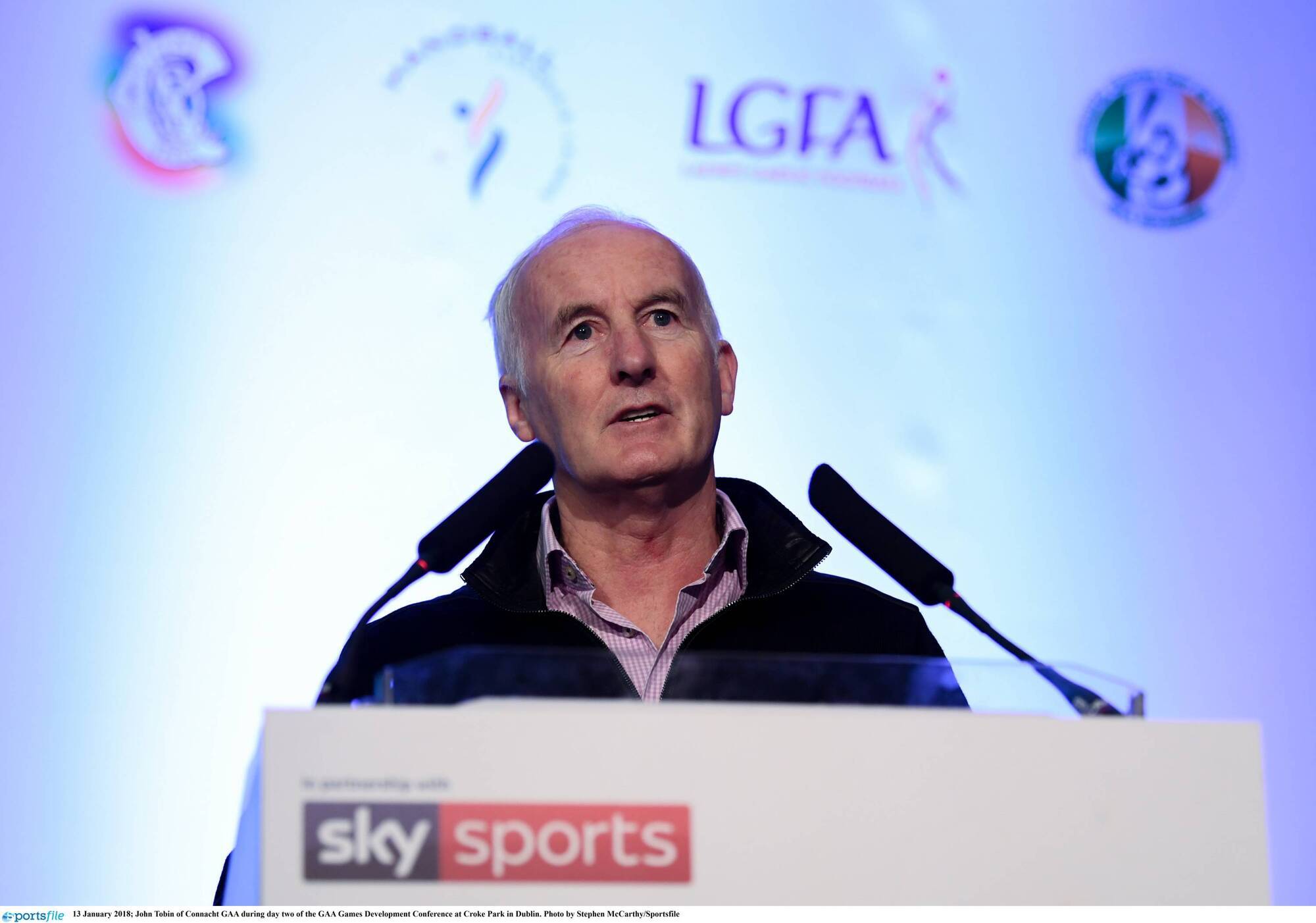
BURNOUT WORRY: John Tobin at the GAA Games Development Conference at Croke Park in 2018. Pic: Stephen McCarthy/Sportsfile
Former Galway and Roscommon manager John Tobin fears years of evidence-based work aimed at curbing player burnout could be undone at Congress this weekend.
Tobin, a member of the current age grades review group and player burnout committee that sat in the mid-2000s, sees a return of U18 as the minor inter-county grade as a retrograde step.
The motion sponsored by Kerry (Parnells), Longford (Clonguish) and Tyrone (board) proposes to replace U17 with U18 at inter-county level. If passed, an 18-year-old could be eligible to play minor, U20 and senior with his county. If his county board also chooses to move to U18 at club level, he could also play minor, U20 and senior at club level.
After the player burnout committee’s report was published in 2007, ex-Connacht GAA games manager Tobin wrote a match programme piece in which he cited figures from it such as one-third of under-age players lining out for at least five teams in a season. Of that number, over a quarter played for seven or more.
While those numbers aren’t as large now due to steps taken by the GAA to decouple and streamline, there is a sense they could return if U18 returns at inter-county level: “That piece is as relevant now as it was back then,” maintains Tobin.
“Teenagers are adolescents; they’re not adults. They must be put in an environment and probably in a structured competition that reflects their abilities, their weaknesses and their vulnerabilities. It’s a very sensitive and volatile time in all aspects of their lives.
“It was a predominantly player welfare issue, it also concerned a number of players that were doing the Leaving Cert. Playing minor was an added pressure but going to U17 took that out of the equation. The fixtures were also being congested and because the minor was a sub on a team, the team couldn’t play and it led to postponements.
“We needed to decouple. We’re trying to reduce the number of teams that they’re eligible to play for. We want to ensure a player has a life-long involvement. If you’re told by a medical expert that you must take a year or two off because of your over-exposure to games, that’s fairly traumatic but they are real things that are happening.
“All our points were evidence-based. The minor review committee followed up on our (burnout group) work and revealed 42% of under-age players reported suffering chronic fatigue. 35% wanted less training sessions. There is a lot of evidence there to support that over-training and over-playing had been happening.”
Tobin cites the Economic and Social Research Institute’s study of 10 years ago that showed 53% of hurlers and 52% of footballers between the ages of 18 and 22 were dropping off within three to four years.
“A couple of years later, Antrim conducted a study after they introduced U13, U15 and U17 with decoupling and their drop-off rate was 38%. They got something like 180 extra games played because of decoupling and those games were more meaningful."
Tobin lists off a number of responses from a recent GAA national youth consultation day.
“’Young players shouldn't be made to play with older teams—it can cause burnout.’ ‘More time needs to be dedicated to player recovery after matches and training,’ ‘Each player should have a restriction on how many times they can train in a week based on their age and the type of training being done.’ We have to listen.
“The Player Pathway gives direction and guidance on all of these issues. The games and training programmes have to be age-appropriate and a learning and development environment prioritised.”
The 1974 football All-Star speaks of introducing a tiered under-age inter-county competition to give more counties “the Croke Park experience”.
“Everyone knows counties aren’t equally resourced be it population, tradition or finances. Wouldn’t it marvellous then to see in a games-based competition to see like playing against like? If we had a weekend where we had two teams of similar means playing against each other in an All-Ireland final in Croke Park of an under-age competition, wouldn’t it be great?
“What we want to emphasise is U17 is for learning and development. It’s always going to be competitive and we don’t want to change that, but we want to take away the adult aspect. It should be a different context.”