Tactical fouling pushes modern Gaelic football to the limits
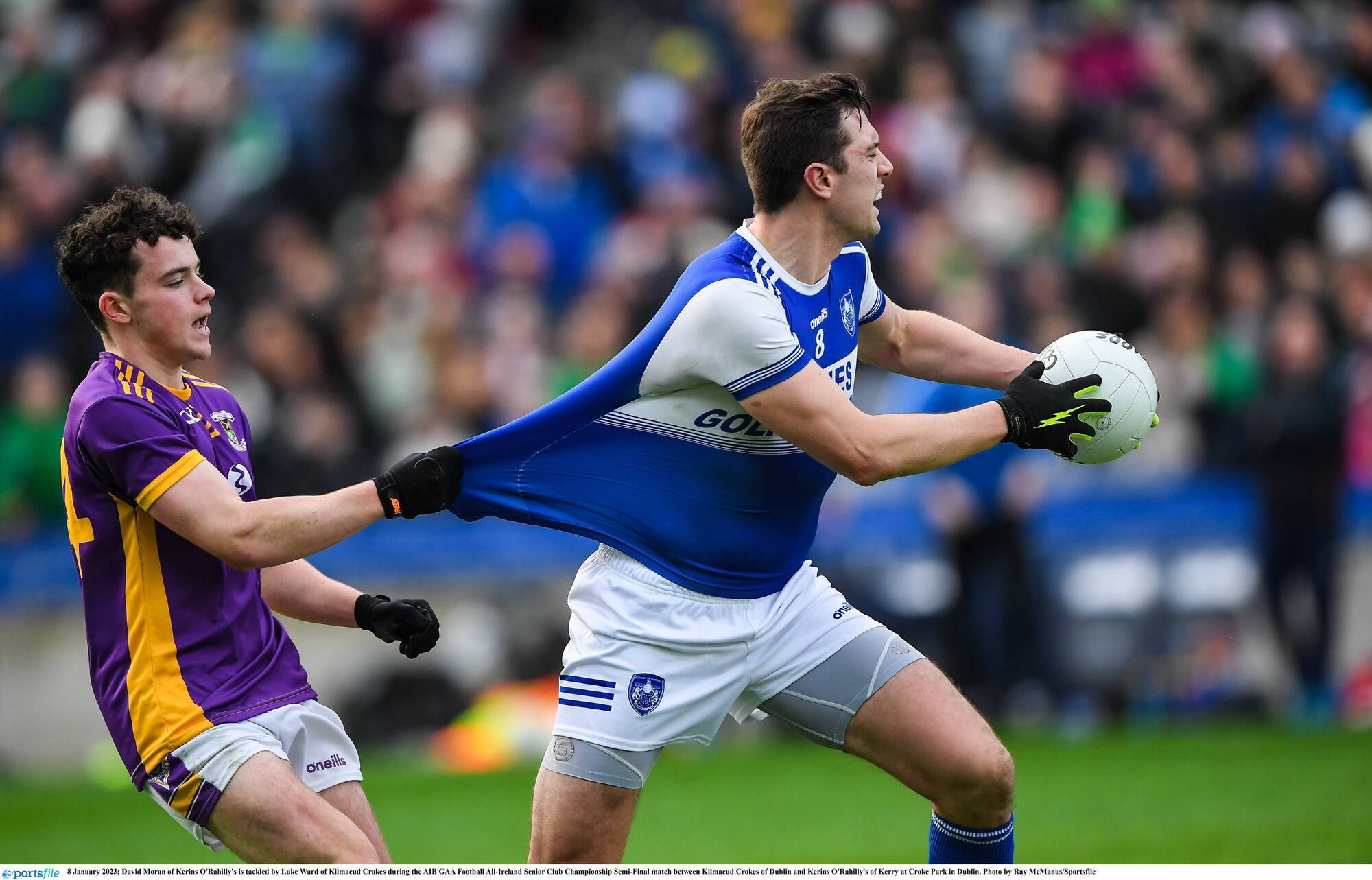
GET TO GRIPS: David Moran of Kerins O'Rahilly's is pulled back by Luke Ward of Kilmacud Crokes. Picture: Ray McManus/Sportsfile
A robust nod confirmed Robbie Brennan already knew the stat that was being levelled at him. Kerins O'Rahillys 8, Kilmacud Crokes 30. The free count from their All-Ireland semi-final victory. Damning evidence, what’s the plea?
"I'll do the old Premier League thing and I won't say anything because I'll get in trouble,” Brennan replied. “I'll let people judge that one for themselves. It's a crazy stat.” Like any good cross examination, Micheál Ó Domhnaill’s follow-up attempted to delve deeper. You think the ref was hard on you then?
“Yeah. Madness some of the decisions but anyway, that is for another day. He will have to look at that himself.”
Brennan was never likely to say much different. When quizzed about such a one-sided figure, the default setting is to muster some sort of a defence. For all of that the Dublin kingpins can have few complaints. Walking such a fine line invariably leads to straying the wrong side.
In Gaelic football, champions have always carried with them elements of cynicism. It is accepted as part of what it takes. Push the rules, break them if needs be. This particular case is in line with the latest evolution of strategic fouling, where the existing rules have been outstripped by coaches’ response.
First, the raw numbers. Of 30 fouls, 11 came after conceding a turnover or losing their own kick-out. 10 came on Kerins O’Rahillys kick-out. Seven came during their own attack and two were after they lost the throw-in.
Clearly, Kilmacud identified David Moran as a crucial player. From kick-outs he provides a significant platform to attack. If you can’t stop him in the air, slow him on the ground. Moran was fouled six times during the game. Another target, wing forward Gavin O’Brien, accounted for another five. By slowing down that transition, Kilmacud provide themselves with an opportunity to reset. Therein lies the key.
Before he was told about the free count stat, Robbie Brennan was first asked for his assessment of their performance.
“I suppose the first thing delighted to get back to a final. Coming out of here in February we were obviously very low. It is special to get back there.” What happened in February? Everyone saw how the Kilmacud Crokes coach was left magnanimously congratulating Kilcoo’s Mickey Moran after suffering late heartbreak. But for the coach, what really happened in February?
Two points up, goalkeeper Conor Ferris had the ball and under pressure elected to boot it up field. Kilcoo attack with Shealin Johnston sprinting forward. Andrew McGowan was able to get a hand on but he didn’t foul. In actuality, he held both hands up to exaggerate that fact. A clean attempt, no free will be found here. Admirable? Undeniably. Astute? It depends on who’s asking. Kilcoo carried on and score the decisive goal.
The black card was a welcomed effort to reach down and grasp the cynical play problem by the stem. At the same time, it was never going to take out the root as well. The majority of scores come from turnovers because that is when play is most unstructured. Therefore, a stoppage and a chance to establish a defensive structure remain valuable. All that changed was that the price went up.
So it became more sophisticated. Now overly forceful tackling, leaving hands in, pulling jerseys back but not down offer the opportunity to break up play. Consider the fourth minute in the semi-final. Craig Dias’ shot dropped short and Kerin O’Rahillys look to respond. A long kick pass found Barry John Keane who immediately is wrapped up for a free.
There are two more frees during the attack. Dias for two hands on Pádraig Neenan. Later a push in the back on Jack Savage outside the 45. He took the free off the ground and dropped it short.
In the entire game, Dias fouled a remarkable seven times. It was only after six different infringements and a high tackle in the second half that he was shown a yellow card.
Detractors bemoan what it does to the spectacle. Look for a solution and the shrieks taper off. The tally is well spread out. Of 14 outfield players, just two Kilmacud starters did not concede a free. Referee Niall Cullen did his best to keep the game flowing despite the stoppages. Only two players, Dias and O’Brien, were shown a yellow card for a tackle. The other three were all for off the ball incidents.
Aidan Jones’ foul on Jack Savage before half-time was a borderline yellow, the fact he had already conceded a free before that perhaps enough to seal it. Who is going to monitor that? Already referees have too much on their plate. In basketball, a player who conceded six personal fouls is fouled out. Are supporters willing to accept that as a cost?
While the repeated interruptions might provoke irritation, imagine the uproar if a player was sent off for repeated fouling in an All-Ireland decider. No referee wants that rod and the association shows no desire to take on such a war.
A stalemate it is then. That is not say tactical fouling is 100% efficient. Kerry’s only goal in the 2022 championship came after a turnover and the referee playing advantage. Kilmacud Crokes conceded just three goals in the Dublin championship and none since. All three came after turnovers. Against Templeogue Synge Street, an inaccurate sideline was intercepted and in the back of the net seven seconds later. No time for an arm pull there.
In the quarter-final against Cuala, there was a turnover and then a foul. However, they lost possession during a Paul Mannion tackle and Cuala’s attack restarted quickly after the free. Amidst all of that, it finished in a green flag.
Against Thomas Davis, it was an intercepted free-kick that led to a goal eight seconds later.
This conundrum has been at the heart of Gaelic football coaching for a decade. There is wide recognition of what we all want to see and a general understanding of what it takes to win. Egregious transgressions are not tolerated but the boundary will continually be pushed as long as the penalty is relatively low.
Put it this way. There is no doubt what Andrew McGowan would do if Kilmacud Crokes were afforded a do-over on that 2022 final attack and put in the same spot again. The question is if it was your team, what would you want him to do?
CONNECT WITH US TODAY



Be the first to know the latest news and updates