12 trial rules set to transform ladies football for National League
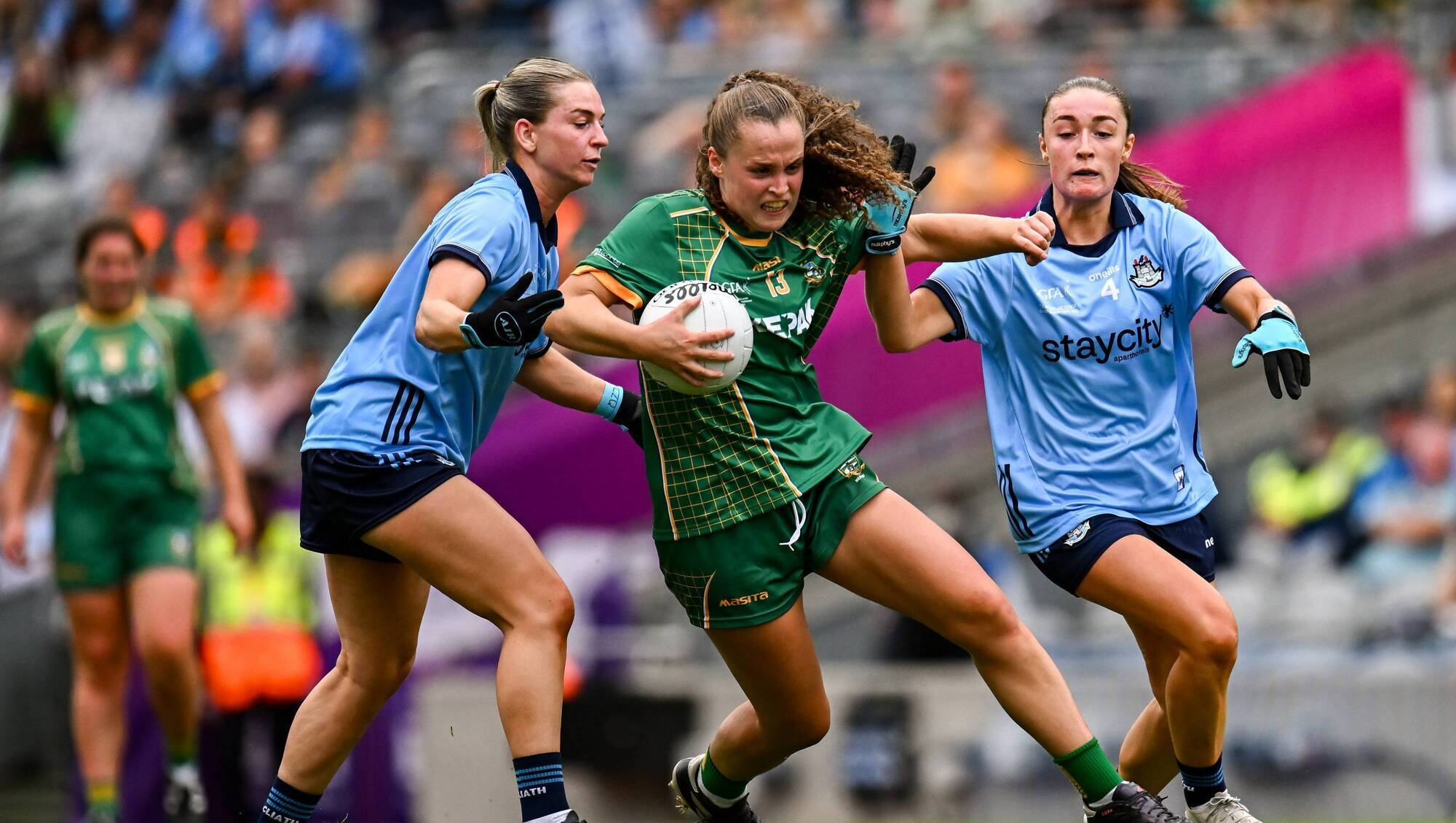
The modified tackle should significantly increase permitted physicality in ladies football. Pic: Piaras Ă MĂdheach/Sportsfile
The Ladies Football Central Council will convene next Tuesday to ratify the full suite of proposed rule changes that are to be trialled during the 2026 National League.
Central Council approval for the 12 trial rules is viewed as a mere box-ticking exercise ahead of the transformed ladies game throwing in on the final weekend of January. Opposition from LGFA delegates to the heavily amended rulebook drawn up by the Playing Rules Review Workgroup is not expected.

The 2026 National League will be the sole pilot for the trial rules, with a Special Congress pencilled in for the end of spring to determine which rule changes become permanent for the All-Ireland championship and club championship season.
The 12 trial rules are to be reviewed after the opening three rounds of the National League, with the two-week gap between Rounds 3 and 4 the one opportunity for the workgroup to introduce alterations for the remainder of the League.
A further review will take place following the conclusion of the League and in advance of the aforementioned Special Congress.
Of the 12 new rules, six are taken directly from Jim Gavinâs Football Review Committee handbook. They are the kickout mark, the requirement to keep three players in the opposition half at all times, the two-point scoring arc, the solo and go, and frees brought forward for either tactical fouling or dissent from the sideline.
In the case of the kick-out, the LGFA workgroup have not completely copied and pasted the change to the menâs game and so short restarts within the 40-metre arc will still be permitted.
The remainder of the proposed rule changes centre predominantly around the tackle, the lack of definition for which has caused consistent and considerable angst for both players and management personnel.
Where previously a player could only tackle their opponent when the ball was out from the body, this has been altered to allow a player tackle the ball at any time. Incidental contact with an opposition player has also been greenlighted.
Former Dublin manager Mick Bohan, who is understood to be involved in the drawing up of the new enhancements, was a consistent critic of the âill-definedâ tackle in ladies football during his All-Ireland winning tenure with Dublin.
âEvery single referee that I speak to has a different interpretation of the tackle,â he said back in 2022.
The modified tackle is part of a step change to significantly increase permitted physicality in the game, the hope being that this will drive improvement in the quality of spectacle as has been the case in camogie since their rulebook facilitated much greater contact.
While the shoulder charge is still not permitted, there has been an overwriting of the rule stating there shall be no deliberate body contact. A player will now be allowed to use her body to fairly contest possession of the ball, provided the challenge does not involve excessive force.
The LGFA workgroup has also sought to tackle the frontal charge, the policing of which is an endless source of frustration for camogie and ladies football players.
At present, the advantage is with the defending player standing their ground, and the player in possession penalised for not attempting to sidestep their opponent, even if there's not time or space to do so.
The defending player may now use one or both hands to legally delay an opponentâs forward movement, provided the contact is made below shoulder height and is not a push backwards. This is designed to achieve better defending and remove incidents where a defending player knows they must simply hold their ground and take the hit to win a free out.
âThese new playing rule enhancements are designed to improve the flow of the game, encourage fair play, and reduce unnecessary stoppages. All players, coaches, and referees are urged to familiarise themselves with these changes to ensure consistent application and understanding,â said the rules review workgroup in the document circulated to county boards last week.
The results of a Gaelic Players Association survey, published in October, showed that 92% of 754 inter-county ladies footballers surveyed were in favour of trialling new rules in next yearâs National League.