Babs Keating: The GAA are divorcing themselves from the older generation
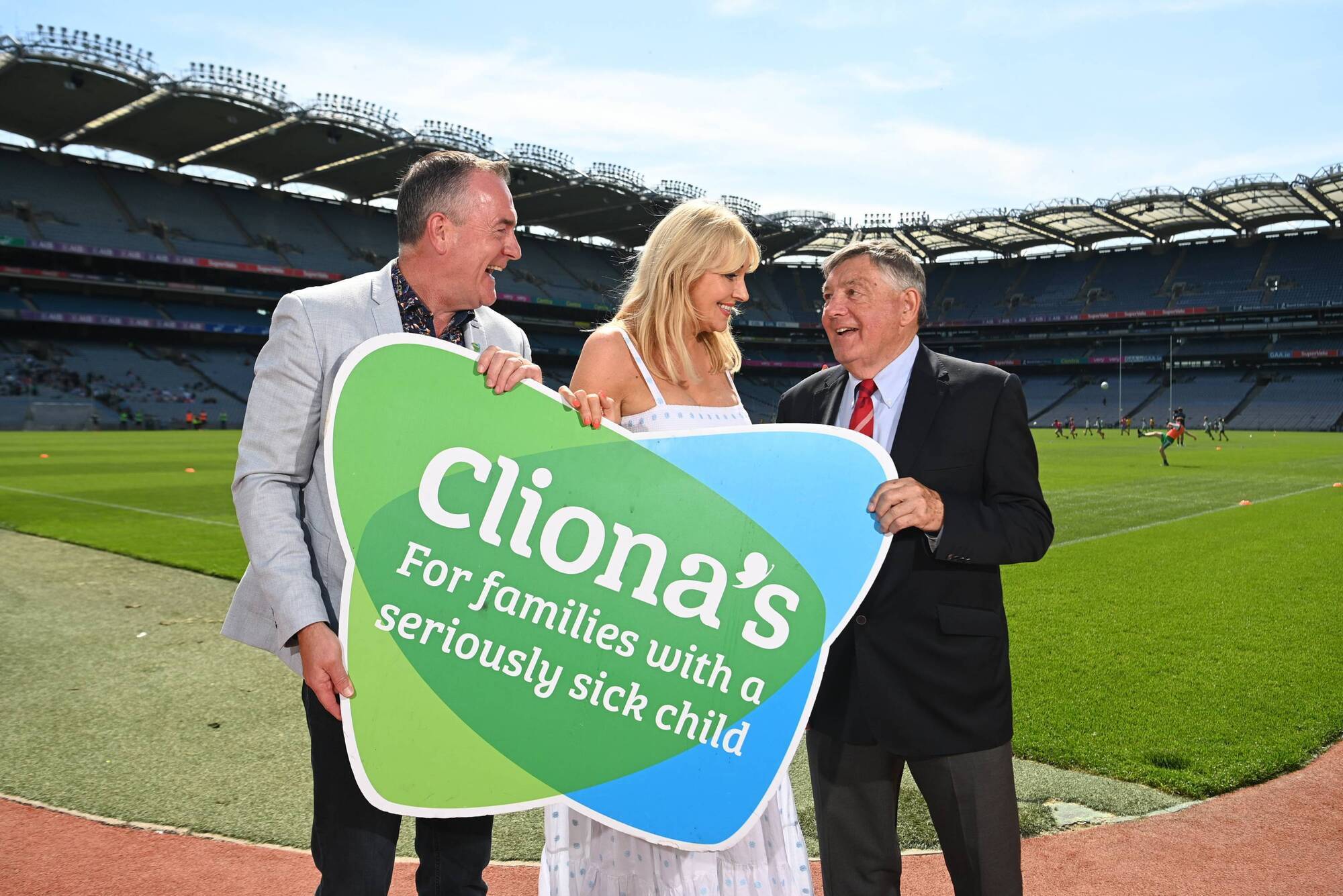
LIFETIME ACHIEVEMENT: Cliona's foundation CEO Brendan Ring, patron Miriam O'Callaghan and former Tipperary hurler Michael 'Babs' Keating pictured at the launch of the GPA Legends Lunch in association with Cliona's foundation at Croke Park in Dublin. Four legends of the game will be honoured on 26th August. Pic: Harry Murphy/Sportsfile
These days, Babs Keating’s routine is easily defined and clearly mapped out. He has spent the last three months at his mobile home in Burrow Park in Rosslare, just 150 yards from the sea. Every morning at 8.30am, Keating will stroll through the Rosslare golf club before going for a swim during the high tide, repeating the ritual again every evening, staying in the Irish Sea for close to an hour each time.
The cool water is like a soothing balm to an aching body and creaking limbs. In the last few years, Keating has had nine operations on his shoulder, which he wrecked in a fall, but his body has taken a pounding from some of life’s hardest punches. During his first visit to Dr Pat O’Neill to assess his shoulder, O’Neill noticed a black ring in the middle of Keating’s back, which proved to be a cancerous melanoma.
“I was lucky that Pat realised how serious it was,” says Keating now. “I probably wouldn’t have done anything about it if I hadn’t gone to Pat with my shoulder. If I didn’t, I probably wouldn’t be here now.”
Keating had another narrow escape 19 months ago. He was struggling so much to breathe that he was sent straight to hospital.
“I had such a blockage in one of my arteries,” says Keating “that the surgeon said I wouldn’t have lasted another week.”
Keating will be 79 on his next birthday. Age, experience and perspective have made him appreciate what he has now more than ever.
“I go back to the 1964 (Tipperary) team I was on,” he says. “With the exception of Tom Ryan, who died young, we were all alive for the 50-year anniversary. But I think there are eight of those players gone since in a short while.”
With such vibrant personality, Keating always carried that air of near invincibility, of near indestructibility, whether it was how he casually projected himself, or how others chose to perceive him. Part of his reputation was caricature. Some of it was false, most of it was true. In any case, the way Keating played, managed and behaved attracted attention. Nothing about him was understated.
He always had something to say, so much so that some of those comments will always be intrinsically linked and connected to some of hurling’s most iconic moments, and events.
Even now, 24 years on from Offaly’s last All-Ireland success in 1998, any discussion around that incredible journey will still always start with Keating’s famous ‘sheep in a heap’ line which ultimately forced his resignation after the Leinster final defeat to Kilkenny.
“When you talk about criticism over my comments, I have to start with the Offaly situation,” says Babs. “If I said that in a Tipperary dressing room, even a Cork or Kilkenny dressing room, it wouldn’t even have been noticed. When you think of the stuff that (Brian) Cody did over the years, and there wasn’t a word about it.
“I think it’s something that a lot of managers go through when they go into another county. When you win something with your own, you win it. When you lose with another county, it’s you that loses it.
“If anything, one of my mistakes was that I was too generous to the media. And I was bitten by them. I was always of the opinion that the GAA needed the media more than a lot of people appreciated. But if I was going over the same road again, there is not much I would change.”
Keating’s unfiltered honesty was a core tenet of his personality but it was invariably always such a source of exasperated commentary that it often granted a licence for exploitation to be used against him in the most destructive way possible.
When Cork dethroned Tipperary to win a brilliant Munster title in 1990, the general tone afterwards was that Cork were pumped and driven from Keating having said beforehand that ‘donkeys don’t win derbies’. Keating’s comments were much more nuanced but they were twisted to suit the narrative Cork sought to design.
The quotes came from an interview with RTÉ’s Ger Canning on the Tuesday before the Munster final, which were broadcast on that Saturday. Early in the interview, Keating said: “We face the old enemy here next Sunday and I hope we treat them with the respect they deserve."
Later, Canning asked: “Of course, you have to respect a team motivated and trained by people like Fr Michael O’Brien and Gerald McCarthy?”
Keating replied: “You still need the talent, you still need the players. Several managers in recent weeks got credit for being great motivators but if you have not got the talent…you can’t win a derby with a donkey.”
Speaking to Adrian Russell for his excellent book , Canning confirmed the real story.
“He was wary of Cork and most certainly was not denigrating them in any way,” he said. “That point was lost at the time. But why spoil a good line?”
The good lines kept coming because Keating couldn’t help himself from calling it as he saw it, irrespective of how unvarnished or undiluted the commentary was. But those words had a different quality and meaning when they appeared cold and hard on the printed page.
“It's the overall attitude,” Keating said after Galway beat his Tipperary team in the 2006 league. “We can't get the drive we want into them. Our fellas are dead only to wash them.”
In his autobiography, Lar Corbett said that Keating’s constant criticism of the team had “broken” them.
“We were a laughing stock and with every passing fixture, the manager’s public comments about us seemed to get more bizarre,” wrote Corbett. “The more Babs criticised us in the public, the more we became a shambles.”
Sixteen years on, Keating is still steadfast in his views of how he managed that team.
“When I was interviewed for that job, 99% of the interview was devoted to discipline,” he says. “We needed to instil discipline in that group. When you ask me now what I would have done differently, I wouldn’t have done anything differently, especially when you put up with what we had to put up with. I have no doubt that Liam Sheedy benefitted from some of the decisions we made. Any decision we made back then, I’d do the same again.”
Keating will always be fondly remembered for how he re-energised and reinvigorated Tipperary when managing them to the 1989 and 1991 All-Ireland titles, but his second coming in 2006-’07 was a mistake he now has no problem admitting. “I regret taking the job the second time,” he says.
After he departed, Keating continued to offer his forthright opinions in his newspaper columns. Keating gave it hard to every county. He wasn’t going to be seen to spare any county, but he gave it excessively hard to Tipperary. When Tipp won the 2010 All-Ireland, their sports psychologist Caroline Currid compiled a bunch of Keating’s columns and quotes and posted them on the walls for matchday motivation.
Keating still has an incredible status in the game, with huge respect amongst GAA people, but that kind of stuff fed into the perception of his persona and the arrogance often attached to it.
“I was giving my opinion but I also felt I had a better insight than a lot of people,” he says. “That might have been portrayed as arrogance but people who would say that don’t understand the game of hurling or understand where I came from.
“My father was a middle sized farmer that worked awful hard and was sick for many years when we were growing up. We were lucky to have such great neighbours. There was literally no hurling in our parish and I ended up in a dressing room with some of the greatest players that ever played. I can tell you, there was no room for arrogance or cockiness in that dressing room.
“The fact that I played football for Tipperary longer than I played hurling for Tipperary meant I understood both sides of wearing the blue and gold. I understood what it was like to be down. I understood it when playing hurling for Ballybacon Grange for a lifetime was a struggle. This thing of arrogance never entered my mind.”
His actions and views may have often been controversial but Keating never recognised any limits. He may not be as relevant to the current generation but his status as one of the great managers of his time is undisputed. Those Tipp teams he managed between 1987-’94 could have won more but Keating was still far ahead of his time.
He was a pioneer around modern and professional preparation, on and off the pitch. When Keating took over Tipp in 1986, fundraising for the team began almost immediately. The Tipperary Supporters Club was established by Keating and their initiatives set a standard for every other that followed.
Their first golf classic raised £30,000, a massive figure for a time when the country was still finding its way out of recession. When they raffled a racehorse, £96,000 was raised.
When Tipp finally made their breakthrough in 1987, the players were treated like kings. That summer they played four games in Killarney and each time they stayed in the five star Aghadoe Heights Hotel. All medical expenses were covered from the supporters club fund and the panel was kitted out in snazzy suits and blazers.
All that stuff was groundbreaking back then, so when Keating still makes judgements, he does so from high standards, irrespective of how other people might interpret the quality of those standards and barometers.
“To me, the last great development in the GAA was the development of Croke Park under Peter Quinn,” he says. “The current crowd, as far as I can see, are doing their best to mess the whole thing up. They inherited everything and all they’re being asked to do is run the association the way it should be run.
“The GAA isn’t relating to the people who supported the association all their lives. They are divorcing themselves from the older generation, who were everyday match goers. This idea of asking older people to go online and buy tickets is a joke. Even myself, I don’t have a facility to print a ticket to go to a club game. I was at a ladies football match recently and luckily enough, someone knew me at the stiles because I didn’t have a ticket.
“I don’t think the GAA hierarchy are fully tuned in. I understand wanting to give the clubs more time and space, but having the All-Ireland finals in July is the biggest joke of all time. We finished with the inter-county game before the Premier League started and a full season of the Premier League will nearly be over by the time we see another hurling championship match.
“It’s nearly the same in some counties with the club championships. To have the Wexford county hurling final over before August 14th is hard to understand. They are leaving the door wide open for other sports to take over the rest of the year.
“I just don’t understand so much of the GAA’s decision-making anymore. The way the Jubilee teams were treated before the All-Ireland final was a disgrace. If they were going to treat those great players so poorly and introduce them an hour before the senior match when nobody was in the ground, why couldn’t they have played the minor final?
“Anyone who knows anything also knows that reducing the minor to U17 is a joke. The minor at U18 was meant to be a stepping stone to senior – 17 is no use. There is too much of a gap. I also think there are too many football people making big decisions. If it continues the way it’s going, I’d be saying to the hurling counties to break away and run our own association.”
Keating’s passion for the game is undimmed but it no longer burns as brightly as it used to. For decades now, he has been saying that the sliotar is too light.
“With the ball travelling so far now, it often wouldn’t worry me if I never saw a hurling game again,” he says. “Hurling balls are not supposed to travel 130 yards. Would it happen in cricket or any other game? No way. The way hurling is now, my generation have no interest in it.”
Keating has often come across as being contrary, of always having a beef with someone or something. His comments may have often been interpreted as a lack of respect or empathy for others but those beliefs were invariably just a reaffirmation of his unwavering confidence in himself, in his opinion, and in how he expressed those views. In any case, holding his counsel in the interests of self-preservation would never have crossed Keating’s mind. It would be contrary to his nature.
He has burned plenty of bridges but Keating has always been consistent. He is a unique figure, having always retained that way of being different, irrespective of how so many view those differences. One of a kind. “He had a neck like a county council roller,” said Richie Stakelum on the TV programme ‘The Game’ a few years back.
Babs’ voice is not as prominent as it used to be but his status and achievements still carry huge echoes. Next Friday, he will be one of four former players – alongside Jimmy Keaveney, Mary Jo Curran and Angela Downey – to be honoured by the GPA with Lifetime Achievement Awards in Croke Park, with the proceeds of The Legends lunch going to Cliona’s Foundation.
He may be less relevant to the younger generation, or those under 45, but Keating knows now that his voice no longer needs to carry as loud and as far as it always used to.
“There is a generation now that don’t appreciate what I have to say,” he states. “It doesn’t make much difference to me at the moment. I’m enjoying what we have. I think I am sensible enough to realise now that we are living in different times.”
No matter the timing or whoever is listening, Babs will still always have his say whenever he is asked. And agree or disagree with him, Keating's opinions could never generate a moderate response.
CONNECT WITH US TODAY



Be the first to know the latest news and updates