Seanie McGrath: Beating Clare then was like beating Limerick now
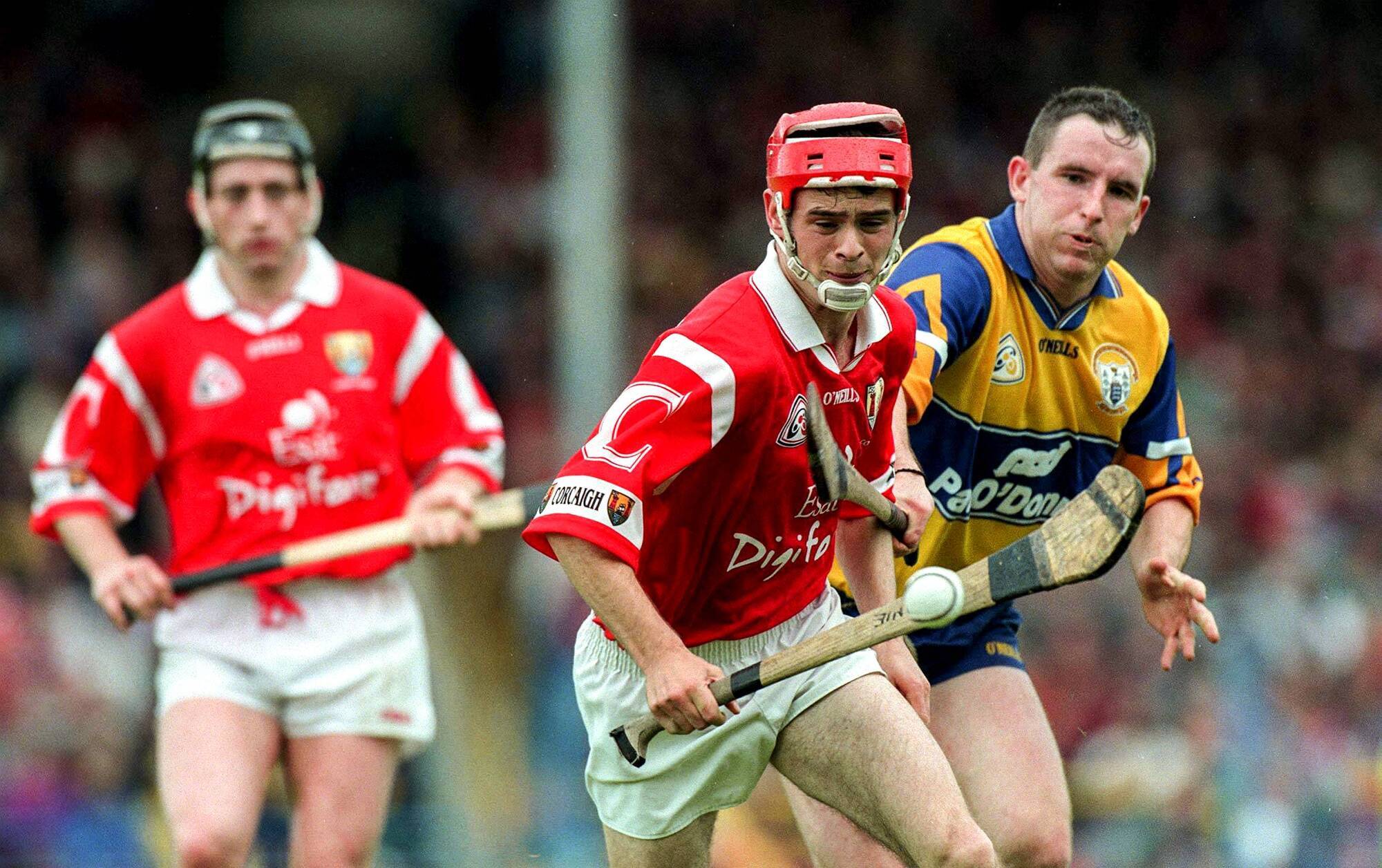
21 June 1998; Sean McGrath of Cork in action against Colin Lynch of Clare during the Guinness Munster Senior Hurling Championship Semi-Final match between Clare and Cork at Semple Stadium in Thurles, Tipperary. Photo by Brendan Moran/Sportsfile
Before Limerick there was another power that came out of the west.
Ask Seanie McGrath, who made his senior hurling debut for Cork in 1997 against a Clare side in their considerable pomp.
“They were the team, no doubt about it. They'd won the All-Ireland in ’95 and it took an incredible Ciaran Carey point to beat them in 1996. They won it in 1997 after and if it wasn’t for a bizarre refereeing decision in 1998 they might have won four in a row.
“They were a great side.”
Characteristically, McGrath wasn’t fazed by his opponents that afternoon 15 years ago.
“I started in the corner on Frank Lohan - Jimmy (Barry-Murphy) liked to do that, start you somewhere and move you to get you involved - and I knew Frank from UCC, which was a help making your debut. Frank was a brilliant, brilliant player but it’s less intimidating when you actually know your marker from playing Fitzgibbon with him.
“Then I moved onto Anthony Daly, and I knew him a little from club games between Clarecastle and Glen Rovers. And he talked so much during a game that you got to know him soon enough.”
That chatty even then?
“Never shut up. Always talking - to opponents, to his teammates, everyone.
“But that was a mark of Clare then. They were very vocal, all of them, encouraging and shouting and arguing - mostly with the referee and the other officials, but in a good way.
“By that I mean they kept the officials under pressure all the way through, particularly in defence. I don’t know if you ever really change a referee’s mind on a big decision, but Clare always argued - the whole full-back line would argue a clear, obvious point with the umpires, for instance.
“And they were just mentally very strong anyway. You could tell that by how much they got out of every player - they got the maximum from each fella.”
That was one lesson for McGrath and his teammates: how to behave like winners. Clare beat Cork in 1997 and 1998 and there was a message in those performances about getting to another level.
“We did reasonably well in 1997 and famously we beat them well in the league semi-final in 1998. So we were confident when we met them again in the championship that year.
“They were much too good for us that day, though. They were gone up a good few notches from the national league and we couldn’t cope with it. We saw it straight away - they were flying it, absolutely flying it, in 1998 in the championship.
“People remember the games with Offaly later that year and the controversy, but they forget how good they were earlier that summer before all the games eventually caught up with them.”
Are the similarities with Limerick confined to a missed opportunity for four in a row?
“It doesn’t add up completely for me,” says McGrath.
“For one thing Limerick have a lethal forward line, they’re killing you from every position.
“Every forward chips in their few points, the midfield and half-backs chip in their few and Aaron Gillane ends up top scorer because he’s the free-taker.
“There’s credit due to Clare because they didn’t have that kind of forward line, with all due respect. Jamesie O’Connor was an absolutely class forward but you’d usually see a team win an All-Ireland with a couple of forwards at that absolute top DJ Carey-type level.
“Clare often beat teams without destroying them, they’d need Seanie (McMahon) to hit a few long frees and the likes of Tuts (Fergie Tuohy) and Sparrow (Ger O’Loughlin) would contribute, but I often thought they were a good bit better than opponents without beating them by nine or ten points, which would have reflected their superiority.
“But that was a time when 20 points, or 1-17, 1-18, would win you a lot of games. Clare were usually able to reach that and keep the opposition away from that total.”
When the empire fell Cork were on hand. The hint for those looking to depose Limerick is in the incremental improvement.
“By 1999 most of us were there a few years and were getting to grips with it,” says McGrath.
“The U21s of 1997 and 1998 were getting mature physically, even. And the management team were learning along the way as well.
“People often say ‘experience, what does that mean?’ in a sporting context. In 1999, for instance, we went to a hotel out in Dundrum the day of the Munster final rather than a hotel in Thurles like the Anner.
“We’d learned that a hotel in town could be chaotic before the game, with supporters wandering in and people distracting the players - so the management changed things and the build-up was all the better as a result.
“And even in the parade and the warm-up there was a confidence there. Jimmy had gone for broke with the selection - six players got their debut in the previous championship game against Waterford so there was a lot of freshness in the team, and sometimes that can go against you, but not that day.
“By the same token that in 1998 we knew fairly quickly that they were at a different level to us, in 1999 we knew fairly quickly that we were at the same level as them, and maybe a bit better.”
As a spectacle the game didn’t live long in the memory. Cork won but as McGrath says, “It was no great shakes as a game, low-scoring, one goal, and David Forde had a chance late on from a free that would have made it nerve-biting but he missed - but that didn’t matter to us, because the monkey was off the back.
“To us that Clare team were the benchmark. I admired them, genuinely, they were a real team. Beating them then was like beating Limerick now.”


CONNECT WITH US TODAY



Be the first to know the latest news and updates