One word can curb sleight of hand

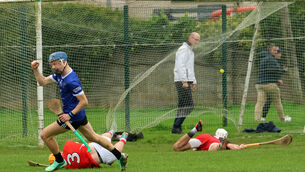
Limerick played Waterford on Saturday and the five throw balls Seán Stack called looked correct decisions, with most being committed by Limerick players. Picture: Stephen McCarthy/Sportsfile
“Due to the increased speed, many hand disposals are effected in the blink of an eye. Some are legal; many — to the naked eye — appear not to be. It's telling that commentators often refer to players ‘shoveling’ the ball. The elite level of the code is now on a slippery slide towards permitting the throw. It's a slide that will only be halted by decisive action. What in recent seasons had been an occasional event has this year become a regular occurrence.
“That players are aware they are being given licence has become clear. In keeping with the non-interventionist style of officiating of many years, overseen by successive regimes, evermore rope has been given to the rule-bender. The umpires appear to take the view that unless they are absolutely certain a handpass isn't legal, they should turn a blind eye.
“The point is that too much of today's handball — like the flick-pass — looks illegal. It appears, rightly or wrongly, that the ball is being thrown. And if it appears that way, throwing the ball may as well be allowed. But I doubt anyone who cares about the game really wants that, so there has to be stricter policing of handball.”
The words of highly-respected Australian Rules journalist Tim Lane about his beloved game in newspaper 10 years ago that could so easily be applied to hurling now where the supposed “clear striking action” has become anything but.
An act of desperation, or an urgency to ensure the safe passage of the sliotar, it most surely is a symptom of the possession game hurling is these days and likely more prominent because so many handpasses are taking place in matches.
In Limerick on Saturday, Seán Stack didn’t get everything right but the five throw balls he called looked correct decisions, although they infuriated the crowd as most of them were committed by Limerick players. Afterwards, John Kiely insisted he “didn’t contest any of those handpass calls tonight”. He mightn’t have remonstrated but after one second-half decision went against his side he certainly demonstrated to linesman Colm Lyons what his players were attempting to do in delivering an under-arm pass.
Kiely added that he knew how difficult it was to determine an illegal handpass as he refereed Limerick internal games and mentioned he would be reluctant to coach players to avoid it as they would then be more inclined to flick the ball via the hurley a la Michael “Brick” Walsh.
That’s a strong point Kiely makes; Limerick resorted to some of those types of transfers towards the end of the game having been pinged too many times. But Kiely doesn’t strike us as the type of referee who would whistle for such infringements. In fact, he seems to be more of the Brian Cody school of in-house officiating in that the whistle is there simply to start and finish the game.
The evolution of hurling has not been reflected by the rulebook. That much was admitted by sliotar workgroup chairman Ned Quinn earlier this year. On one hand, it’s not a problem. Nowhere in the GAA’s Official Guide is it mentioned the skilful practice of batting the ball to the ground and collecting it so as to hold onto the ball longer by starting a new possession. On the other, it is an issue. The size of the hurley bas is so often illegal and players are allowed to casually drop the ball and return it to hand to avoid being blown for overcarrying.
As much as the handpass too challenges the rulebook, solutions are thin on the ground. As we have mentioned before, Conor O’Donovan’s proposal that the hand-pass can only be committed by switching the sliotar from the holding hand to the other comes from the right place but is too awkward to be a workable solution.
And hopefully unnecessary if the likes of Stack, who to his credit has been extremely vigilant on such illegal movements, continue to stay on it. What he and his contemporaries are doing is cleaning up several years of referees giving too much benefit of the doubt. For that, there will be heat but the more accurate calls are made, the more managers’ ire will turn towards their players.
In his piece, Lane suggested: “If the umpire is in doubt, he should pay a free-kick. Forget about being shown to be wrong by the TV replay: The umpire can simply explain that the disposal was insufficiently clean to be passed.”
Clean is the operative word and much more appropriate than clear striking action in the GAA rulebook.
To do away with the handpass altogether would be a great pity when you consider it is a genuine skill as so expertly illustrated by the likes of DJ Carey and Noel McGrath. To allow the throw, even if it is an underhand pass, would be a submission. In the hands of referees, players’ sleight of hand can be curbed.
Foregone conclusions wouldn’t be unfair assessments of the games in Munster the weekend after next. Tipperary’s hurlers heading to Limerick the day before Cork are expected to host Kerry both have the look of Friesians heading to the abattoir.
At least Cork have won a battle, which should at least ensure the scoreboard at the final whistle isn’t as bad as it might have had the game been staged in Killarney – Tipperary, by May 22, could be on the back of their sixth straight championship defeat.
Although, Kerry aren’t exactly over the moon about the uncertainty surrounding the game and having to be the bigger people again. You got a sense of that in their statement last Friday morning. “Kerry County Board acknowledges the close relationship that exists between both Boards, the importance of protecting the integrity of the Munster Senior Football Championship and the priority now for the Team Management and Players to prepare for the game without further distraction,” it read.
Whether it was a case of hell hath no fury like a Kerry team returned to Cork, the stance taken by Cork’s camp underlined once again the potency of player power. Of course, their argument about the Munster Council moving the game to Fitzgerald Stadium for financial gain was a weak one bearing in mind how their own county board are using Páírc Uí Chaoimh this week but they should have been consulted before the switch was made. Had they been kept in the loop, a neutral venue could have been an option.
Getting the game back to Páirc Uí Rinn, knowing Kerry needed a game wherever it was staged, Cork played their hand well. It was a gamble but a calculated one and if their defiance is any indication Saturday week might not be as much of a landslide in favour of the defending champions.
But without Ian Maguire, with whispers about other injuries to key members of the group, the task is mountainous.
“Listen, in terms of the CAC (Central Appeals Committee), there’s a lot of questions to be answered because that whole appeals committee is an absolute farce, to be quite honest,” was Declan Bonner’s frank assessment of Armagh being able to bring Stefan Campbell and Aidan Nugent off the bench on Sunday.
Bonner probably wouldn’t have spoken his mind had Donegal been on the losing side but the CAC can’t be condemned for asking that a referee be thorough in their citing of a player. Bonner was hardly going to criticise Paddy Neilan as they might cross paths again but so much depends on the referee crossing their Is and dotting their Ts.
Donegal pair Neil McGee and Odhrán McFadden-Ferry won’t be lauded in the same way John Mullane was for taking their medicine and not contesting their one-game bans. Nevertheless, the decision not to query a referee’s judgement wouldn’t have hurt Donegal going into the game against Armagh.
It was the contention of Armagh greats Stevie McDonnell and Oisín McConville that Donegal had been Machiavellian if not by initiating the row at the end of the league game in Letterkenny then influencing the disciplinary process. Some of their comments were a bit of a stretch but spoke to the tensions between the counties in the build-up as Donegal were perceived as law-abiders and Armagh troublemakers.
But clearly they felt the need to try and tilt the narrative.
CONNECT WITH US TODAY



Be the first to know the latest news and updates