Armagh 2002: A team before their time
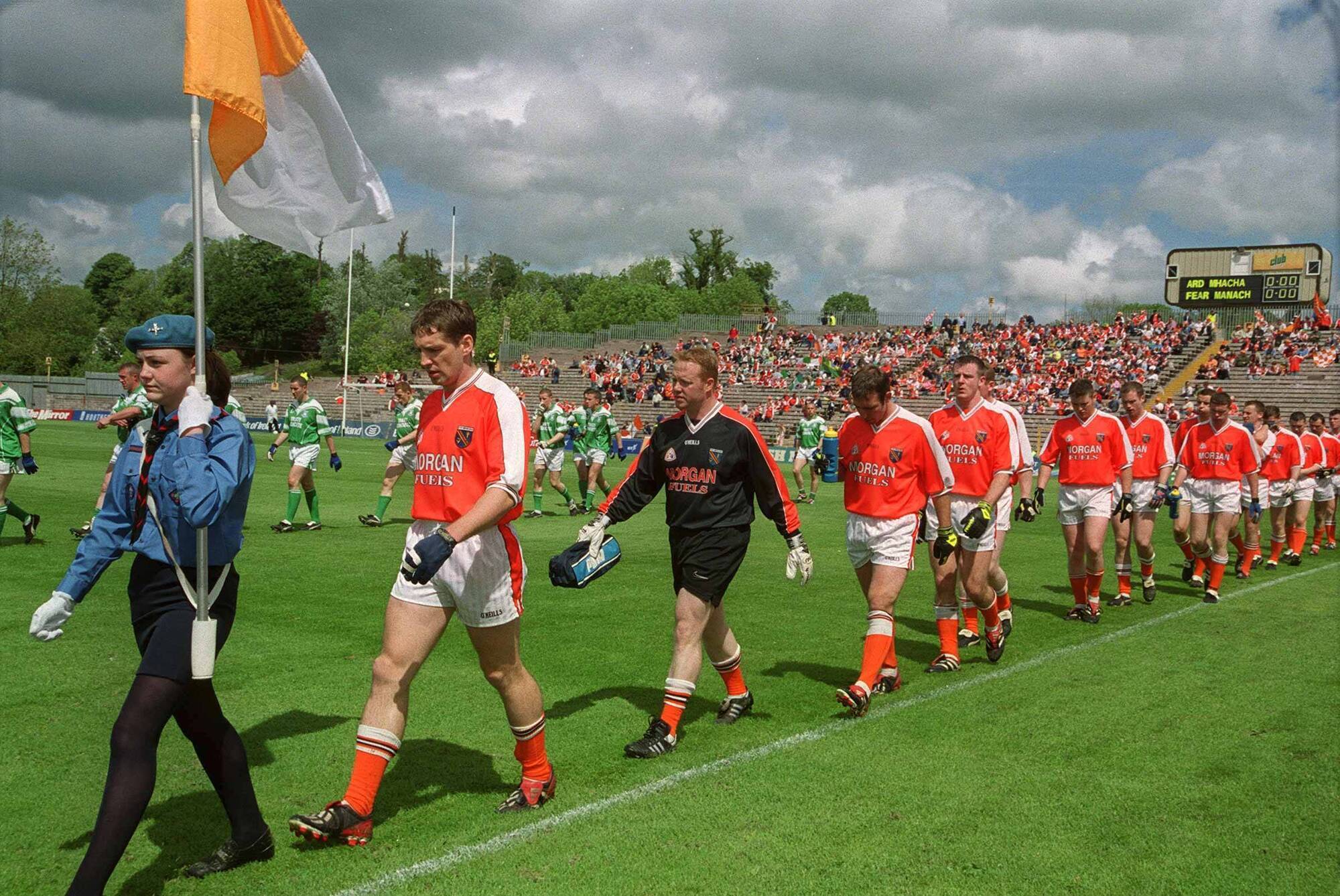
Armagh captain Kieran McGeeney leads his side in the pre match parade ahead of their 2002 Ulster SFC clash with Fermanagh at St Tiernach’s Park in Clones. Photo by Damien Eagers/Sportsfile
TWO decades, gone in the blink of an eye from when Joe Kernan stood on the Croke Park sideline with his hands clasped tight to his face in disbelief. Armagh had won their first All-Ireland, beating Kerry in the process.
If you find yourself idly wondering when exactly the game became, well, ‘the modern game’, the year 2002 is a handy signpost. In terms of preparation, how they went about their business, the lessons of leadership and management, raising of standards, there’s seldom been a crew quite like that Armagh team.
Yes, of course there’s the best-ever, in Dublin. They were unique. But in terms of sheer influence on teams thereafter, Armagh cast an enormous shadow.
No. They didn’t live up to a credo oft-repeated in their ranks that ‘it takes a good team to win an All-Ireland, a great one to retain it.’ And that still haunts many of them. But for sheer influence on the game, their legacy is intact.
It’s a rare thing indeed for any Irish team to speak openly about their admiration of a team of white-clad English sportsmen.
But for Armagh to openly discuss how they looked to the – gulp – English rugby team was something of a departure.
There were many links, however. The strength and conditioning expert John McCloskey would later go and work for Wasps as a coach for a spell and Jonny Wilkinson’s kicking coach, Dr Dave Alred would come to do some specific coaching on Oisin McConville’s free-taking.
Most of it however was down to how they liked how then-coach Clive Woodward articulated his message with buzz-phrases, such as the importance of what he termed the ‘critical non-essentials.’
A slight myth around Armagh was that they were the first to embrace the tight-fitting jerseys that made them appear huge. Up to 2003 they were wearing jerseys that looked borrowed from a big top.
In 2004 they emerged looking leaner and more powerful in a jersey that accentuated their torsos. That was the work of Billy Dixon, a motivational speaker from Bangor who advised politicians on how to dress for the job. Now, every player is sewn into their geansaí.
Look at the names of that 2002 team. Kieran McGeeney retired from playing after 2007 and has been in an intercounty set-up ever since, including the last seven seasons as Armagh manager. Alongside him in Armagh and Kildare he has had Aidan O’Rourke, John Toal, Paddy McKeever and Paul McGrane on the line.
Tony McEntee has managed Crossmaglen to All-Ireland titles and is the current Sligo manager. His brother John, along with Oisin McConville had a successful period as the Crossmaglen management. Stevie McDonnell has managed the county under-20s.
Justin McNulty has been manager of Laois, and his brother Enda has worked as a performance coach for, among others, the Irish Rugby team.
Others, such as Cathal O’Rourke with Queen’s and Diarmuid Marsden with his home club Clann na nGael, have been absorbed in coaching and management.
Nothing new here of course, but the sheer number and range of speakers is impressive.
When the two Brians of McAlinden and Canavan were in charge they held a ‘truth meeting’ when players had to say one thing positive and one thing negative about the man beside them. It went a bit askew when one player bluntly stated that his neighbour ‘just simply isn’t county standard,’ but that was typical of their brutal honesty.
Under Joe Kernan, Paul O’Connell, Mick O’Dwyer and Brian Cody came into their camp to chew things over.
Of course, we are not suggesting that Armagh were the first, and indeed Wexford were entirely open about the role Niamh Fitzpatrick played with them in 1996, even getting a namecheck as they lifted Liam MacCarthy.
But few teams were putting their legend out for all to see as Armagh were in their belief in sports psychology. Throughout their golden period they had Des Jennings – currently with the Down hurlers, and Hugh Campbell involved. Campbell remained with McGeeney throughout his spell at Kildare and is in the present Armagh set-up.
Nowadays, weeks out from a crucial game, players will have clips of opposition danger men that they will have to look after in a game. That kind of approach was in its’ infancy at the turn of the century, but Kernan would bring his players through video sessions where they would break down a team in greater detail.
While manager of Crossmaglen, Kernan began a tradition where they would do all of this on a whiteboard, before rubbing out all the text. Once he went into the Armagh job, they drilled down deeper into their approach play and major players, noting any dummies or habits they all had.
On the training ground, they were front runners in designating people towards particular role.
Their strength and conditioning coach Julie Davis would lead the early warm-up and activation work.
That would be followed by John McCloskey to take the team through more intense warm up and aerobic work, before they would be handed over to Joe Kernan and Paul Grimley to do the football drills and coaching.
Nowadays in intercounty football, the kickout is their greatest weapon or asset, depending on how they are fixed with their goalkeeper.
Dublin with Stephen Cluxton may have perfected it, to the extent that when Jim McGuinness got out the pads and pens to decipher his kickout pattern in 2014 he simply could not identify any repetitive traits or systems.
But Armagh put huge work into it. With Benny Tierney, he hadn’t the biggest kickout in the world, so they created pockets of space for the half-back line to receive the ball running towards the opposition goal.
When he had possession of the ball in open play, Tierney had to kick pass to his wing back rather than handpass to his corner backs – on threat of losing his place on the team.
Once Paul Hearty succeeded him for the 2003 season, his booming kickout found favour among the big bodies and fielders strung in a line across the middle.
Another trait and habit that was formed on the rugby fields.
When Armagh decided they would go a bit more raw than the comforts and climate of La Manga ahead of the 2003 season, it was to the spartan conditions of Bath Rugby they arrived.
Once there, they were given a hard time of it by the irrepressible Shaun Edwards, a student of all sports who was particularly interested in how to develop the tackle in Gaelic football. Around that time in various interviews, Armagh players were given to complain about how a certain level of aggression was not permitted in the tackle.
Naturally, that played into their favour as a team that hit hard and left plenty on opponents.
Edwards delivered his theory that much like Rugby, the first tackler should serve as a battering ram to hold an opponent up, while another could arrive on the scene to strip the ball.
He advised the players to tape their wrists to help their wrist strength. As the years went on, more and more dispensed with the taping, leading Oisin McConville to comment in his autobiography that he felt it was symptomatic of falling standards in professionalism.
Back in 1991, Kieran McGeeney arrived in Queen’s University to an engineering faculty. Already there were the likes of Cathal O’Rourke and Paul Brewster, but the man they all gravitated towards was a Derry lad who had returned from a spell playing Aussie Rules with Melbourne Demons.
It didn’t take long to seek out Anthony Tohill away from the classroom. He could be found in the gym, continuing on the athletic progression he had learned from his coaches in the AFL. Soon, the spine of the Queen’s team that won the Sigerson Cup in 1993 were all confirmed gym bunnies.
In time, it would become accepted practise, but what set Armagh apart was that while other teams would try a little weight training in the winter and then finish it by March, losing all their gains, they would make it a year-round effort. Not everyone was a gym rat, but players on the team estimate there was around a 90% buy-in – miles ahead of others around that period.
As a group who prized the famous Al Pacino ‘Inches’ speech from Any Given Sunday, Armagh were willing to do whatever it took, no matter how new age.
While the likes of Stevie McDonnell and Oisin McConville would still slip away to a quiet corner of the hotel to enjoy their morning fry, diet and hydration became a huge thing among the wider panel. McGeeney even brought up one time that he was spending a daily total of €30 on fruit.
They were early pioneers of core stability, introduced to them by a physio who had seen it in action during a secondment to Australia, and they were dedicated to their pool sessions and other means of recovery.
Read our exclusive 32 page GAA Championship supplement in Saturday's Irish Examiner. Featuring expert analysis from Anthony Daly, Éamonn Fitzmaurice, Derek McGrath, Liam Sheedy, Eoin Cadogan, and Gary Brennan.


CONNECT WITH US TODAY



Be the first to know the latest news and updates