Gary Brennan: Second-week syndrome in Division 2 can scupper plans
While the footballers of Galway, Clare, Derry, and Roscommon may appear to be sitting pretty recent history would suggest they had better be on high alert this weekend
Gary Brennan: Second-week syndrome in Division 2 can scupper plans

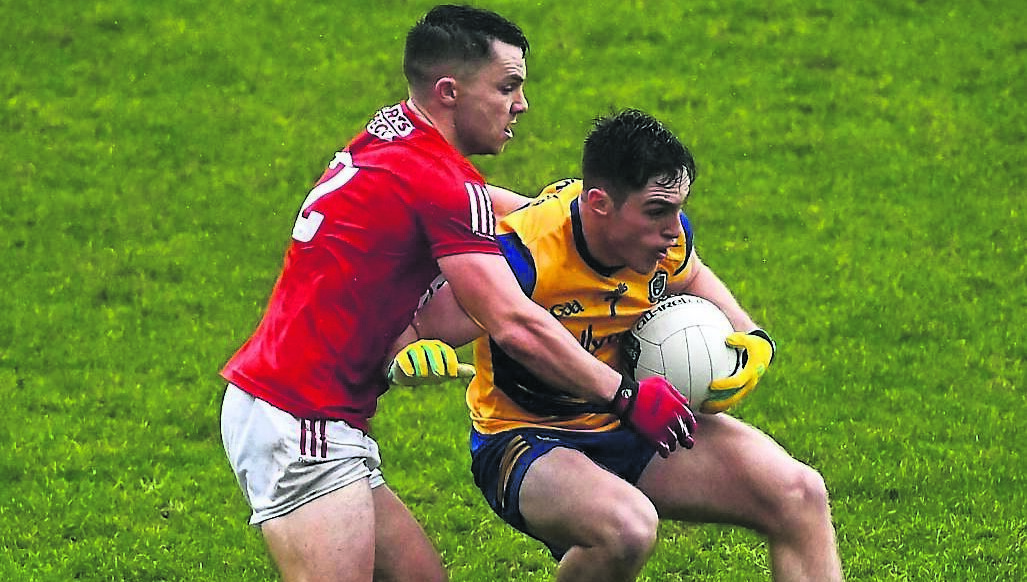
Cork’s Sean Powter battles to win the ball from Roscommon’s Richard Hughes in their Allianz Football League Division 2 opener at Dr Hyde Park last weekend. Picture: David Fitzgerald/Sportsfile

If there is a particular trait managers seek more than any other in their teams, it is consistency.

Consistency of effort, consistency of performance and, as much as is within their control, consistency of results.

I suspect there are few sporting competitions which challenge the ability to attain that consistency as much as Division 2 of the Allianz NFL. While the footballers of Galway, Clare, Derry, and Roscommon may appear to be sitting pretty after last week’s round recent history would suggest they had better be on high alert this weekend.

When the seven-round structure was last played in 2020, all four teams who opened with a win found themselves on the losing side second time out. Winning back-to-back is always a challenge, but it seems to be especially difficult across the opening two games.

In my time playing with Clare in Division 2, only Donegal (2019) and Kildare (2017) managed to achieve that feat, and notably, both went on to achieve promotion. Four points after two games is not essential, but obviously it’s where you want to be. And so, teams who got that much-sought-after opening day win will have been doing everything in their power this week to try and add to it.

But there are challenges to doing so.

Firstly, players will have had the date of that opening round game firmly in their minds from the moment pre-season training began. Switching focus immediately can be difficult, especially if that opening win leads to heightened expectations. Clare players, for example, will have been getting plenty of pats on the back as they went about their business this week, supporters getting excited about potential prospects.

While I’m not a great follower of social media, I do know that there was more online talk than usual about Clare, something many players struggle to avoid. While that good performance against Offaly is to be enjoyed, every minute players spent savouring it is a minute less spent thinking about what’s in store this evening in Páirc Uí Chaoimh. Colm Collins will have reviewed the game early in the week, turned attention immediately to Cork, and reminded his players that those same pats on the back are only six inches from a kick in the backside. So if a player doesn’t seem interested in an in-depth conversation about the game just gone, don’t take it personally!

Another potential issue is that the formula used to win last weekend has now been scrutinised by the opposition. Throw-in routines, kickout preferences, sources of scores, and individual player habits will have been scrutinised by opposition analysts. Management teams will be showing their players video of what powered their victory, and some will use it to tailor their training to nullify those threats.

On the flip side, the winning team may be facing a completely different challenge than the previous week. Our style of play afforded us opportunities against many teams, but we always struggled to break down Fermanagh, for example, and one week of preparation may not be enough to rectify that.

There is, of course, also a physical challenge. The conditioning of the players will influence their ability to repeat the physical exertion. That’s not something that will change this week, however. Many players will have covered upwards of 10km last Sunday, a considerable amount of it at high speed with demanding changes of direction, and their engagement with recovery from the moment the final whistle blew will have a major impact on their capacity to train midweek and achieve peak performance tonight.

Compression garments, cold-water immersion, cryotherapy, and the likes may play a role, but nutrition and sleep (or “nature’s healer” as Dr Liam Hennessy of Setanta College once described it to me) are likely to have the greatest impact. Will players have been as regimental about their sleep in preparation for week two?

There is disruption to a player’s pre-match routine if the second game is away. Management will try to keep things as stable as possible but even small changes in pre-match meal options or time on the pitch before a game can be very uncomfortable for some. The latter is certainly one we witnessed with many visiting teams to Cusack Park, who were not expecting to have such little time as was allowed on the pitch to warm up. We were accustomed to it and it factored into our preparation.

If playing against a team who’ve lost in the first round — as all four winning teams are this weekend — you can likely expect a backlash as teams know a second defeat will push them closer to the trap door. And aside from all these hurdles, there is also the potential impact of injuries, illness, and maybe suspensions which could affect player availability, not to mention involvement in third-level competitions or what may be happening in players’ personal lives.

Of course, the truth is that the best teams find a way to handle all of this, achieve the consistency desired, and separate themselves from the pack. Maybe these teams simply have the most talented players but it’s rarely as simple as that. Dublin, in their pomp, or Limerick hurlers at present don’t attain such levels of consistency through talent alone.

Legendary NBA coach Phil Jackson, in his book Eleven Rings, described the key to sustained success as continuing to grow as a team. The most consistent teams will have successfully created a culture where constant improvement is the focus. Last week’s performance will not suffice. They will be challenging one another to be better this week, competing against themselves and their own standard of performance.

Targets for tackle count, turnovers, scoring efficiency, and kickout percentages will be the focus, with the aim of improving squad depth, empowering players to take responsibility, and, ironically, taking the focus away from the result.

Of course, teams who consistently win aren’t always better from one week to the next, but an approach such as this makes it more likely their off day will still yield results. If I have one regret from my playing days, it is that I didn’t handle these weeks after a win better. After a good performance I placed huge pressure on myself to replicate it, almost as if I was going to be exposed if I didn’t. When I look back now, it was fixed thinking, and it is only as I learned to develop a growth mindset that I was able to stay in the moment and enjoy the process.

So, this weekend, four teams who won in the first round face away games against teams who opened with a defeat. Pádraic Joyce, Colm Collins, Rory Gallagher, and Anthony Cunningham will be hoping their team environment trumps the many potential pitfalls and they can show the consistency required to reach the top tier. It should be noted that the three-round league last year included wins in rounds 1 and 2 for Mayo and Clare. This weekend will tell if that is the beginning of a new trend or an outlier.

The only certainty is that Division 2 will provide plenty of twists and unreliable formlines in the weeks ahead.

More in this section

Cookie Policy Privacy Policy Brand Safety FAQ Help Contact Us Terms and Conditions

© Examiner Echo Group Limited