Midleton hoping to rediscover a golden age in Cork Premier SHC final
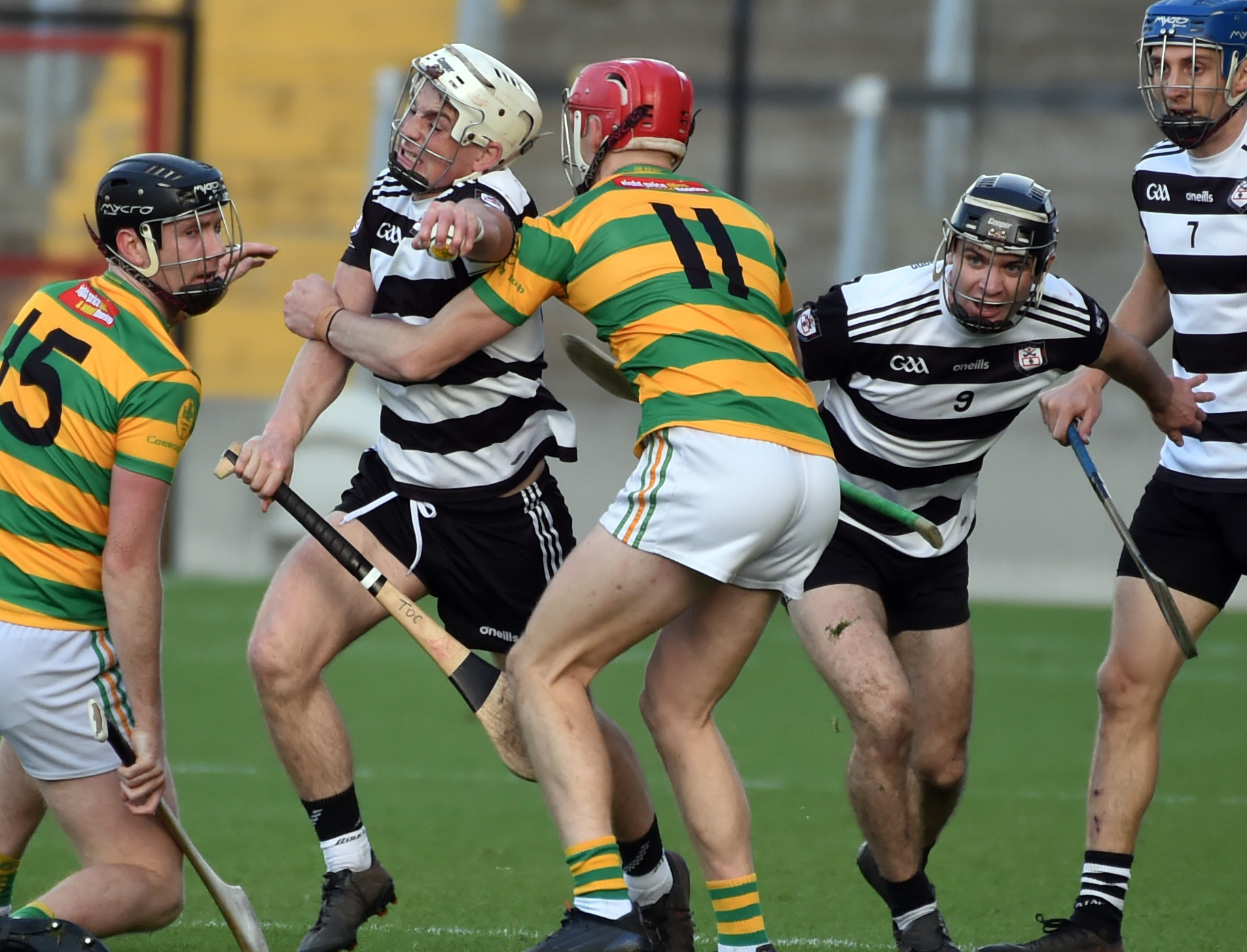
Midleton's Tommy O'Connell tackled by Blackrock's Mark O'Keeffe and Alan Connolly during the Co-Op Superstores Cork Premier SHC semi-final at Páirc Uí Chaoimh. Picture: Eddie O'Hare
Last Saturday morning, as the Midleton players were coming off the field after training, they were given a guard of honour by around 40 U8 players, and their mentors, who were waiting to go on for their session. It was completely unplanned and unscripted, but the spontaneity of the action reflected the gripping excitement and anticipation in the club which has percolated from the top to the very bottom.
It also showcased how much this team has connected with all strands of the club. A couple of weeks back, some of the Midleton players spoke to the U15 squad before they travelled to the Féile na nGael tournament in Tipperary to represent Cork, subtly helping to grease the transition from one generation to the next.
Midleton have always had a rich conveyor belt of talent, especially over the last decade, but transferring that quality into senior success has been a struggle. One county title in 30 years is even more of a disappointment considering that solitary title, in 2013, was expected to be a launchpad for far greater Midleton success.
“It is disappointing that the 2013 team didn’t drive on,” says John Fenton, former Cork and Midleton player. “We had also won the U21 title the same year. That was our seventh senior title in 2013. I honestly thought that the team would have taken us to 10 within the next few years. That was a bigger disappointment to me that not winning more in the previous decades.”
Fenton won four of the club’s seven titles, along with two Munster titles and one All-Ireland club, but his generation did more than just alter the club’s history — they routed all convention and completely altered the tone of Cork hurling.
Despite being renowned as a hurling heartland, only eight titles came to the East Cork division in the first 96 years of the senior championship. East Cork clubs had regularly reached county finals, but they just couldn’t break the dominance of the three city clubs — Blackrock, St Finbarr’s, and Glen Rovers.
In the previous 50 years, only two clubs, Sarsfields and UCC, and one divisional outfit, Avondhu, had managed to break that stranglehold. Yet When Midleton finally smashed it in 1983, they effectively demolished that powerbase and ignited a huge culture change in the process.
Midleton’s success showed everyone else what could be achieved with hard work and belief. Na Piarsaigh won their first county title in 1990. Erin’s Own secured their maiden title two years later. Divisional outfits Carbery and Imokilly secured first county titles in 1994 and 1996 respectively, with Imokilly retaining their title in 1997.
What was also obvious after that Imokilly success was that when teams arrived and won a county title after a hiatus, or after making a breakthrough as Newtownshandrum had in 2000, they tended to stay around for a few years.
Blackrock bridged a 14-year gap in 1999 and then won three titles in four years. After Newtown arrived and blazed a path, Erin’s Own came with a new generation of players and won two in a row in 2006 and 2007. Then Sars became the dominant force with four titles in seven seasons. Glen Rovers finally ended two decades of pain to secure two in-a-row in 2015 and 2016 and have now reached six of the last eight finals. After Imokilly ended a 20-year wait in 2017, they went on to dominate the championship winning three in a row.
Midleton would have hoped to follow a similar path, especially when such a young and talented team looked set to herald another golden era. But they veered off course after 2013 and have been looking to get back on track ever since. “We are hopeful now,” says Fenton. “This is a good team. If we maintain our standards from the last two games, we’re in with a right chance on Sunday.”
It’s 30 years now since Midleton last met the Glen in the final, which Midleton won by nine points.
Midleton won their four championship games in that 1991 season by an aggregate margin of 49 points but the natural life cycle of that team was coming to a close. Midleton reached another final in 1994, which they lost to Carbery, and didn’t return to another final again for 19 years.
“I always felt that there were a couple of reasons,” says Fenton. “Number one, we took our eye off the ball at underage level for a few years. Number two, we had such incredible underage success at other times that by the time a lot of those underage players got to under 21, they had won everything.
“The motivation wasn’t there for them. I won my first medal with Midleton at Intermediate. I won nothing at underage. A lot of our players were the same. We had a tremendous hunger that a lot of teams which came after us never had.”
Fenton had lived through the tough times. In 1977, Midleton lost to Inniscarra in the intermediate championship by five goals. At that year’s AGM, the club were just one vote away from deciding to regrade to junior hurling. The following year though, Midleton beat Newtownshandrum in the intermediate final with a team with an average age of just 19. “We took it from there and built on it year by year,” says Fenton.
Between 1979-’82, Midleton reached four successive county semi-finals against the Barrs and narrowly lost each one. When they met the Barrs again in the 1983 county final, they were ready. “We had served our apprenticeship,” says Fenton.
Seven of that Midleton team were on the Cork panel the following year when Cork won the 1984 All-Ireland. Their impact on that success, and on Cork hurling over the next decade, was massive because Midleton radically changed the narrative and dynamic around the Cork senior squad.
“The Midleton players brought a vibrancy to the panel that kept the city players on their toes,” wrote Justin McCarthy in his autobiography . “Ger Cunningham once said to me: ‘Justin, this crowd seem to be taking over. Is it going to be all Midleton on this team?’ My answer was that if there were 15 Midleton players good enough, I’d have them all playing for Cork.”
Such a huge representation on Cork teams was unheard off outside the big three. Midleton did have five players on the Cork minor team in the mid-1930s, but that was a complete anomaly because Midleton historically had limited representation on Cork teams.
Willie Campbell played a huge part in the Cork four-in-a-row team of the 1940s, while Gerald Murphy was midfield on the Cork three in-a-row team of the 1950s. Paddy Fitzgerald made 21 championship appearances with Cork between 1958-1968. Fenton played in the late 1970s, but he was joined on the Cork squad in the 1980s by a raft of his clubmates which had transformed Midleton into a machine.
“We had a talented group but we were fierce committed as well,” says Fenton. “There was a real maturity there. Lads had a tremendous discipline and work-ethic. We just focused on ourselves. We didn’t worry about anyone else because we were only interested in trying to fulfil what we knew we could achieve. We were moving mountains long before we knew we ever could.”
Thirty years on from beating the Glen in a county final, and eight years on from their last title, Midleton have scaled all peaks before them in their ascent up the mountain. The summit is in sight now, but it will take one last almighty push to get Midleton back to where they feel they belong.
CONNECT WITH US TODAY



Be the first to know the latest news and updates