Better by design: The second coming of James Horan as Mayo manager
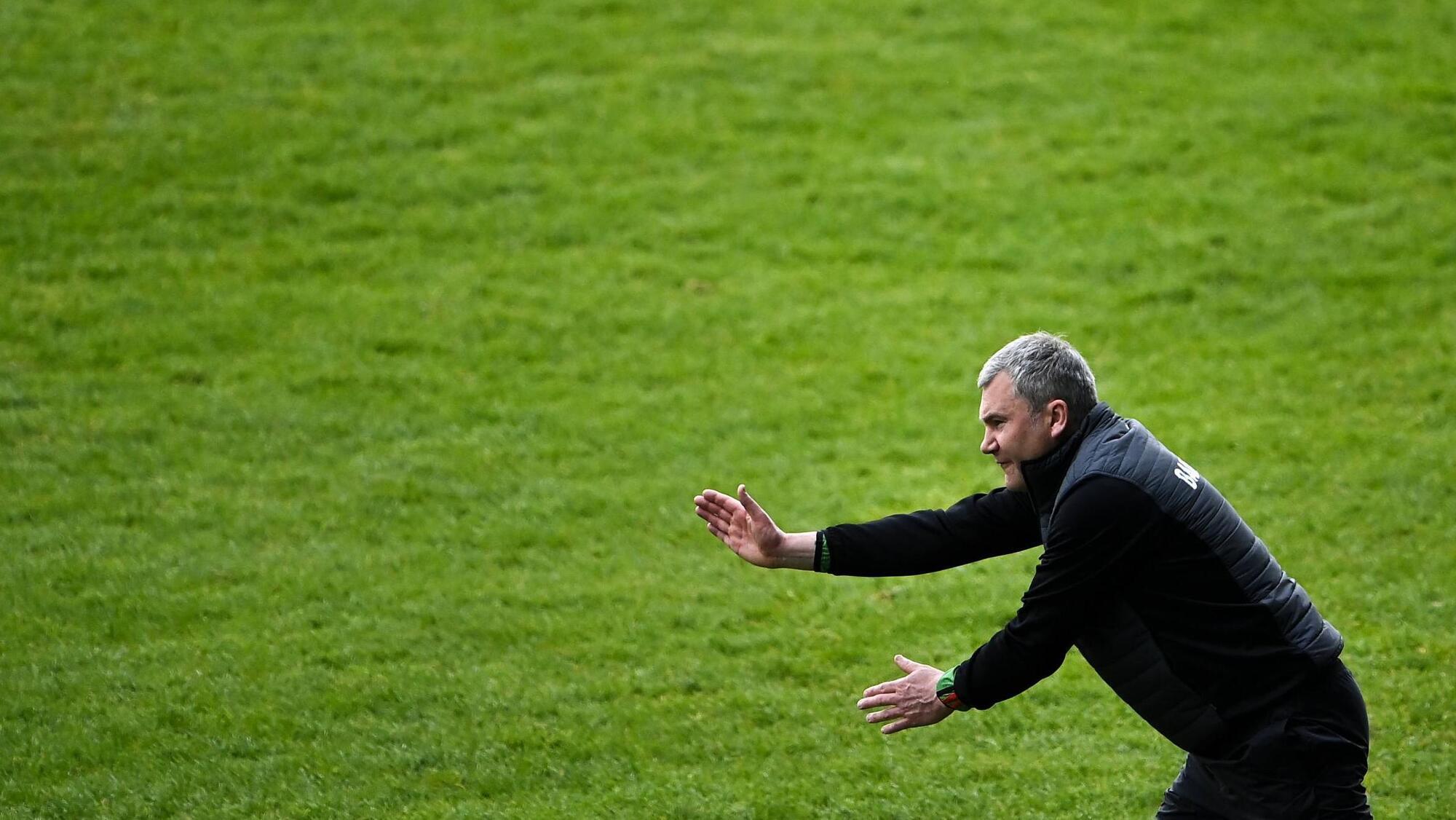
Back when James Horan and Mayo started out on their All-Ireland odyssey a decade ago, they took a leaf out of Tyrone’s book — or at least Mickey Harte’s — on how they had gone about kicking down heaven’s door.
In Harte’s diary of the ground-breaking 2003 season, he mentioned how he took some inspiration and guidance from the words of George Zalucki, a former dean of psychology who had branched into the field of motivational speaking. Some of Horan’s backroom delved further into his work and a few of Zalucki’s nuggets were circulated in audio form to the players to become central tenets of the team’s culture and philosophy.
“Persistence is awesome.”
“Commitment is doing the thing you said you would do long after the mood you said it in has left you.”
And above all ...
“The better you get, the better IT gets.”
And it did. Keith Higgins has admitted that for all his talent his career was meandering aimlessly until he encountered and embraced Horan’s high-performance setup and duly won three consecutive All-Stars.
Over Horan’s first four years Mayo won as many All-Stars – 12 – as they had in the 16 years prior to his appointment. They reached the All Ireland semi-final every year, contesting two finals. The better they each got, the better it got for each and all of them.
But obviously, they needed to get even better to win IT.
Horan would have been conscious that such a truism would have to extend to him, all the more so were he to return for a second stint.
He’d long been a student of the work and words of leading sports coaches — from Bill Walsh to Bill Belichick to Clive Woodward — and collaborated closely with sport psychology consultants in the past, including this writer both with Mayo and previously in helping his native club Ballintubber win their first county title the same year it celebrated its centenary.
Ahead of his second coming he went even deeper.
He continued to be a regular if unobtrusive attendee on the coaching conference circuit; when Jim Gavin during his keynote address at Sport Ireland’s 2017 HPX high-performance conference noted with a smile that there were “competitors” in the audience, he’d have flashed it in the direction of Horan.
He shadowed several leading coaching practitioners for days at a time, such as Leinster’s Stuart Lancaster. He availed of the advice and mentoring of Liam Moggan, the country’s outstanding coach to the coaches from his work as Coaching Ireland’s lead coach education officer, and even had him do some work to upskill his young coaching staff when he did return to the Mayo job.
And even more so he committed to upskilling as a coach himself by signing up to do a masters in personal and management coaching at UCC (the final year of it overlapped with his first season back over Mayo but he managed to complete it, commitment being the thing you said you would do).
“The coaching journey is a bit of a self-discovery,” Horan would write in an article he contributed to for a supplement that appeared in this paper in conjunction with UCC’s Adult Continuing Education department. “You learn an awful lot about yourself as a person.
“I needed a bit of coaching around the thinking patterns and biases that people have… And [the course] helped you recognise the flawed thinking patterns that you have yourself — once you recognise that, you can do something about it.”
As well as involving a 12,000-word thesis and 50 hours of practical coaching experience, the course included many modules such as rapport and relationship-building, narrative coaching, person-centred coaching, psychodynamic coaching and cognitive behavioural coaching.
“You might initially have the solutions in your head as a coach and 10 things you want to say to guide them but coaching is very much about just asking the questions to help the person come to the realisation.
There were other subtle but significant differences between Horan Mark One and Horan Mark Two. Outside of his medical and analysis team, most of his key management collaborators in his first stint came from outside Mayo, a trend which Stephen Rochford continued by having big-name proven operators like Tony McEntee as well as Donie Buckley on his coaching ticket. The second time around, he went for an almost all-Mayo lineup.
And perhaps the most surprising aspect of that was that it didn’t feature his still great friend and confidant, Tom Prendergast, a vital and steady presence and his defacto right-hand man during his first tenure with Mayo and in Ballintubber’s breakthrough. He didn’t just want this setup to be different; he wanted his players to see that it as well as he was different.
Possibly the most vital member in his new-look coaching staff was James Burke who had fleetingly played for Horan in 2011 and 2013. Initially Burke was supposed to just take the team’s Dublin-based hub for midweek sessions but they were of such quality he was promptly promoted to taking collective sessions in Castlebar. As someone who had played for Ballymun Kickhams all through the past decade, Burke had studied how Dublin had edged Mayo and dominated everyone else, and trained under top coaches such as Ken Robinson (Mick Bohan’s former right-hand man with the four-in-a-row Dublin ladies side and now coach to the Westmeath men’s senior team), Paul Curran, and Brendan Hackett.
After the 2019 semi-final defeat to Dublin, a couple of other former players with vital institutional knowledge were brought back wearing different caps. That offseason Evan Regan would have received either one or two calls from Horan: you’re being let go off the playing panel; with your career qualifications, we’d like you on board as our team nutritionist.
Ger Cafferkey’s role description as values and behaviours coach has triggered a few scoffs from the traditionalists who similarly might find difficulty that Tom Parsons’ day job until recently was as a culture manager for the European division of a Fortune 500 company. The world is different than it was and so are young men and Cafferkey, from his own training and lifestyle and time management skills, as well as his huge engagement and experience with previous Mayo team sport psychologists, has been a vital mentor to any young players coming through and instilling and retaining the ‘The better you get the better it gets’ ethos.
A couple of other old colleagues and charges of Horan’s would also have helped with that transition. In the latter years of Mike Solan’s tenure as U21-20 manager, he’d have co-opted his Ballaghaderreen clubmate Andy Moran as well as Mickey Conroy onto his coaching staff.
It would be too reductive to say Mayo only won the one All-Ireland and the two Connacht titles during Solan’s six-year spell. They possibly would have won the 2018 All- Ireland final had Oisín Mullin not broken his collarbone after the demolition of Roscommon in the Connacht final and been available to mark Kildare’s dangerman Jimmy Hyland in Croke Park. They could well have won it in 2020 too if Mullin hadn’t missed a penalty after extra-time in the first-round Connacht championship game against eventual All Ireland champions Galway. At all times but especially upon Moran joining the ticket in 2020 their greatest priority was to produce players ready to go straight away into the senior panel. Mullin was the perfect example. No one now talks about that missed penalty against Galway because he’d end that year as an All-Star and Young Player of the Year after his exploits with the seniors.
He was always going to be a player Horan would love, a mix of Keith Higgins’ dynamism combined with Lee Keegan’s strength and temperament. Back in his days with Ballinrobe CS, he was called aside by team manager Damien Egan at the last training session before the Connacht final. Their opponents had a standout two-year Galway minor and Egan had prepared a considerable video analysis and scouting report of that players’ tendencies to show Mullin upon telling him he had been assigned to mark that player.
But once Egan told Mullin that he was marking that standout player, Mullin just smiled, “Grand job” and breezily continued heading to the dressing room. He didn’t want or need any video analysis. He had it. And sure enough the next day he held that player scoreless from play while scoring himself and eventually leading his school to an All-Ireland title.
Eoghan McLoughlin would be similarly athletic and confident if somewhat more abrasive. A former underage international cyclist, one night with the U20s he told the team’s S&C coach Sean Boyle ahead of a 1km time-trial run to signal when there were two laps left. Boyle ended up only alerting him when there was just a lap to go, prompting McLoughlin to take off and lap half the panel – and then lambast Boyle for not alerting him earlier, that there was plenty more in him!
It is a testament to Horan’s management that McLoughlin has hugely tidied up his skills — especially his solo-run — since the Westport man’s U20 days, but it cannot be underestimated how much someone like a Boyle has been in his athletic development and that of his contemporaries.
For a decade now Mayo have been constantly one of the top three teams in the country in no small part because they have always had a podium-level strength and conditioning programme and lead coach. It’s been regularly mentioned in the past, by the likes of Higgins and many more, how Horan’s recruitment of Dr Ed Coughlan in the autumn of 2010 was a quantum leap in how Mayo teams prepared.
In the autumn of 2014 Coughlan was succeeded by Barry Solan, now lead S&C with the Arsenal first-team. Because Solan was based in London, he delegated a lot of his duties to his Claremorris-based wingman and old housemate Conor Finn who then assumed the head S&C role upon Horan’s reappointment.
Finn runs a gym called AXSOM Sports where among his staff are Boyle and Martin Connor, who have also extensively been lead S&C coaches over Mayo U20 and minor squads. That means there is a level of continuity and collaboration there that few other counties have, helping bring through a Mullin and McLoughlin so they can become the new Keegan and Vaughan and Boyle.
It’s allowed Horan to fashion a team similar to his first, only he’s been possibly even more daring in championing and promoting youth. And possibly his boldest move of all was to co-opt Ciarán MacDonald onto his coaching team in early 2020, a hint that he is even more open more to left-of-centre thinking than he previously was.
He has almost all angles covered — the team even avail of drones to review every session.
There’s also another key difference between Horan Mark One and Mark Two. In his first stint he was one of only two managers over the previous 30 years to bring a team to an All-Ireland final that hadn’t already served as an underage county manager, or served as at least as a selector with a senior inter-county team or won a club All-Ireland or Sigerson Cup: Pat Gilroy was the other exception, and Gilroy compensated for such lack of experience by having Mickey Whelan as his right-hand man. It was levelled at Horan — including by some of players if Pat Holmes and Noel Connelly’s incendiary 2017 interview is to believed — that he could have been better on the line in his first stint, probably stemming from the fact that he’d only been coaching four years before he landed the Mayo job.
But now he appears to tick the profile of an All-Ireland-winning manager. He has previous experience of being a selector or more of a senior inter-county team, to go with his time with Westport in 2018. He would have been a close observer and student of the game’s tactical evolution during his time as an analyst with and and from 2015 to 2018. If the Dublin semi-final is anything to go by, he now sees things quicker and sharper and better than he even did in his first stint when he presided over some huge wins. Tyrone will be the ultimate test of that but he seems ready to answer it.
This might not be the best single-season Horan or Mayo team of the past decade: in fact there’s a case it’s only definitively superior to the sides of 2011, 2018, 2019, and 2020.
But it seems as if he’s never been better. That he’s got even better.
And as he’d preach over a decade ago, the better you get, the better chance you have of getting IT.


CONNECT WITH US TODAY



Be the first to know the latest news and updates