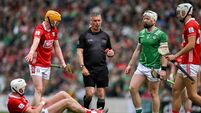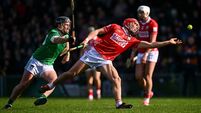
At the Cork-Kilkenny All-Ireland final recently, one spectator in particular put down an anxious hour watching one of the Cork defenders.
They’re not related by blood, but they share something else. Robert Downey’s performance at full-back for Cork resonated deeply with the spectator because in the 1970s he was the Glen Rovers man manning the square for Cork.
Four decades in California are audible in Martin O’Doherty’s voice.
So is the desire to see a clubman do well on the big stage.
“I knew Robert was playing, but then I saw ‘full back, Glen Rovers’ on the team sheet . . . I made sure to keep an eye out for him.
“The full-back line was at the opposite end to us for half the game, obviously, and it’s hard to pick out what’s going on. I’d see a bunch of them around the ball and then Downey would come out with the ball. I’d be wondering how he won it.”
O’Doherty emerged at the start of the 70s as one of the Cork players decorated with practically every medal in the game.
At 19, he made his senior hurling championship debut for Cork against Limerick — “Someone cried off in the dressing room” — and still remembers a reporter’s verdict (“O’Doherty started like he owned the place and ended like he didn’t belong there”).
“I was thrown in at the deep end,” he says now.
“A rookie. Eamon Cregan and Eamon Grimes tested me out.
“A couple of years later we played Limerick again and I wasn’t 19 anymore. I tested them out that day.”
In those days Cork and Limerick met in Munster, not All-Ireland finals. O’Doherty often picked up Joe McKenna in those games, a powerful presence on the edge of the square.
“In one of those games I was doing well, it was one of my better games for Cork, but in the second half they put McKenna out centre-forward and brought a smaller, faster player into full-forward — it might have been Ollie O’Connor.
“Now, a small fast guy was not what I wanted at all.”
O’Doherty thought about following McKenna out the field, and looked around to find a Cork selector for permission to move.
“Ring was passing behind the goal and I saw him: ‘Christy, will I follow him out?’ There was a pause for a second and Ring said, ‘Do whatever you want,’ and he carried on going.”
The Cloyneman was a strong influence on Cork’s three-in-a-row success. O’Doherty says Ring was the supreme psychologist in the dressing room:
“When I was captain I might have said one or two words before we went out, but Ring was the master of the speech before the game.
“Because of who he was, the icon of the game, and because we had him in our dressing room . . . that was the power he had, with the Glen and with Cork. That was huge.
“He wasn’t a guy who took paper out of his pocket to read out. It was organic. And of course, people listened to him. We had good men in the dressing room, but with respect to them, none of them were Christy Ring.
“In training, he’d come and maybe have a few words with you, but the dressing room was the place where he was the best.
“We played Wexford in one All-Ireland and he told us the referee would leave them run 10 steps with the ball — so we could do the same.
“He saw those things and conveyed that, but I’d say the biggest advantage was just having him: we thought about other teams, ‘they don’t have him in their dressing room, but we have him in ours’.”
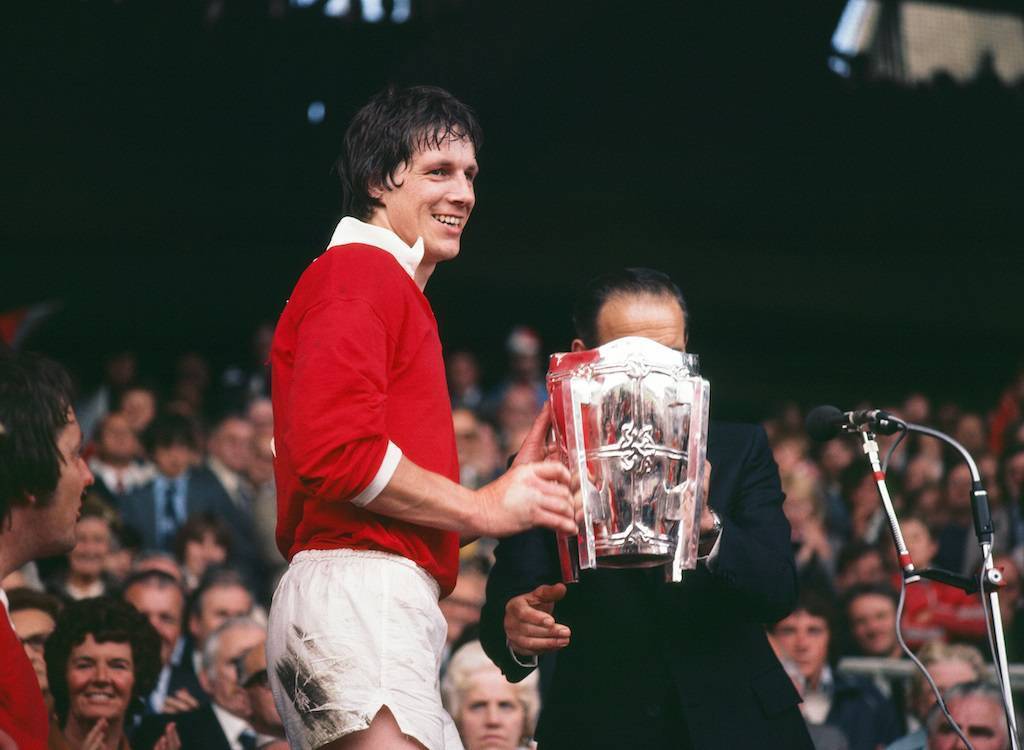
In 1977, O’Doherty climbed the steps of the Hogan Stand and collected the Liam MacCarthy Cup as Cork captain. The cliche is that it was the fulfilment of a childhood dream, but O’Doherty can go further: “This sounds like nonsense, but it’s true — when I was a child I saw a Tipperary player lift the Liam MacCarthy, Mick Murphy, and that was engraved in my mind as the ultimate.
“It never left me. I saw plenty more captains lift it over the years and I didn’t keep track of who they all were, but I remembered him. Tipperary were the dominant team of the day, and that stuck.
“A whole lot of other things had to happen, the Glen had to win the county in 1976 for one of us had to captain Cork, and we’d been hammered in the county final in 1975, but we got back and won it, and I ended up captaining Cork for 1977.
When we won... it makes up for all the pain along the way. And there’s plenty of pain along the way.”
That brisk summary omits, however, the birth of modern full-back play. O’Doherty’s experiences in those consecutive club finals revolutionised life for those wearing the number three jersey.
“Before the 1975 county final I got a lot of advice from some of the older fellas in the club about how to handle Ray Cummins, and a lot of it had to do with putting him, or his hand, out into the river. Which wasn’t helpful at all, because Ray was such a good player.
“Blackrock were very good the same day, and they beat us well.”
Towards the end of the game O’Doherty decided to try a different tack.
“Ray went up for a ball but I went up over him and fielded the ball and came out with it. I didn’t think any more of it. The game ended and the Rockies won.”
When the Glen qualified for the following year’s final they trained in the Mardyke to prepare for the wide open spaces of the new Páirc Uí Chaoimh.
At the last session before the final the legendary Donie O’Donovan, fresh from coaching Cork to the All-Ireland football title of 1973 but now back to help Glen Rovers, fell into step with O’Doherty.
‘How do you think you’ll handle Cummins on Sunday?’ he asked.
‘Donie, I’ll tell you what I’m going to do on Sunday,’ said O’Doherty, ‘I’m going up with my hand for every ball.’
On the day of the county final O’Doherty was again visited by a string of former players in the dressing room and given the same advice he’d received the previous year.
This time, however, as the players walked out O’Donovan motioned to him: ‘Martin, don’t listen to any of that. You do what you said you were going to do at training.’
The Glen won. O’Doherty became captain. Full-backs stopped barring the door to their goalkeepers and started to play from the front.
Incidentally, he began the 1977 championship on the bench with injury. Cork were slow to fire in the opener against Waterford and Dr Con Murphy asked whether O’Doherty would be the only captain of Cork who’d never get to actually lead his side in the championship: “Then Ray (Cummins) won a few balls and that was that. We were on the way.”
All the way to September.
Cork made it three in a row in 1978, but then life changed for O’Doherty, as he moved to America. “I went out in June 1979 and came back to play in that year’s Munster final, and the All-Ireland semi-final against Galway, when they beat us and ended our chance at four in a row.
“One of the things I remember about that game was coming away from Croke Park in the bus and the Galway bus coming against us in the opposite direction.
“One of the Galway lads gave us the finger going past, which surprised me. Almost everyone I played against was a solid guy.”
Famously, O’Doherty commuted back for games for a couple of years, playing in the GAA leagues in California to keep his eye in, until 1982 — “the disaster of all disasters”.
Kilkenny caught a fancied Cork side in that year’s All-Ireland, with Christy Heffernan hitting two goals.
“Kilkenny changed the way they fed the ball into (Christy) Heffernan, they put it in low to him. You can’t be one-dimensional as a player no matter where you’re playing — maybe I shouldn’t have relied on catching the ball so much.
“You have to mix it up so your opponent can’t anticipate what you’re doing, whether you’re a back or a forward.”
Another Glen man captains Cork on Sunday, but Patrick Horgan operates up front. O’Doherty will have an eye on his successor at the back.
“It’s a big day, but he’s a fine player, an athlete. In 1977 I was 25, 26, and my confidence was high. That’s what I’m hoping for Robert (Downey) — for all of them — that they have the confidence to go for it.
“They were very good against Kilkenny. There’s only one game left to win.”
CONNECT WITH US TODAY



Be the first to know the latest news and updates