Six club teams that made St Patrick's Day so special in the GAA calendar
St Patrick's Day was synonymous the All-Ireland club finals for over 30 years. With a changing calendar and Covid-19 leaving us devoid of any matches this afternoon, we asked six writers to mark the day by selecting their favourite club side.
Six club teams that made St Patrick's Day so special in the GAA calendar

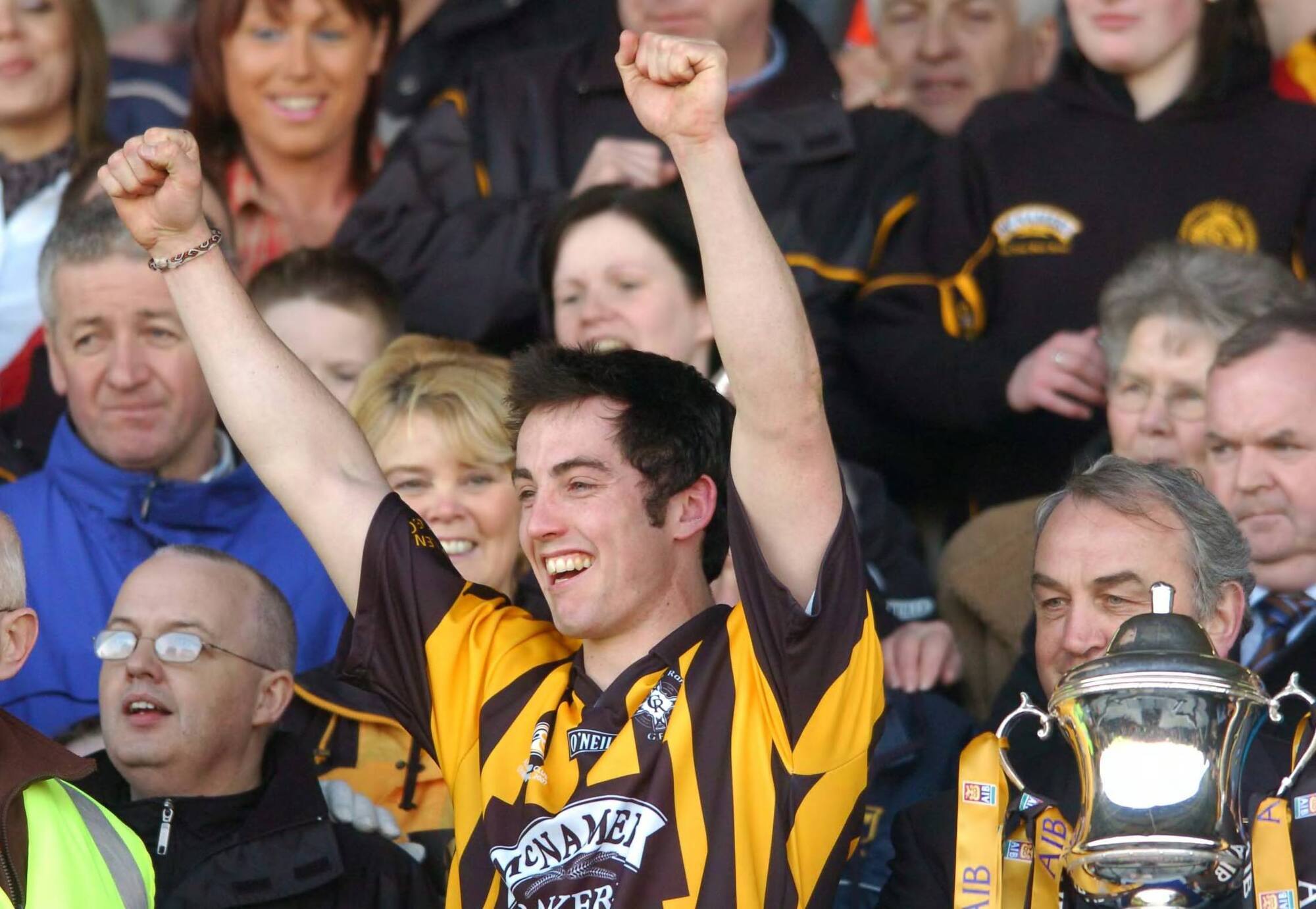
Man of the Match Aaron Kernan celebrates after the 2007 All-Ireland club final success


Birr was that perfect cocktail of individual brilliance, unique character, townie culture and rural steel

Anthony Daly

Throughout my hurling career, I never experienced anything like the wildly oscillating emotional spin against Birr in the 1998 All-Ireland semi-final replay, which sparked the whole gamut of emotions ranging from devastation, anger, disappointment, sadness to, suddenly, almost instant acceptance of our predicament.

Anger was the immediate emotion everyone in the Clarecastle camp was feeling once we got back into the dressing room after the extra-time defeat. We felt that an Alan Neville shot had gone over the line, but the goal was never given. I remember someone booting the door with a venomous kick, out of just pure frustration.

Tears were shed. Everyone was just heartbroken, but we were snapped out of our funk of disappointment as soon as one of the Birr selectors arrived to commiserate with us.

Within seconds, we were commiserating with him, and the Birr club, once we heard the news that Tommy Errity, the father of Birr captain Joe, had died of a heart-attack in the stand during the match.

We went to Hayes’ Hotel afterwards for the meal and I distinctly remember the sobering effect of that news. It wasn’t that it had tranquilized the disappointment but it certainly contextualised the pain when compared to what the Errity family were now going through.

We had lost a match. Joe Errity had lost his father.

When we went up to the funeral afterwards as a club, Birr really appreciated the gesture. I always felt both of those teams had similar characters, plus no shortage of great players but what separated Birr from us, and everyone else, was they had one of the greatest players of all-time in Brian Whelehan.

He was still two years away from being named on the Team-of-the-Millennium, but Whelehan hurled to that level on both days against us in 1998. At different stages in those games, I thought we had Birr beaten. They were concussed from a barrage of our scores but Whelehan was the reason we couldn’t knock them out. He was able to discolour our purple patches with his own red blotches of brilliance, contaminating our dominance by clearing balls that should have been translated into more Clarecastle scores.

Paul Carrol of Birr goes past Gerry McGrath of Sarsfields in the 1998 All-Ireland club final. The Offaly side beat Anthony Daly's Clarecastle in the semi-final. Picture: INPHO/Brendan Healy

Whelehan was a superstar but that was a super Birr team, stitched together by family bonds and individual brilliance; the Whelehans, Pilkingtons, Hanniffys, Errity, Daithi Regan, Brian Mullins.

The pain of that semi-final defeat did resurface when we watched Birr beat Sarsfields from Galway in the final but you always had to admire Birr’s stoic resolve throughout that period. When Offaly hit a slump and went sliding at the outset of the 2000s, Birr came back and won another two All-Irelands. Becoming the first club outside a Galway side to win successive All-Irelands enhanced their status even more considering how competitive the Leinster club championship always was.

They were a real heavyweight. Athenry had beaten them in the 2000 All-Ireland semi-final but when the sides met again in the 2003 semi-final, it was considered real Clash-of-the-Titans stuff, with both clubs having shared five of the previous six All-Irelands. Birr though, confirmed themselves as the top Titan that afternoon with an emphatic and comfortable win.

It was an incredible period of dominance for Birr, winning 12 county titles between 1991-2008, which included nine in ten years between 1999-2008. They returned to reach another All-Ireland club final in 2008, when they were well beaten by Portumna. The torch had been passed on to Portumna by then, who also won four All-Irelands, before Ballyhale took it off them and scorched their way to another raft of All-Irelands.

Ballyhale now have four more All-Irelands than Birr. Ballyhale are the benchmark but Birr just had that fusion of something different, that powerful mix of individual brilliance, unique character, townie culture and rural steel that blended into the greatest club team I ever saw.

And was fortunate – or unfortunate - to play against.

Portumna were that rare hurling entity who created their own tradition of success in real time

Enda McEvoy

The first memory from Croke Park on St Patrick’s Day 2006? The cold. Oh dear God, the cold.

At street level on Jones’s Road it was freezing, which was bad enough. But even on the sweetest of summer afternoons there’s always a wind in the press box, seven floors up in the Hogan Stand, and that day it cut like a switchblade. Suddenly I had a fellow feeling for the Wehrmacht at Stalingrad.

The second memory is of not so much the hurling match itself – All-Ireland club finals tend to bleed into each other with the passing of time – but of Portumna’s calmness and control. Newtownshandrum had been champions two years earlier with an intriguing and controversial possession game; Portumna, having worked hard in training on going with the opposition runners and funnelling bodies back when they lost the ball, deconstructed them clinically. A 17-year-old Joe Canning hit the net after three minutes, the men in saffron and blue built up an early lead and thereafter they punched off the back foot to win by 2-8 to 1-6.

Given the piranha tank that is the Galway Championship it might have been a one-off, a glorious and unrepeatable hour in the sun (or cold). Instead, with four All Ireland titles in the space of eight years, Portumna went on to become that rare hurling entity who create their own tradition of success in real time before our eyes.

Damien Hayes of Portumna breaks through the Newtownshandrum defence during the AIB All Ireland club hurling final at Croke Park, Dublin, Friday March 17, 2006.

They had Joe, obviously, but they were no one-man orchestra. Damien Hayes made a terrific second violin. Andy Smith agitated. Chunky Hayes was the kind of honest trier every club team needs. Ollie Canning, retreaded, proceeded to have a second life as a forward in his declining years.

Above all Portumna were blessed to possess a cohort of players in the sweet spot agewise. Ten of the XV who started against Newtownshandrum started in 2014 versus Mount Leinster Rangers.

At their apogee they were scarily good, 2009 being their annus mirabilis. After taking Birr for 3-19 the previous Patrick’s Day they put five goals past Ballyhale in the 2009 semi-final and racked up 2-24 against De La Salle in the final. En route they were compiling a 29-game unbeaten run that saw them hit three goals or more on 14 occasions, Come the week of the 2010 All-Ireland decider a new angle was clearly called for in regard to a Portumna feature. Dan Lynch, the club chairman, kindly empanelled a group of old warriors in Brendan Murray, John Joe O’Rourke and Micheál Ryan. While the quartet were delighted with the rush of silverware, more than anything else they luxuriated in the club’s new relevance. As recently as 1972 Portumna had disbanded, to be re-formed a while later.

During the 12 years he spent in England, where he hurled with St Gabriel’s, John Joe used to tell people he was from Portumna, “a town near Ballinasloe”. No longer.

“Now I love saying I’m from Portumna.” No finer tribute could a club be paid.

By the way did I mention how cold it was that day in 2006..?

Newstownshandrum succeeded on their own terms and with their own style

Michael Moynihan

There are a few reasons for picking the Newtownshandrum hurlers of the early part of this century as my favourite club side.

Some of the reasons are obvious enough, like the obstacles they overcame.

Over the years plenty of small country places have pulled together a team that flared for a year or two, but Newtown were the power in Cork hurling for a decade or more - an incredible feat when considering the club doesn’t pick from a full parish.

It shares its catchment area with Dromina, a capable unit which was successful at junior level at the same time as Newtown’s pomp, throwing the latter’s achievement in winning four county senior titles into sharp relief.

At their peak there were few apparent weaknesses in that Newtown side. In Paul Morrissey they had an intercounty-class goalkeeper, while Donal and Pat Mulcahy provided a strong spine to the defence.

Further up the field their two best-known players, the O’Connor twins Ben and Jerry, tormented opponents with their (obvious) understanding and anticipation of each other’s play and movement, and were backed by able forwards such as John Paul King and Mike Morrissey.

Newtown showed their class outside of Cork by reaching two All-Ireland club finals, winning one, but that’s a narrow view of the journey.

When the club won the intermediate county title in 1996 they graduated to the top flight of Cork club hurling: that same year their local divisional side Avondhu won a rare county senior title with three Newtown players on the team.

However, winning three U21 county titles in a row showed their supply line was good, and that set them up for a decade in which they appeared in six county finals. From contributing three players to a title-winning divisional side in 1996, by 2000 they were beating Avondhu in a county quarter-final.

The amount of self-belief and confidence needed to make that leap, from bit-part player to leading light, is one of the key reasons Newtown deserve to be acknowledged, but it’s not the main one.

Newtownshandrum captain John McCarthy lifts the Andy Merrigan Cup after the 2004 All-Ireland club final win over Dunloy. Picture: Brendan Moran

The central plank in my admiration for the north Cork side is that they succeeded on their own terms and with their own style. In a sport dominated for decades by tradition, Newtown’s guiding light at that time, Bernie O’Connor, came up with bespoke tactics for his side.

Newtown famously played a possession-based game which required huge amounts of running and co-ordinated support play. The players needed to buy into it totally - which they did - and needed to trust each other to implement it - which they did.

Every serious hurling team now plays a variant of the Newtown game, ironically enough. The approach was derided at the time but the club had the strength of mind to persevere with their tactics, and they were duly rewarded. And vindicated by imitation.

What other club team has changed the way its sport is played?

Almost every game Caltra played was as underdogs

John Divilly

Rumours are rife that a new documentary is soon to be released about St Patrick’s Day; where Presidents and Ambassadors blow Cead Mile Failte’s over zoom and virtual parish parades take place across the country. No All-Ireland club finals either as the GAA has signed a non-disclosure settlement with St Patrick. He doesn’t get visitation rights on the club anymore.

Too far-fetched and untasteful? Artificial in fact.

Unlike the Fantasy sports documentary released in 2004 about a tiny rural club, of a few hundred people, from north-east Galway. They had won their first county title in early autumn, annexed the Connacht title before Christmas and to continue their odyssey had booked their place in the All-Ireland club final by defeating Loup of Derry.

Their manager was serving a six-month suspension so he had to watch the match from the stands. They would win the final by a point on St Patrick’s Day.

Unrealistic? If they wore green jerseys would it make the story more authentic? It would. Fantasy complete. The name of this fantasy club?

Caltra.

A club nestled in the hinterlands of the famous horse-fair town, Ballinasloe. Pulling players from Ahascragh, Fohenagh and Castleblakeney. Up until that famous county final breakthrough in the autumn of 2003, only once in their 104 year history had they even contested a county final, that coming in 1975. They had barren years thereafter and suffered, like most rural clubs, due to emigration. They regained their senior status in 1997 and seven years later and in the space of seven months they would surpass all expectations and win the Frank Fox, Shane McGettigan and the Andy Merrigan Cups.

Caltra captain Noel Meehan lifts the Tommy Moore Cup after the 2004 club final win over An Gaeltacht 

A surprise? Absolutely. And similar to that other bolt from the blue, Leicester City, you were expecting them to slip up at some stage. Almost every game they played was as underdogs and you were waiting for the immortal GAA quip “sure didn’t ye do well to get this far”. Undeterred, Caltra had balance all over their team, were razor sharp and with a backbone of Meehan’s grabbed their once in a lifetime opportunity and sent a shocked An Ghaeltacht team home empty handed.

Dunloy, Newtownshandrum, An Ghaeltacht and Caltra supporters travelled to Dublin city on the 17th March 2004 and caught the stadium committee napping as the majority of the Cusack Stand turnstiles were closed. The GAA clearly weren’t expecting a bumper crowd of 38,500 rural folk to rock up!

Caltra rocked though. They defended with vigour and attacked with venom. They played football with drive, determination and had a clear purpose. The blinding pace and marauding runs of Declan Meehan was a memorable sight. Carrying ball from harm’s way and deep into a more favourable position for his team was soul destroying for the Kerry men. Michael Meehan showed the anoraks that he was able for the big stage and Noel, his brother and captain, put the finishing touches on the scoreboard and sealed Caltra’s place in the St Patrick’s Day archives, on a truly special day.

Out of the shadow of a British barracks came a club bold and brilliant

John Fogarty

Crossmaglen Rangers will always be the ultimate St Patrick’s Day team for me. Now that the day is lost, nobody will come near. Nemo Rangers’ halcyon days, I witnessed on TV but there in Croke Park if not within touching but lob wedge distance were Cross’.

Out of the shadow of a British barracks came a club bold and brilliant. It got to the stage where Crossmaglen weren’t liked by too many in the Ulster SFC but being viewly dimly for their excellence as opposed to their existence was refreshing. We’ll never forget trying to conduct an interview with victorious joint manager Tony McEntee after the 2011 provincial semi-final in Casement Park as an irate Ballinderry supporter heckled him.

To get through that gauntlet so many times, famously seven times in 12 years between 2006 and ‘15, an edge was required but for the older generation of footballers simply playing as a form of protest gave them that toughness. As Oisín McConville said in the excellent True North documentary, their approach to the soldiers’ presence was: “F**k youse. We are going to win an All-Ireland anyway.”

Oisin McConville raises the cup after the 2007 All-Ireland Senior Club Football Championship final

Eleven times they won Ulster, seven times they reached St Patrick’s Day. And like so many northern champions there was an element of liberation about their football thereafter.

That’s not to say the margins were much different. Long before Jim McGuinness was being hailed for making a one-point lead last as long as 10, Crossmaglen were doing it. From the pioneering era of Joe Kernan to the beauty, even grace of McEntee and Gareth O’Neill’s time in charge, that habit of refusing to budge once ahead rarely left them.

Before these great Corofin and Dublin teams were laying claim to being the best final teams, Cross were it. In Armagh, last year’s loss to Maghery was their first county final defeat since 1982 - in the interim Cross had won 23 deciders.

Oisín McConville, Crossmaglen Rangers, celebrates at the final whistle of the 2011 All-Ireland Senior Club Championship semi-final win over Kilmacud Crokes. Picture: Brian Lawless 

In Ulster, they have never been bested on final day - let that accomplishment nestle with you a bit. The only All-Ireland decider blemish on their record is the 2009 defeat to Kilmacud Crokes.

Results followed results despite their metamorphosis from a team of power and perseverance in the 1990s and early 2000s to one of poise and precision. The likes of Michael McConville and Donal Murtagh were the bridges between those times, the influx of the Kernan brothers and others to the team bringing more sophistication to the team’s play.

It wasn’t that they were overly distinctive periods - there was the class of Oisín McConville to complement the might of the McEntee brothers and Francie Bellew as there was the brawn of David McKenna and Johnny Hanratty to aid Jamie Clarke. Direct football was espoused by both but the latter Cross certainly had more scoring forwards.

Compare and contrast these two Ulster final scorelines - 2006, Crossmaglen Rangers 0-5 Ballinderry 0-2; 2015, Crossmaglen Rangers 2-17 Scotstown 2-12. Conditions were atrocious on both days and the latter went to extra-time but through squalls and on a drenched Athletic Grounds sod Cross claimed a classic I was fortunate to be reporting on.

From Margaret McConville to her grandsons Oisín and Rian O’Neill, the vibrancy of Crossmaglen Rangers endures. At this difficult time, they are a cause for celebration.

‘On the field, they were all war. Off it, they were all warmth. Open books, open hearts’

Kieran Shannon

It’s rare that a city or ‘townie’ team capture the hearts of neutrals, especially if that team happen to be from Dublin, but that’s what Ballymun Kickhams managed to pull off in the winter of 2012-2013.

Maybe it was because though they were pure Dubs, they weren’t really a townie team with all the slickness and a hint of softness and entitlement the term normally infers in the GAA vernacular. Coming from where they did, the last thing they were was soft. While most clubs and teams have mere coaches, Philly McMahon and Ted Furman and the rest had in Paddy Christie both a social worker and a miracle worker.

I got to know them better than most. With my background in sport psychology, I was part of the backroom for most of Paul Curran’s management which included that breakthrough county final win the October Bank holiday weekend of 2012 and the run to Croker and St Patrick’s Day in 2013 where a remarkably resilient and savvy St Brigid’s team edged possibly the best All Ireland club football final there’s been.

Colm Cooper, Dr Crokes, in action against Sean George, Karl Connolly and Davey Byrne, Ballymun Kickhams.

They remain probably the most welcoming and genuine group of people I’ve ever met, from the kitmen like Anto Welby and Tommy Hennessy to veteran subs like Derek Byrne and Simon Lawlor to now household names and serial All Ireland winners like James McCarthy and Dean Rock. There was a heartiness as well as a hardiness to the club and the group. On the field, they were all war. Off it, they were all warmth. Open books, open hearts.

The day before last, I checked in with Paul who quickly echoed they were his favourite club team as well. “Coming from a club [Thomas Davis in] in Tallaght, there were a lot of similarities: working class, the bit of hardship. Some of the lads came from nothing and only for the football would probably have gone down a different route altogether. But they made that work for them.

“They were as hard as nails. Streetwise. Yet totally unguarded when they met you. They’d welcome you with open arms because they were totally open about who they were – and very proud of who they were and were they came from.” Naturally when we mentioned that it was eight years ago today we were in Croke Park, Paul mentioned the R word: Regrets, we had a few: losing an eight-point lead that day, then losing the county final replay by a point to Vincent’s that autumn. But more than compensating for that was the other R word he used: the Run. We had the run. And nobody better to run it with.

To this day mention of any of their names prompts a smile. The service and solidity of the Dolan brothers, Enda and Eoin. Davy Byrne, outleaping and fighting men six inches taller than him. Alan Hubbard, another pocket of dynamite, bombing down the wing. James Burke, now part of the Mayo brains machine trying to outwit his clubmates McMahon, McCarthy, Small and Rock. Ken Robinson. Kevin Leahy. Jason Whelan. Ted Furman and how he’s turned his life around, still fighting, still winning.

In his brilliant book The Choice, Philly McMahon would say the Mun would get back to Croke Park some day. With county players now able to train longer with their clubs, they probably could. Either way, those of us involved will always treasure the Run.

More in this section

Cookie Policy Privacy Policy Brand Safety FAQ Help Contact Us Terms and Conditions

© Examiner Echo Group Limited