When Thomond College became the masters of club football
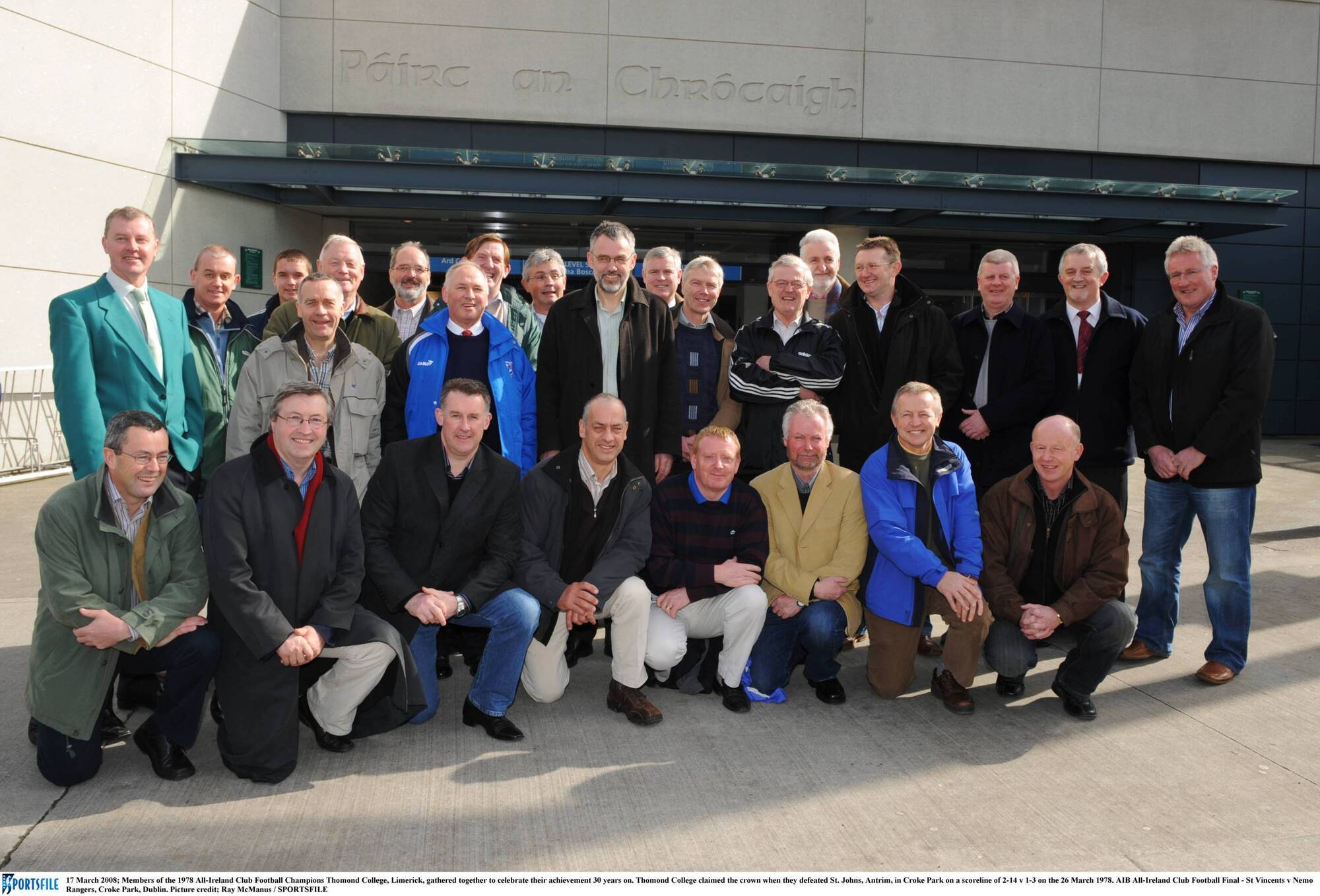
Members of the 1978 All-Ireland Club Football champions Thomond College, Limerick, gathered together at Croke Park in 2008 to celebrate the 30th anniversary of their success. Picture: Ray McManus/Sportsfile
In the beginning it was a Limerick college. Only it was based in Kerry.
Thomond College began life as the National College of Physical Education in 1973, about 60 miles west of its intended destination.
“The very first year was in Tralee,” says Pat Spillane, one of those early students. “The first students were based there because the buildings weren’t ready in Limerick, so the first years and the lads who had started their studies in Strawberry Hill in London and came into the NCPE as second years, they were all based in Tralee.”
At the start there were “a lot of English lecturers who didn’t really understand the Irish scene, to be honest,” says Spillane.
“There was a sense of making it up as they went along in the early days, but what kept us going was the GAA club.
“One time the All Blacks were on tour — I want to say 1974 - and they trained in Limerick, in a field in the NCPE, and obviously there was a big crowd in to watch them train.
“Larry organised training for the same time on an adjacent pitch, though, and the All Blacks eventually stopped training and came over to watch us.”
Larry was Larry McCarthy, Spillane’s classmate from Cork, and now President of the GAA. The two men started off together in the old NCPE (it became Thomond College in 1975), a friendship that goes back to the first-year hurling team.
(“I was full forward with the hurlers, red raw useless, just making sure we had 15 players,” says Spillane. “One of my last games was against St Pat’s of Drumondra and I may have been marking Brian Cody.” Entire podcasts have sprouted from less.)
In five years Thomond’s Gaelic football team went from “Division 2 in the colleges leagues to the top club team in Ireland,” adds Spillane.
“And Larry was the man responsible for that. He did everything. He organised training, he organised the buses — he paid the bus driver — he filled the team sheets, he got the jerseys washed. Everything.
“He was a one-man operation and he gave us structure and direction. Without him we wouldn’t have achieved anything because our focus would have been on the club or the county, but he got us to buy into the college team.
“There was no ego. He’s never been like that. He wants to do something and he wants to do it right — it’s not about an agenda or wanting to get his name in lights.
“Fellas get satisfaction out of playing, obviously, but he was someone who got satisfaction out of having the team there.”
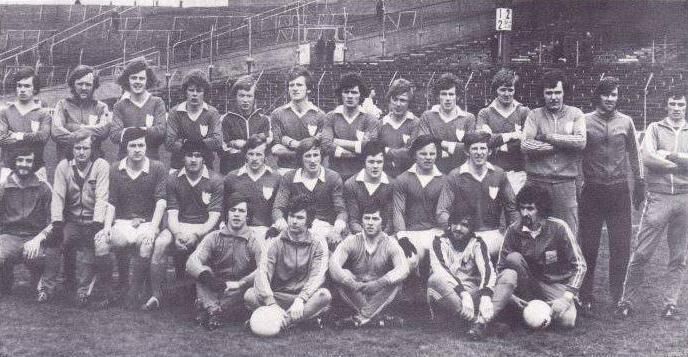
One of the mainstays of that team was Galway footballer Brian Talty, who can recall the excitement of landing into the college, ready to become a PE teacher.
“There were good footballers there before us, the likes of Johnny Tobin, Brian Mullins, Fran Ryder, Jimmy Deenihan, Andy Shortall, Hugo Clerkin — that drove us on, definitely.
“In our time then the likes of the Spillanes, Mick and Pat, were there, and a lot of good quality players who improved each other through training.
“As secretary of the club, Larry was a key man. He was unbelievable. He always had that leadership or management thing about him. That much was very clear.
“We didn’t know anything about running a GAA club, but some of the lads did — Larry in particular.”
The students had certain advantages. They were studying physical preparation, after all, and were privy to some of the most advanced training techniques of the age.
“In terms of preparation we were doing something physical all the time,” says Talty.
“The day was made up of lectures in the morning and then skill work, practical stuff. It’s not that we were killing ourselves training all day long but doing something all the time, your fitness was bound to be good.
“The preparation of the team was terrific — videoing games wasn’t done then but Dave Weldrick, who lectured us, did that. We had a psychologist from the college as well: those of us playing county football at the time didn’t have access to that.
“The likes of Joe McGrath, John O’Halloran, Dermot Morris, they were all a huge help.”
Spillane goes further: “We trained as professionals under Dave Weldrick, really. Videoing training sessions was one thing, but we did walk-throughs of particular moves, signals for kick-outs, everything — we could do that because we were able to train during the day together.
“We were as close to being a full-time GAA team in terms of strength and conditioning, preparation — we were the Dublin of the time.”
The Sigerson Cup was the preserve of the universities then, so Thomond stayed local. A Limerick senior championship title in 1977 didn’t win them many friends in the county, though.
“Did we do anything for football in Limerick? No,” says Spillane.
“One year ahead of a championship game in Limerick, I got a call from the Kerry secretary who said people had been in touch with him to suggest I pull out of the game. I played anyway, but it was a filthy game alright. We weren’t popular, and we often had issues as a club in terms of procedures and rules and objections that Larry had to handle for us.
“There always seemed to be something, but as a training ground for an official ... after jumping through some of the hoops in Limerick that time, running the GAA at a national level is going to be child’s play for Larry.”
Thomond’s emergence from Limerick was noted by others with designs on the provincial championship.
Kerry champions Austin Stacks had won the All-Ireland the previous season, for instance, and were keen on another title.
“Thomond had a lot of intercounty players who mightn’t have been household names necessarily, but as a team they were very strong,” says Mikey Sheehy, then in the middle of an immortal career with Stacks and Kerry.
“We had a very good team ourselves, but we weren’t taking them lightly. If anything they were favourites — though we won the All-Ireland club in 1976-7, we were probably lucky enough to win that one.
“Barring the players and supporters who were there at those games with Thomond, though, do people really remember those games? Without video evidence, for want of a better word, I don’t know if they do, which is a pity because they were great games. The football was top class.”
And no shortage. Stacks and Thomond had to meet four times to decide the provincial semi-final: 2-6 apiece; 1-10 to 3-4 (Sheehy with the Stacks goal); 2-18 to 3-15 (Sheehy levelling with a late penalty); and finally, Thomond winning 3-8 to 2-5.
“Brian Talty was very good,” says Sheehy. “But Pat (Spillane) did the damage, really, at full-forward. In the fourth game, which they won, he got the two goals that made the difference. He did untold damage.”
For his part, Talty identifies Sheehy as the danger man: “They had a great team, but what I remember is the sense of leading some of those games but they eventually pulled us back.
“The sensation that stays with me was that you were half-waiting for Mikey Sheehy to come up and pop over a 50 or stick a penalty and make a draw out of it. Which he did more than once.”
As noted by Sheehy, the games haven’t survived that well in the popular mind.
“They were cracking games,” says Spillane.
“I asked Larry one time if there was any footage of our All-Ireland club final win, and I don’t think there is any.
“And it’s not the dark ages, 1978, but there’s nothing.
“Those Stacks games were terrific. They had won the All-Ireland club the year before, and they had four or five of the greatest Kerry players of all time.
“The games drew huge crowds when you bear in mind that we probably had a core of 40 people following us. But they only live on in our memories. And badly, at that.”
Thomond duly overcame Nemo Rangers in the Munster final. The All-Ireland club final itself they won handily, beating St John’s of Belfast 2-14 to 1-3.
“We gathered in Limerick for a training session and went to Dublin the day before the All-Ireland final,” says Spillane. “We stayed on people’s couches and floors that night, literally — I slept on a couch the night before that club final.”
Thomond was eventually folded into the University of Limerick, but the men who put it on the map with an All-Ireland title in the ’70s met up for an anniversary reunion a few years ago.
“That was a great day out,” says Spillane.
“The reunion was all of us in a box for the All-Ireland club finals in Croke Park.
“Larry organised it all, of course.”


CONNECT WITH US TODAY



Be the first to know the latest news and updates