Brian Cuthbert: How many children will be lost to sport after Covid pandemic?
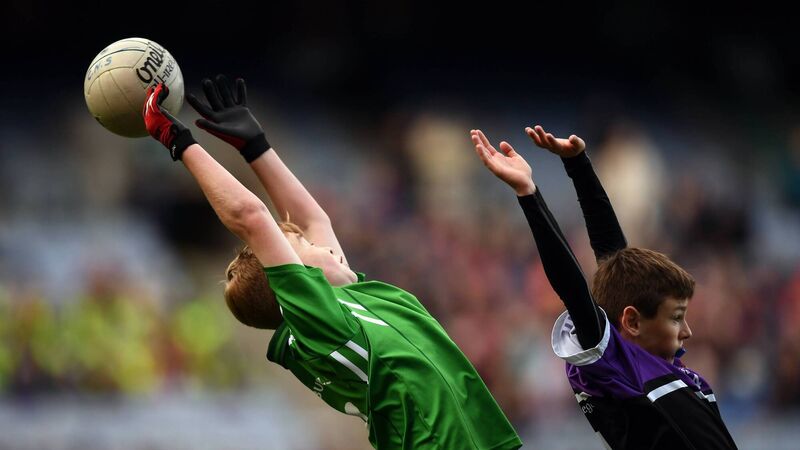
UP FOR IT: Cormac Gavin of Our Lady Queen of the Apostles NS, Clonburris, and Eddie Bohan of Terenure College JS attempt to win a dropping ball during the 2016 Corn Chlanna Gael final at the Allianz Cumann na mBunscol finals in Croke Park. ‘Right now, our youth need connection to their peer group,’ writes Brian Cuthbert.Â
The pandemic has forced us all to reflect and reevaluate. It has forced us back to first principles and has made us realise what is important in our lives. Outside of the well-being of our loved ones, sport and its absence have occupied the thoughts of many. For our young people, who now live in a world of structured play, sport provides a critical social platform to experience others and develop life skills. All sports provide an opportunity for personal growth, not least learning to build tenacity and resilience.
Teams sports are uniquely placed within this learning continuum as they provide the added bonus of a shared
experience.

It is this shared experience which we all have been denied so much over the past year. If the pandemic has given sport anything more than a temporary pre-eminent standing in society, it has surely allowed sporting organisations and their constituent clubs the opportunity to reset and examine how to create more impactful shared experiences for youth.
Getting vision aligned to behaviours is difficult within volunteer organisations and much work is needed in this space. However, there exists some low hanging fruit that we can get right in terms of attracting, nurturing, and retaining young people in sport. For example, the design and structure of competition is a crucial and manageable construct in any sport programme.
Competition is perceived from many differing perspectives, but it offers us much more than simply being viewed as an endeavour of triumphing over others. Most sporting bodies support the notion that competition is much more worthwhile than this narrow-minded viewpoint and attempt to design competitive structures that promote participation, performance and personal development (the three P’s).
However, unfortunately, the promotion of these by-products of healthy competition are often hindered by barriers unintentionally put in their way. We can only hope, that during the ‘Year of the pandemic’, organisations have examined the position of competition within their youth programmes so as to ensure stated outcomes are being achieved.
Of the three P’s, increasing and sustaining participation seems to dominate the agenda of the most sporting organisations. Competition can be used as a means of doing both. Recently, the GAA have determined that U13, U15, and U17 are the priority age-grades for competition at youth level across this country.
Locally, there was much debate around what was to happen with U14 and U16 groups in the larger clubs, who traditionally had a team on every age. Initially, it was mooted that there would not be any competition for them as stand-alone groups. Instead, they would amalgamate with the groups a year older than them, and depending on numbers, numerous teams could be entered in the priority age competitions. Many of those involved in these clubs felt that this new competition structure would not be an attractive proposition for some of their players. They felt that a number of these children would be lost to the club because of it.
Thankfully, this issue has almost been resolved to everyone’s satisfaction but, as a very simple example, it allows us a window to view the influence of competition on participation.
From the outset, as the gatekeepers to youth sport outcomes, we must not put barriers in the way of children enjoying positive, shared sporting experiences. As supports to their sporting journey, we need to be constantly cognisant of why children play sport in the first place.
A few key reasons dominate the research landscape. Most pertinently, children and youth seek experiences that are enjoyable and offer them a challenge in terms of their need for competence. They also will only persist with experiences that afford them a sense of affiliation.
This implies that the majority of youth players are motivated to participate because of challenge, competition and connection to their friends and their year group rather than connection to their clubs.
Competence refers to overcoming challenge and the feeling that one is effective within their environment. Players, regardless of age, need to perceive that they are competent at their chosen sport and have the ability to master challenging tasks. Coaches have to operate within the ‘Goldilocks’ zone and provide players with tasks that are not too easy but not too hard either.
During adolescence, youths perceive their level of competence through peer comparison. Therefore, in order to sustain motivation, their ‘moments of delight’ in sport need to occur within groups that matter to them.
The peer group is also crucial in terms of developing affiliation, another major construct of motivation. Individual players, in order to sustain motivation, must possess a feeling of belonging to their group. This feeling of belonging to an individual team lends itself eventually to commitment to the club. However, the initial step in developing this commitment relates to the player’s peer group. The group becomes part of his/her social identity and in ways becomes an extension of themselves. The group becomes the primary point of reference in deciding behaviours, attitudes and efforts during these formative years.
In large urban clubs, the group invariably all share the same year of birth. That is their distinguishing feature. This feature remains very much relevant until later adolescence, when players are comfortable enough in their own skin to share and negotiate power with new peer groups. This happens naturally at minor level in Gaelic games, whereby groups are a make-up of multiple groups within a club.
Competition therefore is a major vehicle in terms of providing opportunities for players to shine, as well as providing occasions to grow this necessary feeling of belonging. Appropriately framed, competition can deliver many magical moments for our youth, moments much more impactful than those defined simply by winning or losing.
Right now, our youth need to experience as many of these magical moments as we possibly can manufacture. They need connection to their peer group and their wider community.
They need to feel valued and a sense that they fit in, the sense that they belong here. Above all, they need to know that we are doing all we can to ensure that they don’t continue to miss out. Exposing them to shared positive experiences within their own peer group is the beginning of their return to normal.
Or we could be very brave and develop a new normal!