Route to the top: 10 steps to becoming GAA president
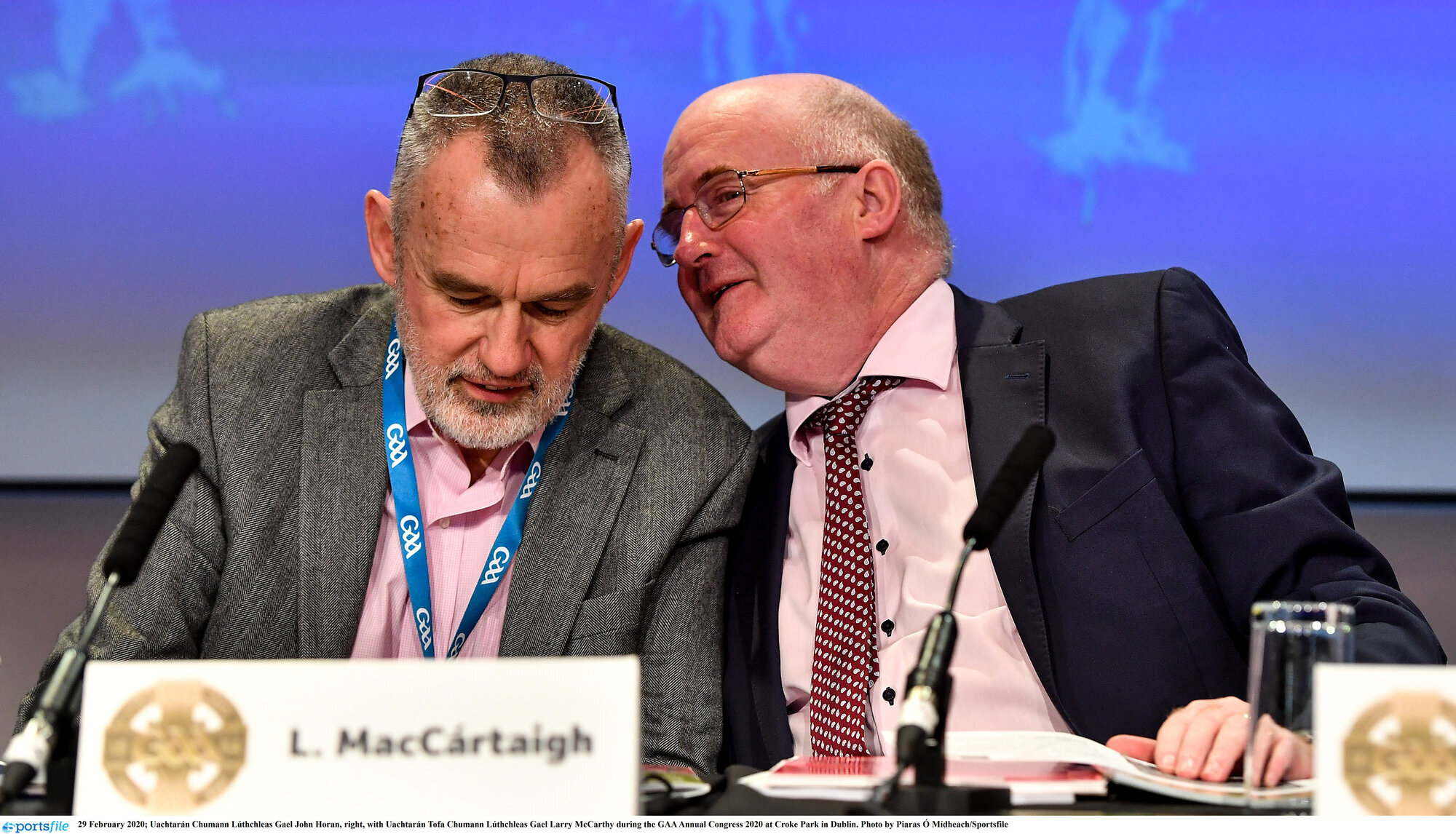
Uachtarán Chumann Lúthchleas Gael John Horan, right, with Uachtarán Tofa Chumann Lúthchleas Gael Larry McCarthy during the GAA Annual Congress last year. Picture: Piaras Ó Mídheach/Sportsfile
This Saturday, Larry McCarthy becomes the 40th president of the Gaelic Athletic Association. So what does it take to wear the medal? Clearly a lot as New York-based McCarthy clocked up 36,000 air miles campaigning at the start of 2021.
But what exactly is required other than going on the canvassing trail? Here’s your 10-step guide:
Having filled all the roles at county board level in New York, there is no question about McCarthy’s bona fides. He had also served on several national committees and has been a GAA trustee the last three years.
Current president John Horan’s route to the role was an unconventional one via schools GAA, but then he had served as Leinster chairman and vice-chairman prior to becoming Uachtarán-Tofa in 2017.
County chairmanship is no longer a rite of passage for an aspiring GAA president — like his predecessor Aogán Farrell, Horan didn’t follow that path — but provincial chairmanship had been almost a necessary step on the ladder up until McCarthy’s success 12 months ago.
In seeing off the challenges of Jarlath Burns, Jerry O’Sullivan, Jim Bolger, and Mick Rock last year, McCarthy’s victory saw another man in the education sector take the position.
From Seton Hall University associate professor McCarthy back to the late Joe McDonagh, seven of the last nine presidents have been teachers. Horan is a secondary school principal and Farrell was a primary school principal as was Liam O’Neill. Seán Kelly taught in St Brendan’s College, Killarney and Seán McCague was principal of St Mary’s Boys National School in Monaghan.
Christy Cooney (FÁS) and Nickey Brennan (Glanbia) were the two exceptions.
The last three presidents would also be exceptions in this regard given that they won the election at the first time of asking. Before that, O’Neill succeeded Christy Cooney whom he lost to in 2008 and Cooney previously was defeated by Brennan, who prior to Farrell was the last first-time winner.
After accruing a considerable amount of votes last year, Burns will be in a healthy position should he chose to run again in 2023.
Twice in the last seven years, no sooner has a president settled into his office on the ground floor of Croke Park that somebody has announced they intend succeeding him.
Not the cleverest move in the world given the power wielded by the man in office and not surprisingly neither candidate were victorious. Not that current presidents are kingmakers but they can make enough of a difference in tight battles.
In a recent election, the chair and secretary of one county had agreed to vote for a certain candidate only for another to approach the others on the Congress delegation and convince them to give him their No 1.
Assuming that the two most senior officials in a county will carry the vote for you is the height of hubris. Eleventh-hour deals have been notorious in the GAA and over the last 15 years at least one favourite has been beaten as a result of them.
Just as it is in General Elections, winning Dublin goes a long way to sealing victory. Whether it’s a case of promising to leave them alone — ie don’t split the place — or acknowledging their strength, the unofficial fifth province of the GAA carries weight.
The likes of Cork, Galway, Limerick, Wexford and Tipperary also have big voting representations. Central Council, whose members aren't often whipped by their counties to vote for a candidate, also commands serious influence.
With the growing voting strength of international units at Congress, chairing an overseas committee has been a coveted role by those aspiring to be president over the last decade or so.
Three years ago, former GAA trustee Niall Erskine was appointed to head up the World GAA body by Horan and his time in that role finishes this weekend, but the Donegal man didn’t put his name in the hat last year. As Burns, current Leinster chairman Pat Teehan, and others consider running in two years’ time, maybe he will then.
The days of presidential candidates doing solo runs now are long gone. That’s not to say they don’t have to hit the road hard and press flesh (when that was allowed) but campaign managers are a requisite.
What’s more, having somebody on the ground in each province works wonders. Even if interference can be run against a candidate who hails from that province, it can be crucial when the votes are counted. It’s amazing how loyalty can be sidelined so quickly when voters are predicting who is going to be the successful candidate.
Over the years, there have been some sour concession speeches where beaten candidates have taken the opportunity to have a dig at those whose word clearly wasn’t good enough.
It was the wit and class of Noel Walsh that he was able to make that point without losing any graciousness in his defeat to McCague in 1999.
“I’d like to thank those who voted for me — there weren’t many but thanks. I’d like to thank those who voted against me because, well that’s democracy, and I’d like to thank those who promised to vote for me but didn’t quite get around to it.”
Not since the late McDonagh who finished his term in 2000 has there been a GAA president from Connacht.
McCarthy’s links to Sligo via his Yeats County club in New York does offer some link to the western province but candidates like Rock (Roscommon) and Frank Burke (Galway) in recent years have discovered sentimentality counts for little or nothing.
Since McDonagh, there have been three presidents from Leinster, two from Munster, and one from Ulster. Not since Waterford’s Pat Fanning succeeded Seamus Ó Riain of Tipperary in 1970 has a president hailed from the same province as his predecessor.
As McCarthy breaks new grounds next weekend, it's open season next time around.
CONNECT WITH US TODAY



Be the first to know the latest news and updates