The Big Interview: 'The All-Stars upgraded the social standing of the GAA'
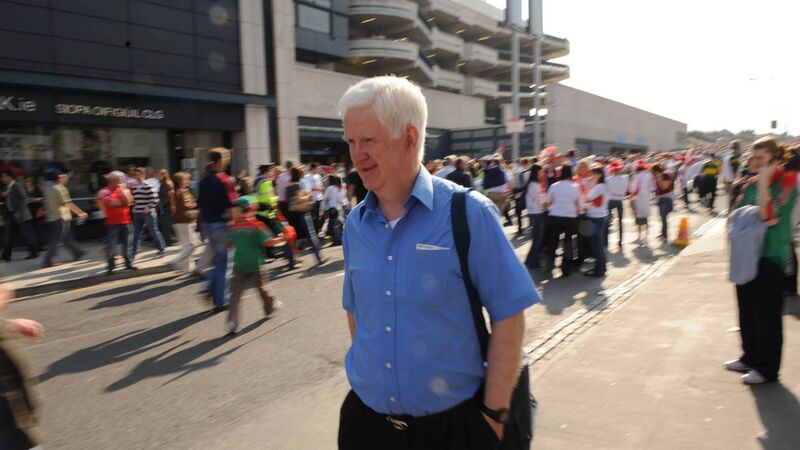
Jim O’Sullivan arrives at Croke Park ahead of the 2008 All-Ireland final between Kerry and Tyrone. The former ‘Irish Examiner’ GAA correspondent is concerned about the current state of football. Picture: Ray McManus/Sportsfile
Tonight's (virtual) All-Star ceremony marks the 50th anniversary of the scheme. Former Cork Examiner GAA correspondent Jim O'Sullivan recalls its earliest days and how it quickly became hurling and football's very own Oscar night, bringing a bit of Hollywood into the lives of players half a century ago.
Although he’s long been its silver-haired daddy, there’s still something of the boy about Jim O’Sullivan when it comes to the All-Stars.
While the purpose of our call was to hear his reflections on 50 years of the scheme, his enthusiasm for it and facts and figures remains so intact, that he can’t help but look to the future too.
There are some very “interesting” statistics arising out of the Dubs winning nine All-Stars in the football this year, he explains; over the course of our chat, that word “interesting” regularly surfaces since few journalists have scoured for interesting stats the way O’Sullivan did throughout his career, and continues to excavate, even in retirement.
You’ve probably heard or read elsewhere by now that it’s a record-equalling haul for one county in one year. What you might have missed only for O’Sullivan’s vigilance and curiosity is that because Stephen Cluxton wasn’t one of them and remains stuck on ‘just’ the six All Stars, the top three spots in the football pantheon for now remain the exclusive preserve of Kerrymen — Pat Spillane leading the way with nine, followed by Gooch on eight and “Mikey”, the name ‘Sheehy’ being superfluous for someone as amiable as O’Sullivan, on seven.
But, he notes, there’s another indicator that Kerry’s historic pre-eminence is under severe threat. Dublin are now on 139 All-Stars, within six of Kerry.
By the time we come out of this pandemic, the Kingdom may no longer be the kings.
One All-Star record that is bound to last for some time yet is O’Sullivan’s service. No one has sat on more All-Star selection committee meetings than him.
His first year as the GAA correspondent for the then titled Cork Examiner coincided with several landmark developments in the history of the association. The first Congress he covered was the one in Belfast which saw the lifting of the Ban.
His native county, Cork, appointed a bright young full-time county secretary by the name of Frank Murphy. And then there was the birth of the All-Stars.
Although it was the brainchild of the more senior quartet of Mick Dunne and Pádraig Puirséal of the Irish Press, John D Hickey of the Irish Independent and Paddy Downey of The Irish Times, the fresh-faced freshman from Douglas was immediately co-opted onto the selection committee.
The scheme would broaden everyone’s horizons, including O’Sullivan’s.
Although he’d been in the Examiner for close to 10 years by then, work had been mostly confined to what he jokingly refers to as “the deep south”. He’d started out as a proof reader straight out of school before graduating to being a general reporter, like his father John before him, covering everything from corporation meetings to courts to priests’ funerals. He’d also give a hand at sport, covering colleges and some club matches, but his big break came around this time of year exactly half-a-century ago.
“Val Dorgan and Dick Cross would have covered the GAA when I was just doing bits and pieces but then Val was given the Brussels brief [Ireland at the time was negotiating to join the-then European Economic Community], so early in ’71 I was appointed the full-time GAA correspondent. And luckily for me it coincided with the beginning of the All-Star scheme.
“Being a selector really helped establish me as an up and coming journalist and was invaluable in gaining experience and contacts to do the job. You’d get to know players on All-Star tours and then see them again maybe in the dressing room after a match and say: ‘Hey, woud you be okay for an interview next week?’
“I remember interviewing Brian Cody in his home. That came from establishing a rapport and trust from things like the All-Stars.
“Back then, you could nearly have drawn a line from Dublin across to Galway and the Examiner would rarely have covered games north of it. But through the All-Stars you were able to meet and know and be known by people from all over.”
New
It was new to everybody: Players, selectors. The first awards were held towards the end of the year in Jury’s Hotel, Ballsbridge, the cigarette manufacturers Carroll’s picking up the bill.
Prior to then about the only time a hurler or footballer would have been exposed to a gathering like that would be at the Caltex awards, the precursor to the Texaco sports awards — and even at those there would have just been the two GAA players, football and hurling being just two among multiple sports.
The All-Stars was like the GAA’s very own Oscar night, bringing a bit of Hollywood into the lives of lads from Holycross.
Bringing players together on the night, everyone getting dressed up, black tie, being put up in a big hotel — something like that would have been mostly the preserve of the rugby fraternity up to then. So the All-Stars upgraded the social standing of the GAA.
That night though was only a ticket to the real eye-opener: America. Sometimes even Hollywood itself. O’Sullivan was as enthralled by the new world as much as anyone else.
“I’d never been to America until the first All-Stars tour and I’m sure it was the same for most of the players. With the price of a transatlantic flight as it was back then, they wouldn’t have been able to afford it.”
Some were so enraptured with the place they never left. A member of the Limerick hurling panel of 1973 — back then the reigning All Ireland champions in either code would play the All-Stars in those Stateside exhibitions — didn’t return with his team-mates and the rest of the entourage.
One year a 23-year-old Frank McGuigan, already on his fourth All-Star trip as a replacement, decided he was enjoying the few pints in the bar in Gaelic Park so much he’d stay there, which he would for years to become the King of Gaelic Park.
It was an innocent, even naïve time.
The tours were usually held in the spring, after the national league, and before the championship; it’s hard to think you’d very few kicking up about players being needlessly away from their clubs or it disrupting their county’s championship preparations.
And back then families would put up the All-Stars.
“A Limerick man in San Francisco might say, ‘Sure, I’ll take Pat Hartigan.’ And Pat would stay in that man’s private home. But then you’d have had players who were maybe staying 60 miles away from San Francisco so it would only be a few times during the tour that everyone would convene together. But then in 1979 Bank of Ireland took over the sponsorship; there’d been a growing concern with the GAA over a cigarette company sponsoring the scheme so Carroll’s withdrew. And when Bank of Ireland took over they put everyone on tour up in hotels.”
For the first 15 years of the scheme the tours were solely in the States: San Fran, LA, Chicago, Boston, New York.
For the most part they were harmless affairs, though O’Sullivan has a memory of one football encounter getting so heated, the then GAA president Donal Keenan ran onto the field to urge the players to calm down and behave themselves.
On another tour, things got tetchy between players from Kilkenny and Galway from some lingering resentment carrying over from the previous year’s championship.
For the most part though any rancour regarding the All-Stars was confined to the selection of the teams themselves.
The fallout could be so huge because the status an All-Star afforded was so huge. You could barely walk into a bar in the 1980s without seeing an All-Star poster on the wall, meaning tens of thousands of kids from Donegal to Waterford got to learn who Peter McGinnity from Fermanagh was. It wasn’t just a magnificent form of recognition for a player; sometimes it was a form of validation for an entire county.
Although in his mid-70s now, O’Sullivan’s faculties are still sharp, and at the drop of a hat he can tell you that only two counties have yet to be honoured with an All-Star: Longford and Carlow. Limerick, Waterford, and Kilkenny are still awaiting their first football All-Star but have been more than compensated with their respective hauls in hurling.
The All-Star breakthrough for other counties though are ingrained in O’Sullivan’s mind, just as they are in the memory of those players and their people: Like a McGinnity in ’82, Kevin O’Brien and Wicklow in ’90, Seamus Clancy and Clare in ’92, Matty Forde and Wexford in 2004, and Paddy Keenan for Louth in 2010, O’Sullivan’s first year retired as the Examiner’s chief GAA corr.
Some episodes, like the Brian Whelahan saga of 1994 and Éamonn McEnaney’s omission in 1985 on account of being sent off in a Kilmacud sevens game, have been well documented, but a trainspotter like O’Sullivan can recall some other now ridiculous sagas.
The suspension rule, to encourage and reward greater sportsmanship, created all kinds of quandaries and anomalies.
O’Sullivan recalls how in 1991 Tipperary’s full-forward Cormac Bonnar was only allowed to pick up his award on account of the function being unusually held on a Saturday night; he’d been sent off a couple of weeks earlier playing for Cashel King Cormacs in a Munster club final but his suspension had expired a few hours before the ceremony itself.
If it had been on the Friday night he wouldn’t have been able to get his award!
He’d witness all kinds of other changes. There was one stretch where there was only a handful of tours over the guts of a decade until in the late 1990s Eircell-Vodafone came on board as the sponsors.
Soon O’Sullivan and another generation of fresh-faced players were exposed to a new new world: Dubai, Singapore, Hong Kong.
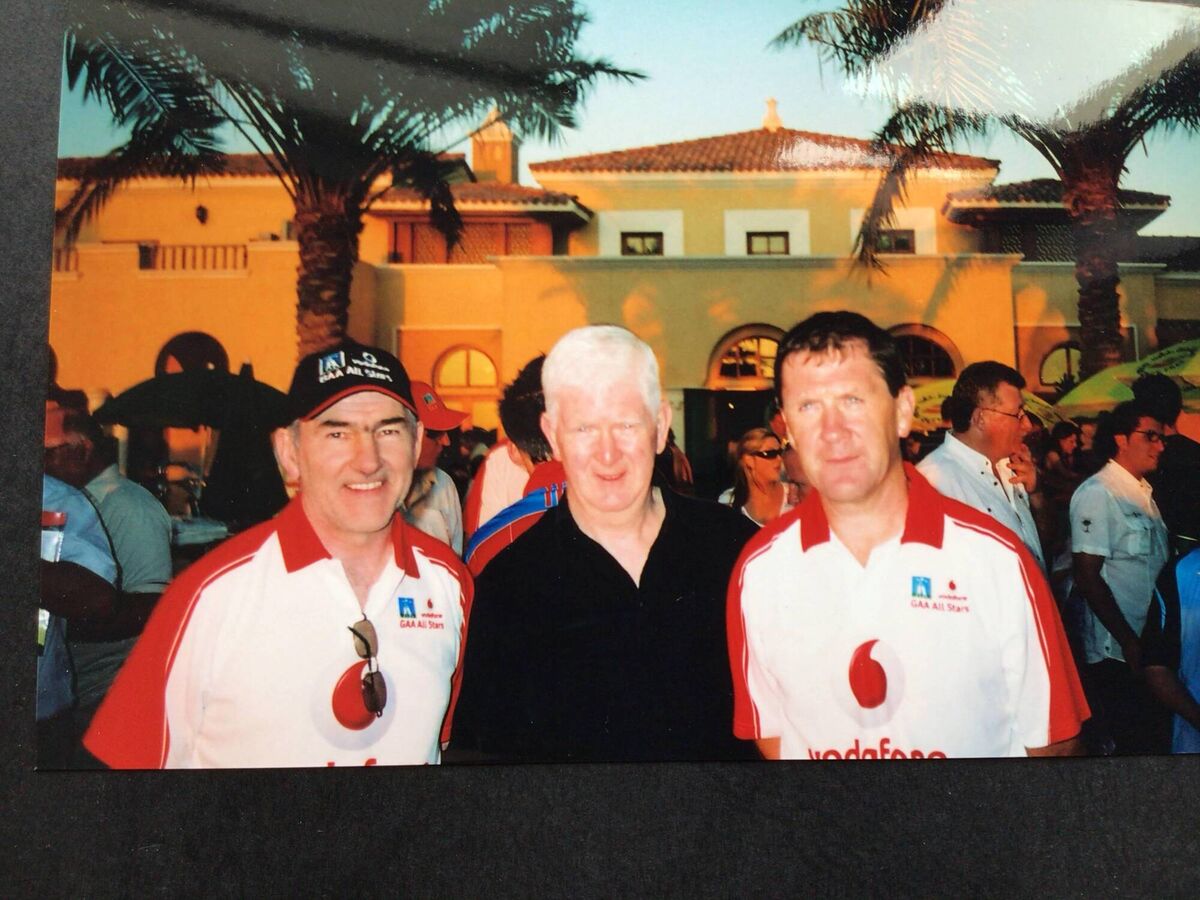
Television would also come to play a bigger role, and craving an even bigger one. “It wanted both teams announced live on the night but instead they had to settle for one.”
With an O’Sullivan still on board, there was someone there to remind everyone that the scheme originated with the print media and it was only fair that it got the first crack at announcing one of the teams.
Ireland itself has changed. At centre-back on that first football All-Star team of 1971 was a Nicholas Clavin, of All-Ireland champions Offaly. He’s now a priest in San Diego; in 2003 when the All-Star toured that part of the world, O’Sullivan and his friend Brian Carthy of RTÉ tracked Clavin down and met up with him.
It’s hard to think of any current or future All-Star becoming a priest.
Those inaugural All-Stars of ’71 also saw Ray Cummins having the distinction of winning a statuette for both hurling and football. All these years on and no one has emulated him; while Jimmy Barry-Murphy, Brian Murphy and Liam Currams would all win at least one All-Star in both codes, only Cummins did the double in the one year. And it’s doubtful if anyone will emulate any of them again.
The one constant
For four decades O’Sullivan was the one constant in the press box, the definition of the word venerable.
His authority radiated from a sense of fairness and decency, for players and referees alike — it was a trademark of his match reports to reserve a paragraph at the end for how the man in the middle had performed.
“I never had any notions about my writing ability. I always looked up to a Paddy Downey and later a Denis Walsh; I wasn’t a writer like them. But I always set out to treat players with respect, even when I was being critical of them, by maybe writing something like: ‘He was untypically off form.’”
Since stepping out of the press box for good about half a decade ago, he sees two games that are unrecognisable from the ones he started out covering 50 years ago.
“I find a lot of football games depressing to watch. I don’t like how the game has gone. And I don’t like how hurling is going. I pass the ball to you, then you pass the ball back to me, then I crash into an opponent or they crash into me: The amount of physical contact has increased enormously. And it’s not for the better. It’s going to take its toll.”
Thankfully though he himself is in fine fettle, making sure to still get in a 90-minute cycle around the Douglas area at least three times a week.
“A few years ago I met an old colleague from the Examiner in Douglas Court and we both mentioned how our fathers used to always say ‘Your health is your wealth.’ And it was only then we appreciated what they meant. I’m lucky. Jo and I have three healthy children and grandchildren. You read in the paper about poor families and children with awful ailments and limitations and it brings home how fortunate we are.
“So I’m blessed to be wealthy in that sense.”
He’s one of only a couple of the original All-Star selectors still with us. But thanks to him, it’ll always be with us.


Cancel anytime
CONNECT WITH US TODAY



Be the first to know the latest news and updates