What lessons can GAA players take from Super Bowl stars’ speed tests?
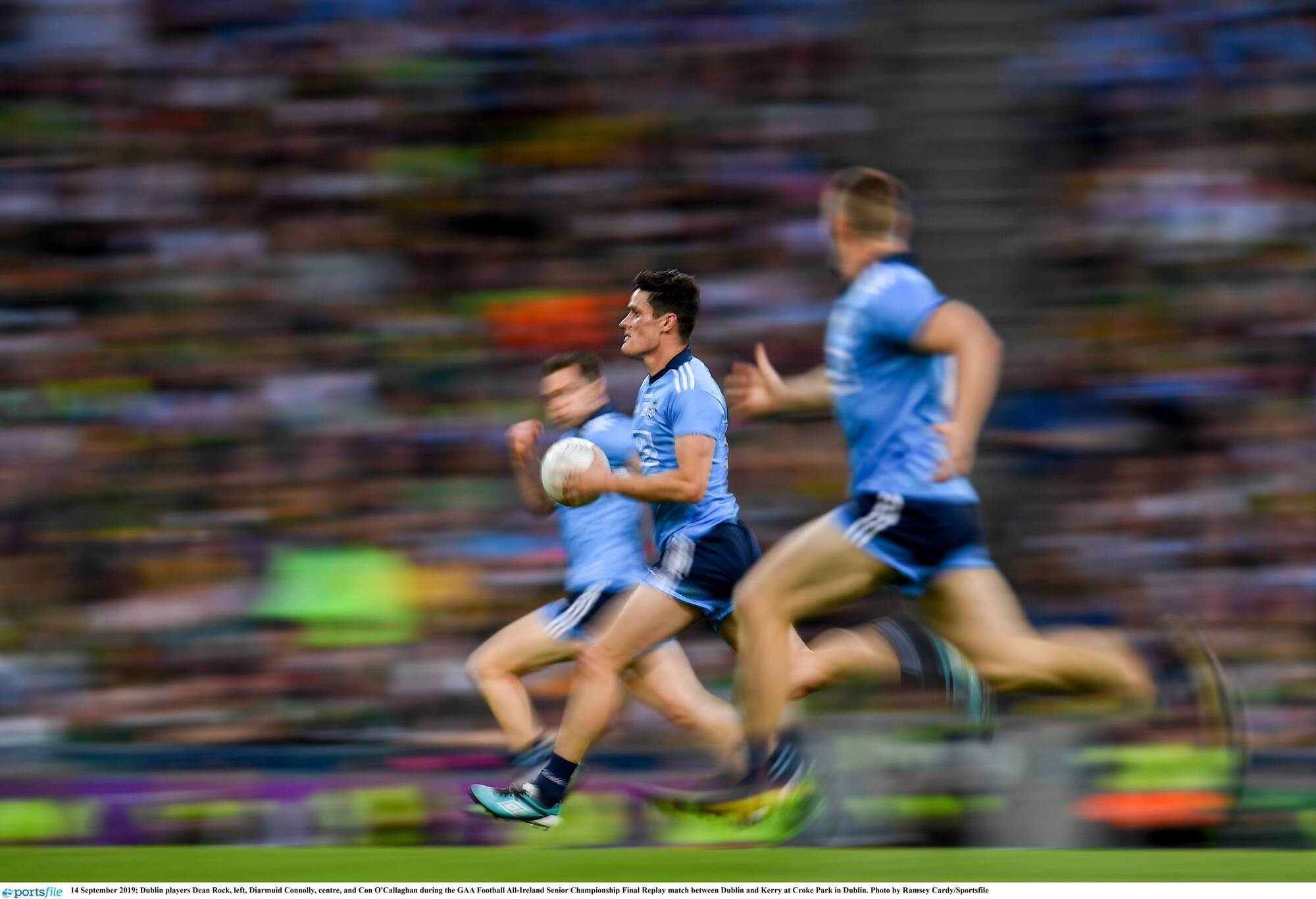
Dublin players Dean Rock, left, Diarmuid Connolly, centre, and Con O’Callaghan breaking at pace. The 40-yard dash at the NFL combine is a big deal but how much of a correlation is there is between players that are very fast and those who are successful in the NFL and other sports?
Whether you’re an American football superfan or a casual follower, you’re probably aware the Super Bowl is on this weekend. Tom Brady. Patrick Mahomes. All of them.
NFL superfans will be aware of the NFL combine, where those hoping to make the professional game undergo a series of physical tests including the gold standard for speed — the 40-yard dash.
How effective is that as a measurement of game speed really? And what’s the lesson there for GAA players, some of whom are NFL superfans as mentioned above?
“The 40-yard dash at the NFL combine is a big deal but I don’t know how much of a correlation there is between the fellas who run that very fast and who are successful in the NFL,” says athletes coach Gary Ryan.
“They’re good at the 40-yard dash, but how often do you run 40 yards in the NFL? How often do you run 40 yards in a hurling game or a soccer match?
“People like testing, but tests tell you how someone does in a test on a particular day. I did a lot of training in the States with groups of athletes, some of whom were spending months to get ready for the NFL combine.
“But all they were getting good at was that particular test — the combine. Becoming really good at that specific thing isn’t necessarily improving you for your game.”
Ryan represented Ireland at the Olympics in the 200 metres and trained the Tipperary hurlers. He pinpoints what speed means on the track and on the pitch.
“The fastest person isn’t necessarily the fastest person in a straight line.
“The analogy I use is Formula One — the fastest car in a race isn’t necessarily the one with the biggest engine, the one going fastest in a straight line. It’s the one with the best engine combined with the best brakes, the best gearbox, the best driver. In team sports one of the significant issues is how fast you can stop as much as how fast you can run - or how fast you can get going again.
“If you look at the NFL, or Gaelic games, or any team sport, it’s about creating space, so can you stop quickly and go in another direction? Can you deceive someone by stopping and starting? Very little of it is about getting up to top speed.
“Top speed is interesting. Obviously you train people to get to their top speed, because the better that is then their acceleration is probably going to be better — but you don’t reach top speed until you’ve gone 30 metres plus. The average distance a hurler travels in a championship game is between 17 and 20 metres, that’s the length of their sprint.
“How important is top speed? It’s important, but there are more important things — your reaction time, anticipation, acceleration profile.”
Let’s backtrack. How does speed training for those in team sports compare to individual athletes? Dave Matthews was an Irish Olympian, specialising in middle distances, before becoming the Cork hurlers’ physical trainer. He’s worked with other GAA teams as well.
“Often when you ask a hurling or football team to line up for a sprint,” he says, “The first thing is a lot of the players will set up incorrectly in terms of their sprint mechanics.
“Instead of starting with opposite hand and opposite leg, they often start with left leg and left hand, so immediately there has to be an adjustment.
“Second, players will try to gain a few inches. The toe is never behind the line. I’ve never seen a team start from behind the line - which is fine, but in track you’re told from the age of eight to line up with your toe behind the start line.”
Then there’s the strain players can put on themselves: “Third, if you say the sprint is out to the 20-metre line, then the brakes come on at 20 metres and they’ve stopped completely at 22 metres. There’s no ease-down in running, which isn’t good for the body.
“In fairness, that’s changing with more athletics coaches coming into the GAA. The players’ mechanics are improving.”
Gary Ryan points to another issue when it comes to a match situation.
“Take sports where you’re marking someone: a multitude of factors are involved then.
“In hurling, for instance, if a forward gets past a defender and the defender has his back to goal, then momentum comes into it, relative speed, and the forward has the advantage.
“Also, if you look at a back and forward running back towards the goal, you’ll notice the back is often stressed and anxious because the forward’s gone inside him.
“You’re always telling sprinters to relax to run faster, and it’s the same in team sport, but if the back is stressed because he’s chasing back he’ll feel tighter, he’ll feel under pressure and his running action suffers.
“Anticipation and reaction time also come into it. If you’re not confident of beating your man to the ball, and he wins it, then you’re on the back foot, so reaction time becomes important. Reaction time becomes more important over a shorter distance — so if it’s a 15-metre distance that’s involved it’s even more important.
“If you’re taking longer to decide to go for the ball, if your body position is off, if you’re not confident you can make it to the ball — those all become factors.
“As a result of all of that, if you’re working with someone who’s not particularly quick, then those are all areas — reaction time, body position — you can work on. And then the speed becomes less important, because if the player can get ahead of an opponent, say, it’s a massive advantage.
“You see it in other sports. I grew up watching Paul McGrath, who hardly seemed to sprint, but he was there at the ball before other players. So that game sense, is another factor again.”
Ryan also saw that in his first year with Tipperary: “At the very first session I stood behind the goal and just watched Eoin Kelly.
“He was coming towards the end of his career and had had a lot of back problems, but his movement . . . he was already gone to where the ball would land before the player out the field had even delivered it. He could read the game that well, and you see that in very good players. So speed is also about perception.”


CONNECT WITH US TODAY



Be the first to know the latest news and updates