Kieran Shannon: Mayo's long and winding road in search of success
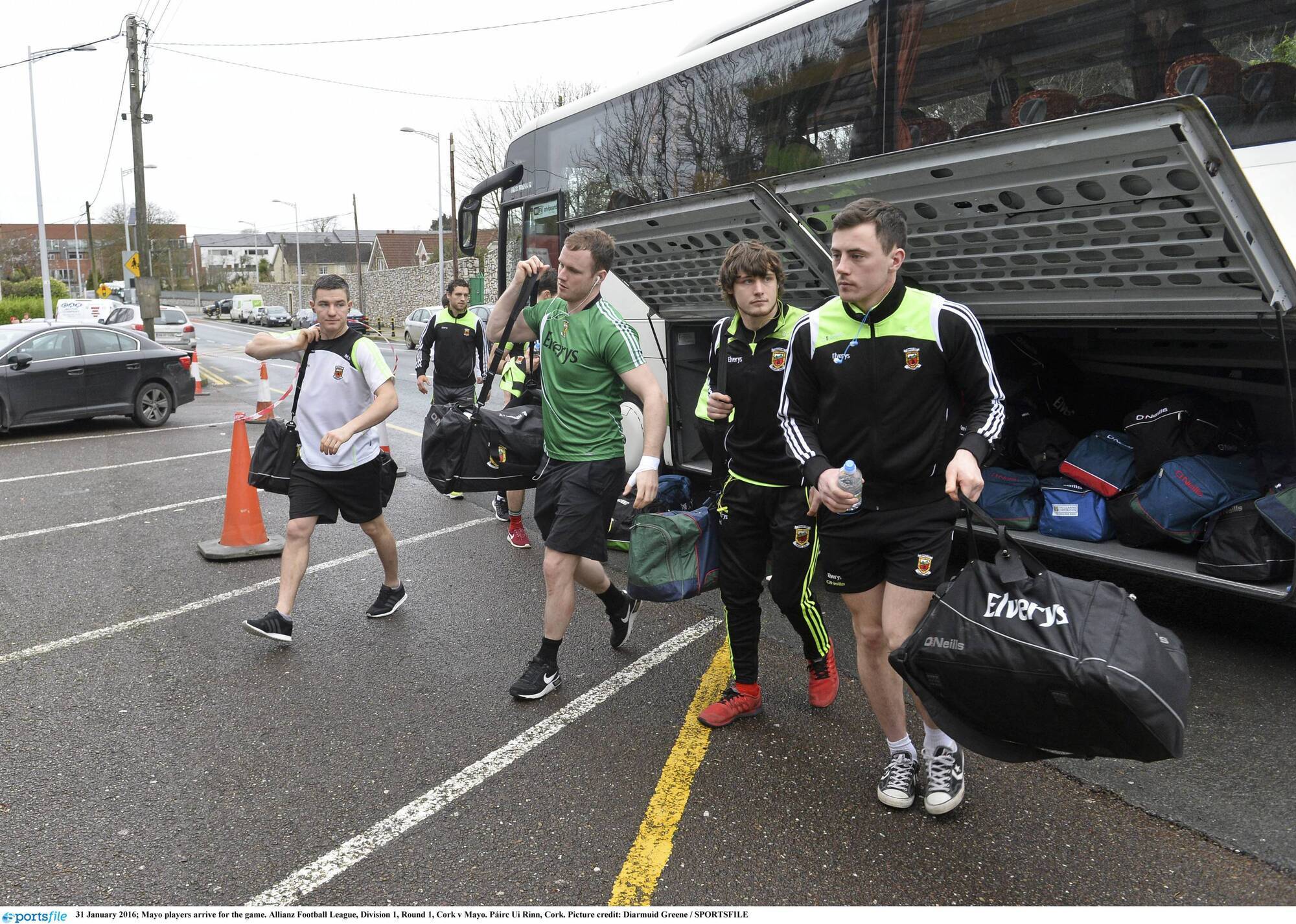
Mayo players arrive for a 2016 National League game. Picture: Diarmuid Greene / Sportsfile
WHEN Kenneth O’Malley thinks back on all those journeys coast to coast and back with the lads, the image that most comes to mind is when the slide door of their minibus would open in the car park of the Lucan Spa Hotel a little after midnight and a flood of water would gush out.
After being put through one of the most demanding sessions in the country a few hours earlier in MacHale Park and grabbing a quick bite to eat upstairs, they’d no sooner have boarded the bus when they’d have all applied ice packs to nurse their various knocks and bruises to accelerate their recovery for the next workout.
“By the time we’d arrived back in Dublin,” says O’Malley, “all the ice would have melted.”
For years O’Malley’s life revolved around that routine and Mayo football: meeting up with the rest of the Dublin-based lads at the Lucan Spa around 4.15 or so, and then being dropped off there again about eight hours later where they’d then disperse and make their way back to their respective houses.
Their night wouldn’t necessarily end there. At least for O’Malley it wouldn’t. After one of those midweek sessions with the rest of the group in Castlebar, the Dublin-based players typically had a gym session together in Clontarf the next evening.
O’Malley at the time was a secondary school teacher in Coláiste Éanna in Rathfarnam on the other side of the city, taking the likes of Niall Scully and Collie Basquel in honours maths as well as PE. To make it to Clontarf in time he’d have to head straight from work. Which meant having his gear bag ready at 8am in the morning. Which meant washing his gear from the session in Castlebar the night before, right away – if he could.
“At the time I was living in Clondalkin in a six-bed house with five friends from college. So you were getting back to the house at about 1.15am, but as a goalie diving around for two hours, your gear would be filthy. So you’d want to be putting it into the wash because you were going to be gone all day the next day as well.
“But then you might be living with a lad who’d say, ‘Look, it’s 1.30 in the morning. My bedroom is right next to the utility room. I don’t want to be listening to the washing machine for the next two hours.’ So there were loads of small things like that which made it very challenging.”
And yet, like so many Mayo players before and after him, he just got on with it and tried to get around it, finding a way to compete at the top end of the game.
O’Malley wouldn’t have been one of the panel’s big names, but he was a regular feature of it. Within a year of being the goalkeeper of the U21 team that won the All-Ireland in 2006, he was between the posts for John O’Mahony’s first Championship match back in charge of the seniors, and was between the posts in Salthill again the day Conor Mortimer declared his reverence and commiserations for Micheál Jackson and his family.
A kidney injury contributed to David Clarke and Rob Hennelly leapfrogging O’Malley in the pecking order but he’d make it back to be their respective backups for the 2012 and 2013 All-Ireland finals.
Sandwiched between those two finals, he’d have the distinction of saving a penalty from Stephen Cluxton in a league game under the lights in Croker. For the guts of a decade he was there, or at least thereabouts.
And during that time he would have shared that bus with the panel’s big names: at some stage or another, more of them than not would have studied or worked in Dublin for a while. Cillian. Aidan. Caff. Mort. Dillo. Seamie. Chrissie Barrett. Kevin McLoughlin. Jason Doc. Alan ‘Freezer’ Freeman. Rob Hennelly. Enda Varley. Tom Parsons. Paddy Durcan. Stephen Coen. Diarmuid O’Connor. The list and tradition goes on.
Earlier this year Edwin McGreal of the shrewdly observed that in a way the manner in which Dublin and Mayo have vied for the game’s top honours is reflective of the country’s demographic, socio-economic and psychological makeup and the wider issues around migration and imbalanced regional development.
As he’d point out, Ireland has one of the most skewed distributions of population in the EU, with its capital city six times larger than its second city, Cork, and 24 times bigger than its fifth, Waterford.
To do the course you want, to land the job you want, often you’ve to head east, young man. And the living locations of Mayo footballers over the course of a year mirrors that pull.
Yet the fact so many of them continuously haul up and down the N5 and M4 is instructive of a strong tie to home and the defiance and cry of a people on the margins: Don’t forget about us here – because we don’t.
And so, in a typical year, about 10 Mayo county footballers, give or take a couple, assemble midweek in the Lucan Spa before most of us have clocked off from our work for the day.
For O’Malley those commutes were some of the best as well as the most testing days of his life.
On the way to Castlebar the chat could be about anything. “Relationship woes would get thrown up. Work woes. You name it.”
Quite often to make the most of the window that they had, O’Malley would use it to correct some schoolwork, and more than once would collaborate with Kevin McLoughlin, a fellow maths teacher, on some equation.
“Could be proof by induction, or inverse trigonometric functions,” says O’Malley before flashing his Bradley-Cooper-like grin. “Really sexy stuff.”
But for the most part the accompanying soundtrack heading to MacHale Park was laughter, especially with Noel Howley at the wheel, offering his blunt verdict on everything from football matters to the relationship woes he was hearing about.
How to describe Howley if you’ve never encountered him before? By appearance and personality he’s quite like Sallah, Indiana Jones’s gregarious, hefty, bearded and fiercely-loyal Egyptian sidekick, but over the years he’d garner a nickname because of his similarities to another film character: The Wolf, from Pulp Fiction. The owner of a successful transport company, Howley was and is James Horan’s logistics manager and much more: he solves problems.
O’Malley can vouch for that. A few nights out from the 2013 All-Ireland quarter-final, he crashed his car. Immediately he called Howley. Right, where are you? The Long Mile Road. Okay, I’m in Malahide. That’s 30 minutes away. I’ll be there in 10. And sure enough, nine minutes and thirty-seven seconds later…
He was always there for them: no matter what, where. A few weeks earlier O’Malley momentarily had possession of the number one jersey; during that year’s Connacht semi-final against Roscommon, David Clarke had to hobble off and be replaced by O’Malley, while Rob Hennelly had dropped off the squad 12 months earlier, in large part because of all the stress mounting up from dashing from a new job in Dublin to try to make it back to Mayo training on Friday nights.
But then just 10 days out from the Connacht final, O’Malley had to hobble off himself after sustaining an injury in a famous challenge game against Monaghan. And who carried him off? Howley, an umpire on the night, fittingly by his side.
“He’s done so much for so many players through the years,” says O’Malley. “And sometimes that’s been telling us the truth right between our eyes when we might have been feeling sorry for ourselves. ‘You’re not playing, Ken, because you haven’t been going well enough!’
“But then he’d treat you to something at just the right time, like maybe after a gym session take those of us in Dublin to a restaurant and just when we’d be expecting another plate of pasta we’d learn he’d arranged a few steaks for us. James [Horan] or our nutritionist maybe weren’t to know we were getting that good stuff but even that just built up the spirit and camaraderie even more.”
Enda Varley was someone else who was treated to a few of those steaks and who was on that minibus which Howley owned and drove. To him there were a couple of upsides to being based in Dublin.
“In Dublin you can be anonymous. Mayo is a bit like Texas – there’s basically just football and religion. Coming up to big games, people will try to stop you to talk about it, something I had zero tolerance for. In Dublin it’s easier to have a separate life to football.”
Still, there was that road, and week by week, month by month, year by year, it could take a toll.
“I’ll never forget the day before the 2012 All-Ireland final we had a light session in Cuala and getting back onto the bus I was excited at the idea that the season was nearly over. Obviously, I was looking forward to the final – ‘Alright, all the preparation and shite is done, it’s showtime now’ – but I was looking forward to the end of the season as well. We’d have been on the go 10 months by that stage.
“I’d know someone who worked with Jack McCaffrey when he was a student doctor below in Kilkenny in 2019 and Jack had been basically saying that he could see himself giving football up at the end of that year because there wasn’t the same enjoyment level from all the travel and toil. And that was just one year. And Kilkenny is only an hour and a half away. Mayo lads have to do at least two and a half hours.
Of course, various managers tried to minimise the travel for them. During Horan’s first stint they’d all do most of their S&C work individually, meaning an O’Malley wouldn’t have to commute across town to get in his gym or runs.
During the winter and the league, the preference is to try to keep the Dublin-based players in Dublin as much as possible and have a field session together there.
When John O’Mahony was over the team, he could preside over such sessions himself, being in the neighbourhood and the Dáil. In 2011 and 2012, Liam Moffatt, now the county chairman but back then a team physio with a capacity to coach as well, could take 10 or 12 of them – senior panellists, accompanied by some of the U21s and a couple of handy club players – for a ball session in Ballymun or a DCU or UCD while either side of it then treat them on the table.
In 2013 and 2014 James Horan and Donie Buckley would rotate which one of them would take the session in Dublin and who’d look over the main group in Mayo.
In Stephen Rochford’s time, Tony McEntee would look over the Dublin sessions. During Horan’s second stint, James Burke, who for a decade now has played his club football with Ballymun, impressed so much in how he took those sessions that Horan soon promoted him to being his lead assistant.
But such arrangements still had limitations.
“Some of those sessions with the 10 or 12 of us in Dublin could be brilliant,” says O’Malley, “but even then you could feel you were missing out because James hadn’t seen you: he was at home with Robbie and Dave.”
As well as that, after a couple of early league defeats with the team literally not quite at the same pitch as one another, Horan or whoever was in charge might make the call that everyone needed to train together in midweek, be it in Mayo or possibly a Longford. And again that had challenges.
“Goalkeepers like to stay on to do some extras after training, but if we had a midweek session outside of Dublin, I felt a responsibility to all the other lads on the minibus not to keep them waiting for me and delay their sleeping time. There were a lot of things you were trying to balance.
"I’m sure there was a financial as well as logistical side to that which James would have to weigh up.”
It’s something no other challenger other than possibly Donegal have to contend with, having what’s known as a split squad: for years Munster rugby tried to accommodate having one pod in Cork and another in Limerick until they made the call to move the whole operation to Shannonside.
A few years ago Dr Ed Coughlan, Mayo’s S&C lead during Horan’s first stint, wrote a column in this paper saying that the location conundrum was seriously compromising Mayo’s chances of winning All-Irelands.
As someone who also has a degree in sports science from DCU, Conor Mortimer agreed with Coughlan’s thesis.
For a few winters in his time, you didn’t just have to go back to train with the rest of group in Mayo on a Tuesday but a Thursday as well; it was only around 2012 or 2013 that they moved the latter session to Fridays.
More time travelling means less time recovering, less time collectively on the training pitch earlier in the season, seriously compromising their league performances especially. In the battle for inches with a Dublin, they’re yielding yards on that count.
Yet what’s the alternative, Mortimer wonders. Kerry players may tend not to go beyond Cork or Limerick to study or work but if you’re from Mayo you’re more likely to have to leave your province.
“I know in my case it was for the better of my personal development to go to Dublin and get a degree and earn a living in something I was interested in. I had been six months sitting at home without a job when the opportunity came to study and work in Dublin so I said, ‘Feck it, I’ve to go.’”
For Varley though, Mayo as a county needs to be more proactive and strategic about such a quandary.
“It’s imperative that Mayo get as many players studying and working closer to home.”
And in Moffatt, he believes the county now has a chairman with a similar vision and the necessary initiative to address it.
But that’s not for today. And what O’Malley knows about today and players like Barrett that he travelled and soldiered with for all those years are impervious to any such excuses or thoughts. On those long trips back to Dublin through the night, their bodies and minds knackered from all their exertions that day, Barrett would have the steel of mind to refuse to dose off so he could sleep properly when he got home. For them the obstacle is the way.
Besides, it’s less of an issue this year. With Covid more players have been based at home, most spectacularly illustrated in Cillian O’Connor’s rejuvenation.
And O’Malley is also mindful of why the likes of a Barrett have kept trucking along the road for all these years. Because for all the hardship there’s nothing like it, whether it’s being on one of Howley’s ferry buses or the 52-seater that would take them all into Croke Park on a day like today.
For the last five years O’Malley and his wife Miriam have been living in Abu Dhabi where he is the curriculum manager and head of physical education for 15 Emirati schools.
He plays football for Abu Dhabi, against the likes of Dubai Celts who have Alan Freeman on their books and while Covid has meant they haven’t got to meet up on or off the field the last nine months, they still are regularly on WhatsApp in the same group as Varley, another one of the contingent from the old Lucan Spa days and is still living in Dublin and playing club ball with St Vincent’s.
And sometimes they reflect on how even the rough days were good times, like the 2012 final which they lost to Donegal and on the way in Barry ‘Big Bird’ Moran was chirping at the back that Varley would be the first player Michael D Higgins had encountered going along the red carpet that was actually smaller than himself.
O’Malley even sees a humorous side to losing the 2013 final when again he’d been Mayo’s No 16. “That was a very tough one. Lost by a point. So the Tuesday after the game, you’re back in school which is a feeder school to Ballyboden St Enda’s and the following week the whole school is assembled in the hall where I teach PE and all the Ballyboden and Templeogue Synge Street lads rock in with the cup.
“Now for years Cian O’Sullivan’s father, John, was the principal. A fantastic man, very understanding of the demands of county football. But our principal in 2013 wasn’t into football. He just knew I played a bit of it. And so while all Eoghan O’Gara and all the lads were with the cup, he motioned to me, ‘Ken, you play football! Go in for a picture with the lads there!’ And I was like, ‘Not a effin’ chance!’”
In his dreams then and now, there’s only one set of footballers he sees with that cup.
CONNECT WITH US TODAY



Be the first to know the latest news and updates