Defence Forces take part in world’s biggest cyber exercise

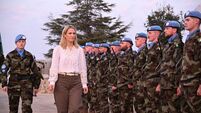
The exercises were based on cyber and hybrid attacks from fictious countries in Eastern Europe and beyond, which appear to be similar to Russia and China. File picture
The Defence Forces are taking part in the world’s biggest cyber defence exercise, including simulated cyberattacks on Ireland’s critical national infrastructure.
A total of 70 members of the Defence Forces — both full-time personnel and reservist — and civilian experts have been taking part in the Nato-led operation over the past week.
Brigadier General Mark Staunton, head of DF Joint Cyber Command, said Ireland is taking part in the “largest cyber defence exercise” in the world, along with Nato members and partner countries, as well as organisations and agencies.
He said the purpose of Cyber Coalition 25 is to “enhance cyber resilience to deter, defend, and ultimately defeat cyber compromises or threats”.
Between 65 and 70 people took part each day in the eight-day-long exercise in McKee Barracks, Dublin, comprising a core of 60 personnel, both permanent and reserve, and experts from industry and academia.
Lieutenant Colonel Mark Conway said there were 1,300 participants across 29 Nato members and seven partner nations, including Ireland.
He said the overall aim is set by the Nato Cooperative Cyber Defence Centre of Excellence.
This centre, which Ireland is a member of, is located in Tallinn, Estonia.
Two members of the Defence Forces were sent to Tallinn who selected and issued the cyber threats to the Irish team.

Lt Col Conway said the objectives for Ireland were to train personnel in cyber defence, test and refine Defence Forces' response procedures and plans, strengthen Defence Forces and civilian coordination and assess Defence Forces' ability to deploy resources during incidents.
He said they were looking to build a “national cyber network” to respond to incidents and enhance cooperation with Nato partners.
He said the Irish participants comprised 34 personnel from the Permanent Defence Forces, 20 from the Reserve Defence Forces, 12 experts from the ESB, and two from Irish Rail.
There were three cyber experts from consultancy group KPMG and one representative from the National Cyber Security Centre.
It started last Thursday morning, continued over the weekend, and finishes on Thursday afternoon.
The exercises were based on cyber and hybrid attacks from fictious countries in Eastern Europe and beyond, which appear to be similar to Russia and China.
Brig Gen Staunton said two of the five scenarios related to cyberattacks on critical national infrastructure — electricity and subsea communication cables.
“Critical national infrastructure is obviously fundamental to our economic wellbeing, so in this instance we’ve had an attack in the guise of an energy grid compromise," he said.
"We’re collaborating closely with partners from the ESB who have primacy in the maintenance of that essential service but we are engaged in how to confront a challenge in the event of an outage.”
Lieutenant Saoirse O’Reilly, who led this exercise, said in one scenario a phishing email was sent to a power grid system, which was clicked on by a worker.
This allowed an external server access to the network, activate malware, and “take down” the power system.
She said their task was to get the power grid back online as quickly as possible.
Full briefings of the exercise were provided to Defence Forces chief of staff Rossa Mulcahy, the Department of Justice, and An Garda Síochána.

CONNECT WITH US TODAY



Be the first to know the latest news and updates