Tom Cunningham: A witness to Waterford GAA's greatest days
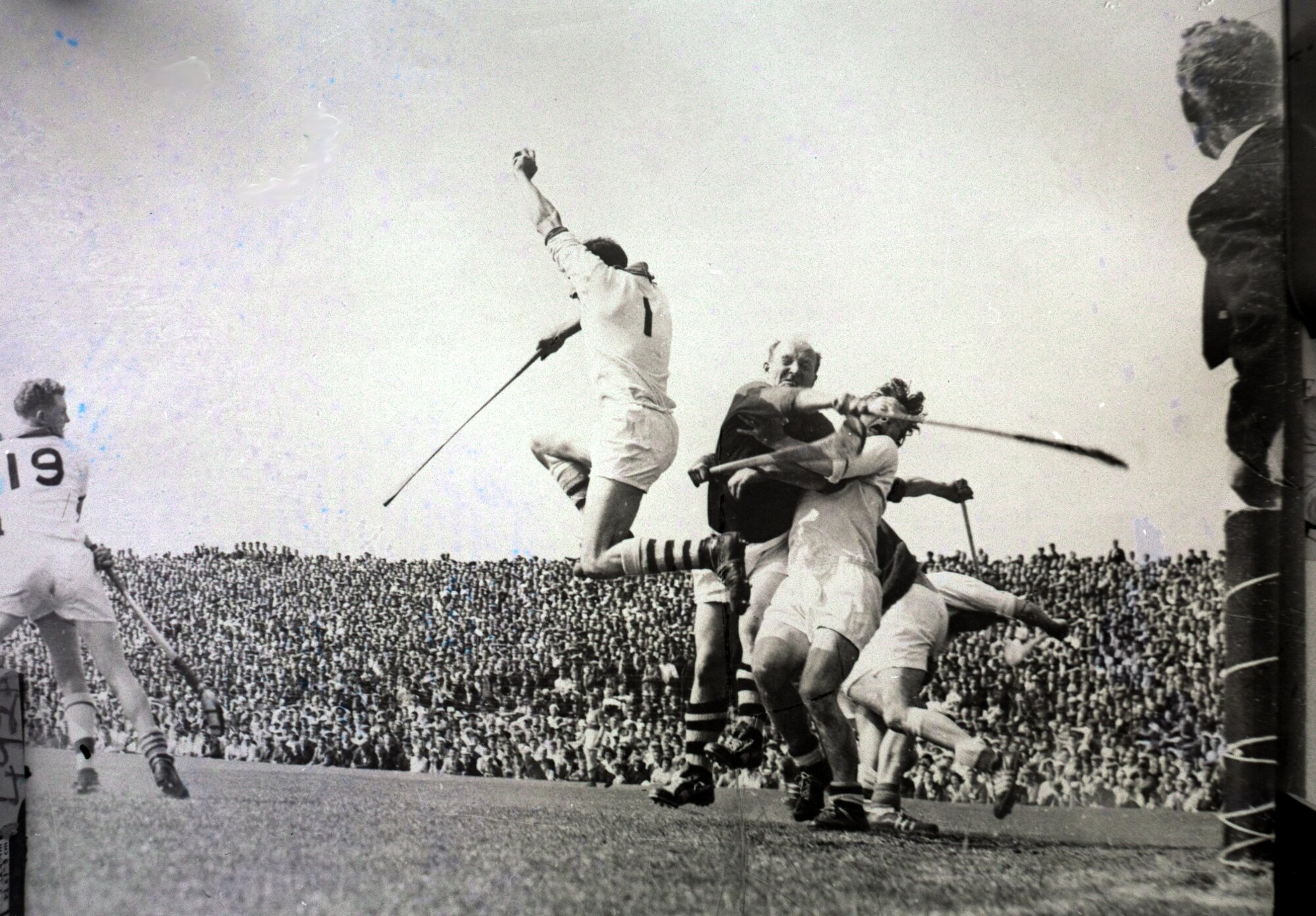
Waterford's Ned Power takes flight with sliotar in hand as Cork's maestro Christy Ring thunders into Tom Cunningham during the 1962 Munster hurling semi-final. Picture: Louis MacMonagle, Irish Examiner.
You could call Tom Cunningham the third man.
There is that photograph, one of hurling’s most famous images, shot by Louis MacMonagle for The day was July 8, 1962, Cork and Waterford in a Munster semi-final. Ned Power, goalkeeper, sails up to fetch a ball as Christy Ring pulls hard. That third hurler, taking the brunt of Ring’s stick across his face? He was a Dungarvan clubman, someone who unscrolled a remarkable GAA career in both codes.
Tom Cunningham smiles at this mention. “I didn’t mark Ring much,” he reflects. “But that photograph overtook everything. And it was Christy’s last championship day with Cork. Besides, there are two other men in the shot, Austin Flynn, our full back, and Liam Dowling, the Cork full forward. Christy must have come in from corner forward, hunting for a goal, and I naturally went with him.”
He has no recollection of the incident, that high ball gathered by Power:
“You marked Christy Ring second by second, minute by minute. It was all concentration. My job was just to keep down his impact, try to limit him to a couple of points. I was under no illusions about what he could do.
“Ring was an unusual man to mark. He didn’t shake hands before the throw in. Just came down to his position and stared at you. Kept staring at you, right in the eye. He had these bright piercing eyes. Ring was a gunfighter. It was you or him.”
Waterford won by three points and Cunningham survived the shootout. If he marked the man widely considered hurling’s finest, he also marked a figure often promoted as football’s greatest ever exponent, Galway’s Seán Purcell. The moment came in 1958’s Railway Cup Final, when the Waterford man appeared centre back for Munster. Connacht triumphed by five points, 2-7 to 0-8.
Cunningham was seriously accomplished with a big ball, capable enough to be selected for the Munster panel between 1955 and 1960.
“What I remember most about Seán Purcell is his attitude,” he stresses. “He came down to centre forward beforehand, shook hands with me, and wished me well. Maybe he knew I was from Waterford, that it was maybe a bigger deal for me to be there than someone from Kerry or Cork. I don’t know, but Purcell was a class act. The game itself is a blur at this stage.”
A quiz question for football heads, following this year’s Munster Championship, did the rounds: ‘Name the last time the team that beat Kerry did not go on to win the Munster Final?’ Answer: 1957 and Waterford.
Kerry were shocked, with Mick O’Dwyer as senior inter-county debutant, by the minimum margin, 2-5 to 0-10.
Here was Waterford football’s days of days. I am looking at the man who kicked the winning point.
Again, that wry laugh: “I could pretend I have a pinpoint memory of getting that score. I could, but I’m not going to invent a myth.
Cunningham began as a footballer with his county in 1950. His inter-county hurling career launched in 1952. There were bumps along the way but he stayed going until 1967, playing in four All-Ireland senior finals and winning the ultimate in 1959, when Kilkenny fell after a replay.
“Dungarvan has a long tradition of producing Waterford hurlers,” he notes. “The club had three men starting in 1948, when our first All-Ireland arrived. But there was always a football tradition too. Christy Moylan, one of those three men, also kicked football with Munster. Christy was also a marvellous hurler.”
Born on April 6, 1931, Tom Cunningham is a product of family, schooling and club. He simplifies the issue: “From my point of view, I was always interested in hurling, from the time I was seven, and in playing hurling out in the street, that sort of thing. The Christian Brothers, at both primary and secondary, really promoted hurling. And there was the radio. You would hear all the great hurlers’ names on the radio, and you would start to dream a little bit yourself.”
He relates a story redolent of how wit survives a vanished time: “There was a man in Dungarvan in the 1940s who rarely went to matches but would be glued to the radio. They used say Christy Ring was the best hurler that man had ever heard…”
Tom Cunningham stood in Croke Park, as a minor, on 1948’s marvellous day. He hurled right half back on the Waterford team that beat Kilkenny in their All-Ireland final. Yet Cunningham is emphatic when asked if he expected, in the early 1950s, to succeed at senior:
“No, I didn’t, to be honest. The 1948 Waterford team was an old team. And we experienced some hard defeats afterwards. Another All-Ireland seemed an eternity away.”
Frustration led him to opt out in 1956: “I always considered myself a back, but I kept being shunted up into the forwards. I sort of became a moveable feast. I just said I’d had enough of it.”
Wise counsel prevailed: “I went back for 1957, and everything had changed, for the better. Pat Fanning was the County Board man, and Pat was a brilliant organizer. John Keane came in to train the team, and he was excellent. No roaring or shouting or embarrassing anyone in front of everyone else. John would just have a quiet word here and there, as required.” Waterford were most unlucky to lose 1957’s senior final to Kilkenny by a point. They returned in 1959 and made no mistake. As Cunningham details:
“I got split by [Jim] ‘The Link’ Walsh and had to go to The Mater to get stitched. But it didn’t matter. My biggest memory of the celebrations is some public figure, a county councillor or someone, saying in a speech: ‘Waterford are not just the best team in Ireland but the best team in Europe.’ I suppose he could have said the world…”
He elaborates: “People say Waterford should have won more. Maybe, but it was very hard to get out of Munster. We might have been overconfident in 1963 for Kilkenny. Not us, the players, but the county. Kilkenny saw us coming. But no regrets.”
This man lived a good and successful life on and off the field. He rose high in the finance section of Waterford County Council. He married Bridie Mulcahy and they were blessed with three sons, Michael, Fergal and Kieran.
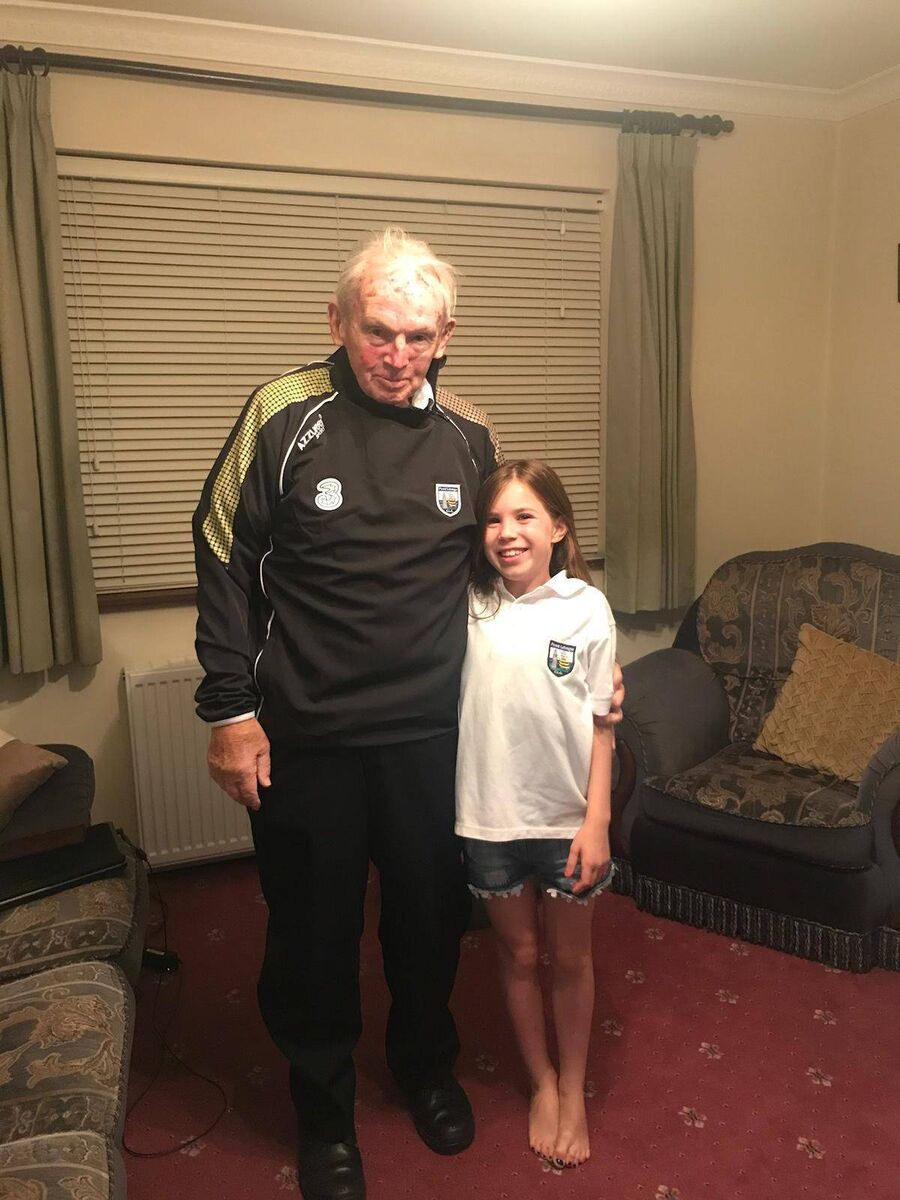
Fergal Cunningham, as his father omits to mention, was part of the Waterford U21 panel that won the All-Ireland in 1992. Mrs Cunningham passed away in 2011, a terrible blow, and Tom Cunningham’s eyesight now gives him trouble.
But he is still the same individual, considered and thoughtful and trenchant. Tom Cunningham is, in himself, an archive of Waterford hurling. He saw the first senior title in 1948, hurled for the second senior title in 1959 and hopes to witness tomorrow a third senior title.
He offers honed summary on what will be required: “We are all conscious in the county of how long it’s been, but you have to put that stuff aside at some point. The players have to want to do it for themselves and for their families. It doesn’t matter whether it’s been 60 years or six years or 600 years. It’s immaterial. It’s just two years since Limerick won it and they’re ever bit as anxious to win it again as Waterford are.
“The players have to put everything else to one side. Everything else is immaterial except winning. The first part of the job is to get to the All-Ireland final. It’s very hard to get there but Waterford have done that. Now they have to win, which is the second part. It’s as simple as that. Everything else is totally immaterial.”
Dungarvan, like Kilmallock, Patrickswell and other provincial towns, has fostered hurling across the decades. As I walked out from the centre of Dungarvan to Tom Cunningham’s house in Abbeyside, the sea breeze had bunting and flags whipping in what must now count as crowd reaction.
Croke Park will be eerily quiet this weekend as countless sitting rooms across two counties rise louder than ever before. There could be no more profound time to meet such a figure.
He even goes back, as that archive, to 1938, a season in which Waterford’s hurlers reached their first senior final but lost to Dublin. The memory stayed resonant:
“That year, my mother brought me to see Waterford and Cork in the Fraher Field. I don’t remember the action but I do remember being put on the players’ bus after the game, because the day turned out wet. Jimmy Mountain, one of our players, worked in a shop around the corner from where we lived, and my mother knew him from shopping.”
Tom Cunningham is aware of that moment’s symbolic colour. He is even, characteristically, a little amused by the thought:
“So my mother put me into the bus, in the care of Jimmy Mountain, to get a spin back. Nothing at all. Nothing, only a kindness to a young fella, on a dirty day. But you could look at it another way, looking back at it now.”
CONNECT WITH US TODAY



Be the first to know the latest news and updates