The old adage that good hurlers come out in the rain has never been seriously undermined
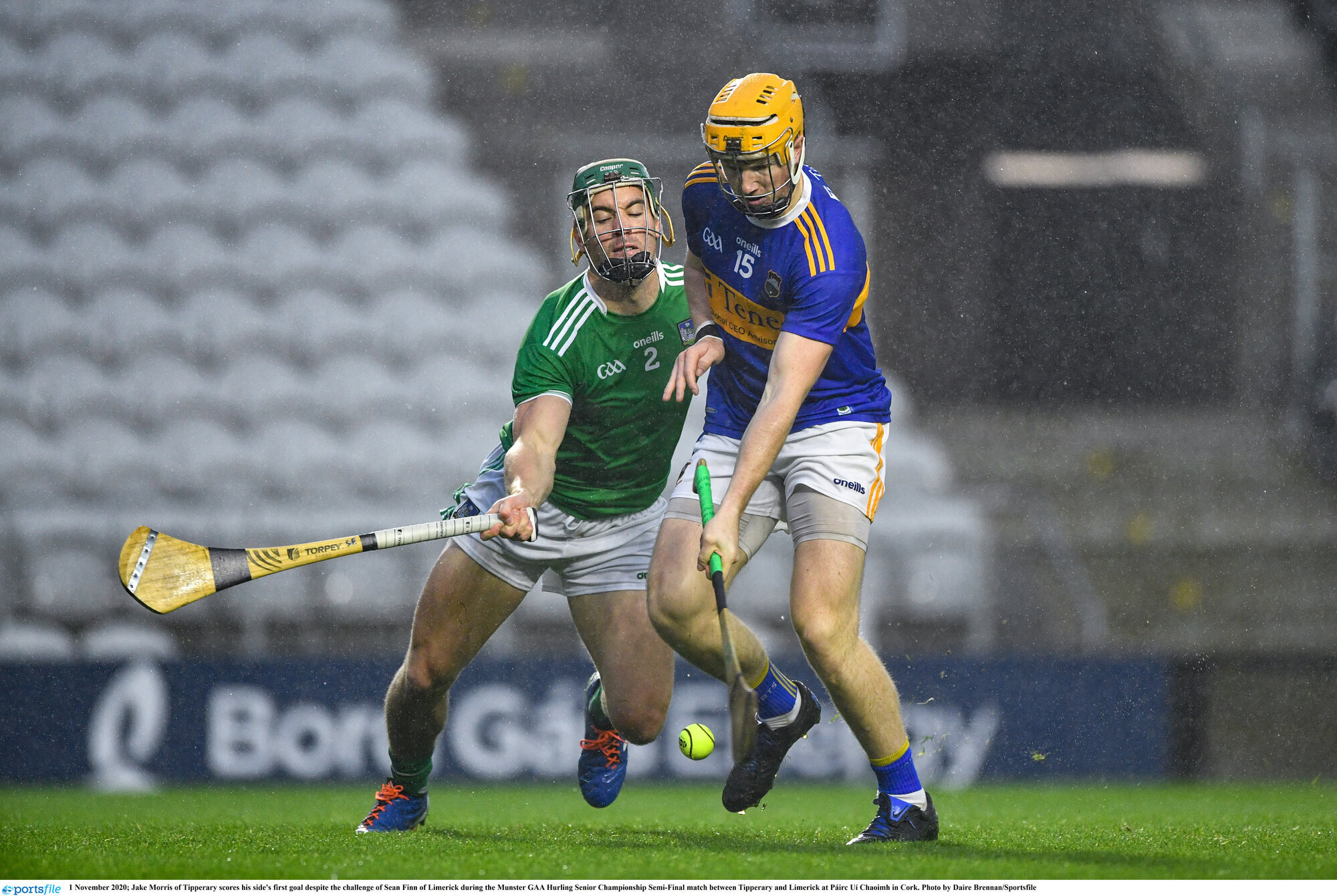
Jake Morris of Tipperary scores his side's goal despite the challenge of Sean Finn. Picture: Daire Brennan/Sportsfile
What did we learn, really, this weekend about the Munster Hurling Championship? What new information seeped into your consciousness and made a home for itself?
A couple of data-oriented economists would have a lot of fun with the three games so far in the winter version of the summer game, despite the fact that there are probably only about four hours of hard evidence in total to go through.
Because of that such creatures would be the first to issue warnings: in the search for patterns in this small sample size we may be overestimating the dips occurring in the graphs, or underestimating the trends underlying the crucial events. Still, there are surely some constant values we can find.
Take the ability of different sides to deal with variables like the weather, which was more notable yesterday than Saturday night (by ‘weather’ here I mean ‘bad’).
After a couple of brisk but bracing evenings we were finally struck with squalling rain and a driving wind. Well, it was the first of November.
Traditionally a sports report focusing on the weather is the last refuge of the scoundrel, but the prospect of a Munster Championship in the winter has had this caveat for some time, that it would have to be played in terrible conditions.
We got to see what that means at first hand yesterday and learned which side is good at it, but the first point is that this is not winter hurling as the elderly among us remember it, your correspondent included.
That meant Harty Cup games in locations like Bansha and Emly and Buttevant, where the underfoot conditions were so adhesive there are surely a few old adidas boots still stranded there, lonely in the mud of no man’s land, stuck fast out near the 65 from a game played around 1979.
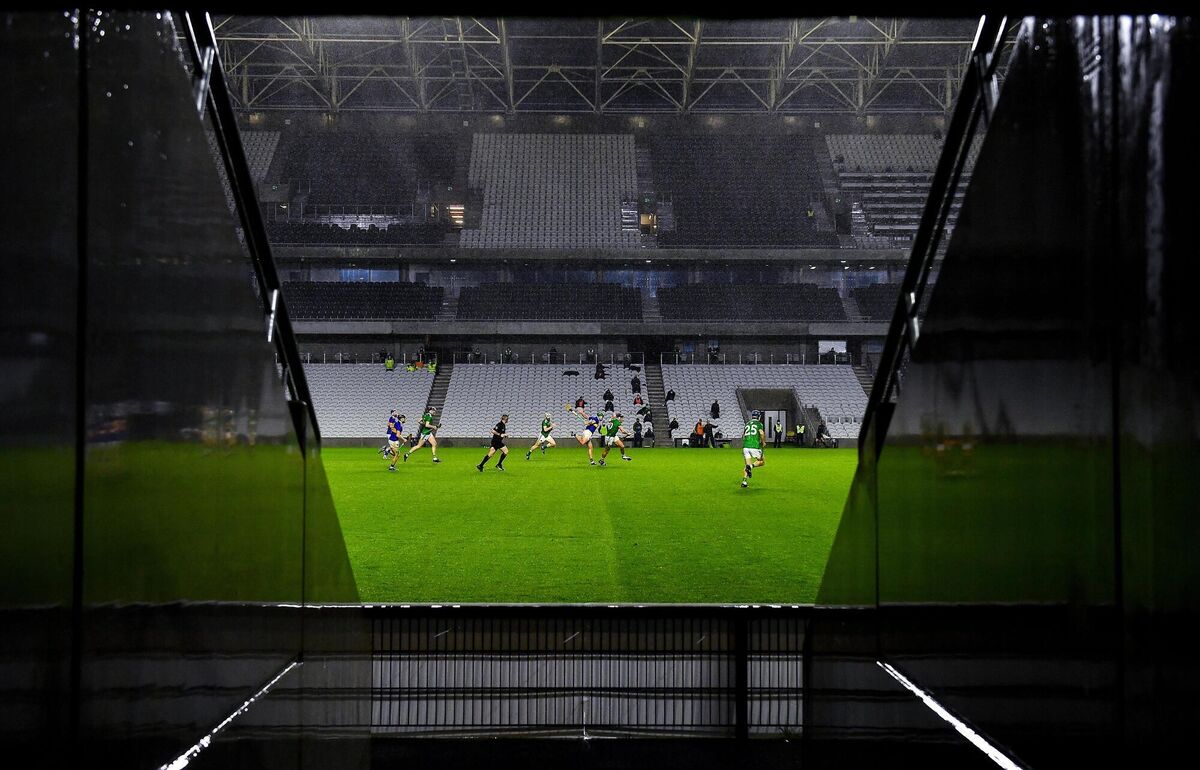
The surfaces in Páirc Uí Chaoimh and Semple Stadium alike were good over the weekend, but yesterday in Cork the rain and wind undoubtedly added a layer of difficulty to the players’ task.
Yet this should ultimately reward the better hurler. In the past, we have quoted the Cork hurler of a century ago who pointed out that the good hurlers come out in the rain, and his principle has not been seriously undermined since.
However, Limerick’s physical power was an added advantage in yesterday’s game, conditions notwithstanding.
Their physical power is often the main focus — a lazy focus — when it comes to evaluating their strengths as a team, but the cohesiveness of their tackling as a team is so strong that it can sometimes be taken for granted.
At the start and end of yesterday evening’s game they stripped opponents of the ball as they tried to work their way out of defence, a couple of handy bookends just to underline that notion.
But the lesson has already been well absorbed by their Munster final opponents. On Saturday evening in the dusk of Thurles Waterford boss Liam Cahill acknowledged the appetite for work of his players, as he was entitled to do.
They had won more 50-50 balls than Cork in their semi-final and were also more aggressive in the tackle all through. That was clear even to those who weren’t present.
“They really impressed me in the league, they are very organised, very hard working, same again last night — very organised, very composed and very hard-working last night is what I would say. It’s going to be a big challenge.”
The speaker? John Kiely yesterday, recognising the quality in Waterford’s performance.
For the two sides which lost over the weekend the lessons are different.
Tipperary will be disappointed with the result but a campaigner with Liam Sheedy’s experience will recognise the value of a game in this unusual championship.
Kiely himself pointed out that the only real benefit may have more to do with getting acquainted with the strangeness of the logistics, but Tipperary took a while to get accustomed to the pace of a championship game, albeit a winter championship.
In the opening eight minutes, for instance, Limerick had six points on the board to Tipperary’s one, while further back the field the Premier defenders’ deliveries were contaminated by the pressure Limerick put them under.
(Another lesson worth learning: Limerick moved Cian Lynch up to the half-forward line and Kyle Hayes to wing-back at the start of the game and Tipperary took some time to get themselves organised in response.)
On the plus side, Tipperary got goals: Seamus Callanan’s sumptuous assist for Jake Morris’s opener was the kind of pass that the Tipp captain can produce in a heartbeat to turn a game. It might be no harm to remember this morning that an easy point was on offer to Callanan before he placed his teammate for goal: a lesson not just for blue and gold fans but for young hurlers everywhere.
If Tipperary’s second goal had a whiff of sulphur about it there was something to be learned there also: John McGrath padded through to finish calmly instead of waiting for a ruling on his brother Noel’s sleight of hand. Playing to the whistle is a constant in every code.
For Cork an unspoken part of what was common to Limerick and Waterford alike over the weekend may sting sharply this morning.
When Liam Cahill was asked about his players’ work-rate in their semi-final win he acknowledged it, as noted — but he segued immediately to praise for his players’ distribution and composure when in possession.
The lesson there? That some qualities are non-negotiable and taken as a given. It clearly didn’t occur to Cahill that his side’s work-rate was a matter for debate, hence his speed to discuss their delivery of the ball.
The best teams either learn that fast or have never forgotten it in the first place. The lesser sides find it all the harder to assimilate, and some never do.

CONNECT WITH US TODAY



Be the first to know the latest news and updates