Dónal O’Grady: The Tipp fans roared when they saw John Doyle trotting out to mark Christy Ring
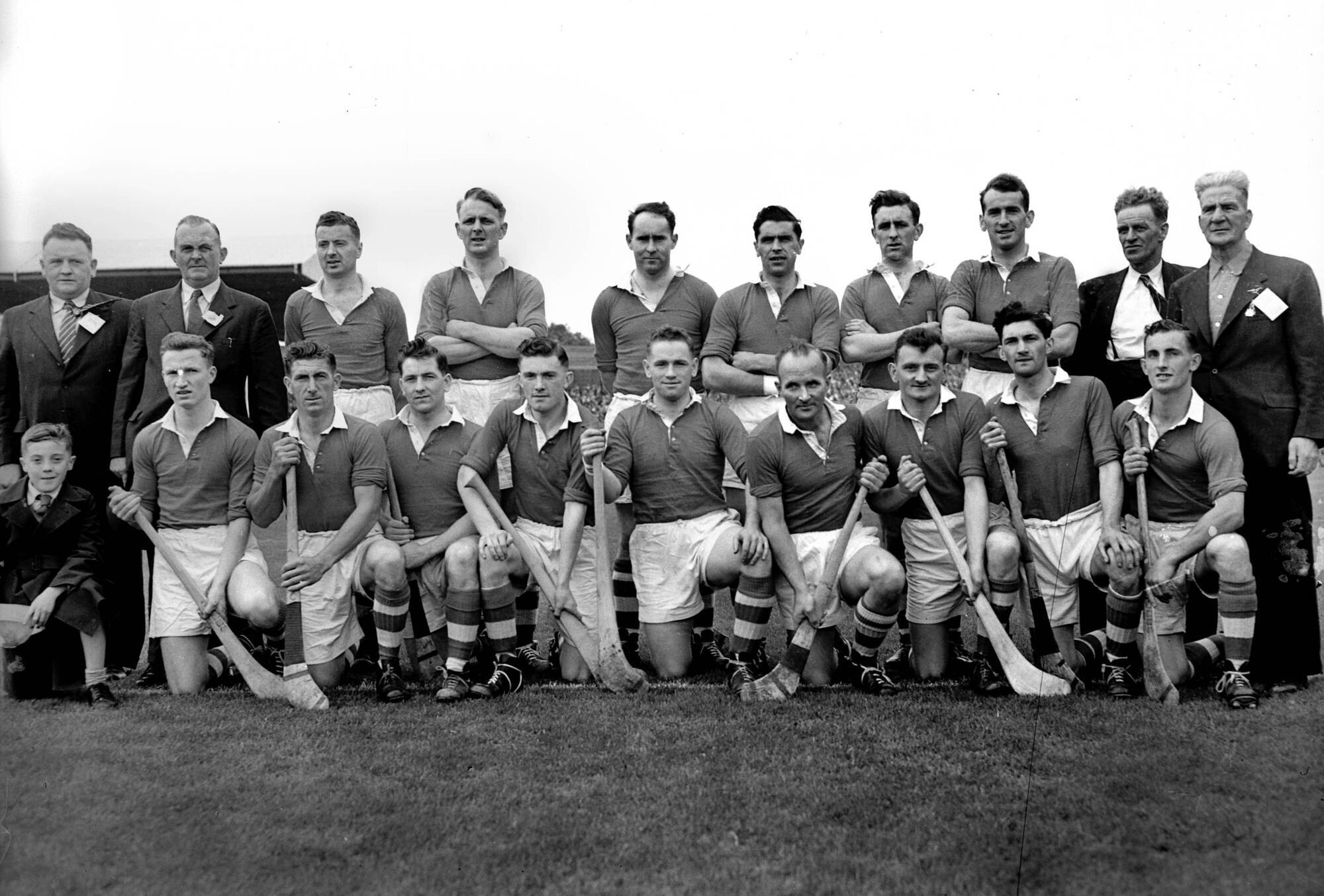
The Cork team who played Wexford in the 1954 All-Ireland senior hurling final at Croke Park: Back, from Left: Jack Barrett (Kinsale, Selector), Andy Scannell (Chairman Cork Co. Board), Dave Creedon (Glen Rovers), Jerry O’Riordan (Blackrock), John Lyons (Glen Rovers), Derry Hayes (Blackrock), Mattie Fouhy (Carrigtwohill), Gerald Murphy (Midleton), Paddy ‘Fox’ Collins (Glen Rovers, Selector), Jim ‘Tough’ Barry (Trainer). Front, from left: Eamonn Goulding (Glen Rovers), Willie John Daly (Carrigtwohill), Tony O’Shaughnessy (St. Finbarrs), John Clifford (Glen Rovers), Josie Hartnett (Glen Rovers), Christy Ring (Glen Rovers), Paddy Barry (Sarsfields), Vincie Twomey (Glen Rovers), Willie Moore (Carrigtwohill). Picture: Irish Examiner Archive/ Ref 857G
A photo of the 1938 All-Ireland-winning Cork minor team hung on our kitchen wall when I was a child.
I was always proud that my mother’s brother Kevin captained the team to beat Dublin on a scoreline of 7-2 to 5-4.
However, the player kneeling third from the left in that photo — the team’s right-half-back — was the great Christy Ring, that I ‘became’ when I picked up a hurley and ball.
I have clear recollections of pucking a sponge ball ‘ad infinitum’ against the brick wall of our house.
It was the ideal practice area and I constantly hurled the ball against the wall, aiming each time for a particular brick because I’d heard that Ring had practised in that fashion.
I grew up in a hurling household listening to adults discussing the game and the merits of the various personalities. My father had played with Ring on Cork teams and against him in club games, and he was also very friendly with Mick Ryan of Roscrea and Tipp, who hurled with the Barr’s when he moved to Cork.
Ryan was a big player for Tipp in the three-in-a-row team from 1949 and in their battles with Cork in the early ’50s. Listening to this hurling analysis, I formed the opinion that games against Limerick and Waterford were important, but that they were elevated to life and death struggles when Cork played Tipp.
Anyone present for these regular deliberations was left in no doubt about the greatness of the ‘maestro’. It was easy to discern from these exchanges that Ring was Cork’s leader, our greatest warrior, our Cúchulainn.
Later in life, I remember discussing some game with my father in which I had played. I said I thought our defenders played well. He scoffed at this remark and said: “Defenders? Ye wouldn’t have lived with Ring.”
Christy Ring made his full debut for Cork seniors in October 1939 against Kilkenny in the league, which then began in October and finished the following May.
The ‘Cats’ had pipped Cork by a point in the ‘Thunder and Lightning’ final a month earlier. Incidentally, Alan Lotty of Sarsfields and Ted O’Sullivan from Midleton, minors with Ring in 1938, went straight onto the senior team at corner-back and full-forward respectively. (If Ring had been selected on that 1939 senior team, would Cork have overturned that one-point loss?)
In a replay in 1940, Cork were beaten by a strong Limerick team who went on to win the All-Ireland against Kilkenny.
It was Ring’s first introduction to a senior Munster Final. In Val Dorgan’s book, Ring described the replay as the toughest game he ever played in. He learned in those games against Limerick “that hurling needs courage, heart and a firm belief in one’s own ability”; he demonstrated those in spades for almost a quarter of a century in front of an adoring public for Cork and in Railway Cups for Munster, where his drawing power led to phenomenal crowds
Many hurling fans — particularly those of a certain age — have said the stirring contests between Cork and Tipp during the ’40s and ’50s ‘made’ hurling. They were full of passion, both on the pitch and among the spectators.
There were controversial goals and ‘non-goals’ with Ring central to it all. His finest performance for many was at midfield in the loss to Tipp in 1951. He played in his bare feet in the second half and drove the Cork comeback but two late points brought the spoils to the Premier.
Thousands of passionate supporters came in their droves to see him play and thousands more tuned into Mícheál Ó Hehir’s commentary to hear of the exploits of Ireland’s foremost hurler.
Eddie O’Donnell, a native of Nenagh domiciled in Mallow for many years, was ‘statistics co-ordinator’ for Cork from 2003 through 2006 and is well known by current and former players of all counties.

In the Munster final of 1954, Ring was playing left half-forward. Tipp played Mickey ‘The Rattler’ Byrne —normally a cornerback — at wing-back to mark Ring. That didn’t work out for Tipp and Ring went to town. Eddie told me a huge surge of excitement and expectation went through the crowd, and a huge roar went up from the Tipp fans when they saw John Doyle trotting out from corner-back to mark Ring: this must have seemed like the arrival of the cavalry in the old western films.
“Within seconds, the ball came down in the air,” said Eddie. “Ring moved smartly and caught the ball.
Doyle made a huge lunge to try and collide with Ring but he sidestepped him.
It was these personal battles that drove Ring.
My mother saw Ring at his best and has always been an astute judge of sport.
“There was always an expectation and a huge buzz of excitement whenever Ring went to a ball,” she told me last week.
“He stood out from all the others. He was fearless. He had fierce powerful wrists and above all he relished the physical exchanges.
“It was as if he sought these out, and the tougher the better.”
According to her the anticipation of these games for months beforehand kept people going in the tough economic times of the ’40s and ’50s.
Ring captained Cork to victory on three occasions. His first victories were as an important member of the 1941-44 ‘four-in-a-row’ teams. However, he came of age for many in the final of 1946 against Kilkenny: the headlines on the press reports of that game name him as the star of the show, which was most unusual at the time.
He took that game by the scruff of the neck and bent it to his will, scoring a decisive goal when he ran through from well outfield to crash the ball to the net.
He was so good that day that in the following year’s final Kilkenny detailed two men to mark him. This reduced his influence considerably and Kilkenny scraped home by a point, 0-14 to 2-7, having developed the strategy of double-marking Ring and striking points from outfield.
Seamus Leahy — a nephew of the famous Paddy Leahy of Tipperary — and his family holidayed with the Ring family for many years in Kerry.
“We talked a lot about hurling but he never had a bad word to say against anyone who played against him,” said Leahy.
One can judge the respect in which Ring was held by the attitude of his opponents to him. He was shouldered off the field by Wexford’s Art Foley and Nick O’Donnell after the 1956 final and former opponents from Tipperary held him in the highest regard.
’Mackey’ McKenna of Borrisokane, a great attacker with the blue and gold in the ’60s, told me that he adored Ring. ‘Mackey’ remembers the hurling discussions when families and friends went to the bog to foot the turf: “The conversation was always about hurling and Ring.”
This was in an era when Cork and Tipp had built up a rivalry of titanic proportions.
“Half of the people there were for Ring and the other half were against him,” but according to ‘Mackey’ all recognised his genius.
Mick Burns, a classy wing back for Tipp from the late fifties through the sixties, told me recently that Tipp defenders were always conscious that they would “come up against no one better” in reference to the ‘great one’.
“I often met him off the field and he was as gentle as a child,” he said.
Burns added that Ring was ‘special beyond all’ and unlike other forwards of note ‘he never had an off day’.
Another Tipp defender of that era, Matt Hassett, marked Ring on various occasions: “I always tried to get out in front of him. Once he got it in his hand you were in trouble.”
Hassett added that one had to be cool and calm to have any chance against Ring.
Matt O’Gara of Toomevara played for Tipp in the ’60s wearing glasses and referenced the three goals Ring scored against Limerick in the Munster final of 1956 as a performance he would never forget: “Just after he changed his hurley and went into the edge of the square.” Ring scored 3-1 in the space of a few minutes to turn the game.
Tony Wall made his debut for Tipp in 1953. He was a most cerebral player and one of the greatest, if not the greatest, centre-half-backs of all time. When I asked Wall how they viewed Ring as defenders, he answered by quoting lines from Bryan McMahon’s ballad: Now Cork is bet; the hay is saved the thousands wildly sing, They speak too soon, my sweet garsún, for here comes Christy Ring.
Wall also mentioned that ’56 final: ”Cork had beaten us in the semi-final so I wandered down to the field (Semple Stadium) to see Cork and Limerick.”
Speaking about Ring’s burst, he said: “It was the most magical few minutes I have ever seen on a hurling field.”
Seán Ó Tuama, a former professor of Irish in UCC also referenced Ring’s performance as an example of courage in a TV interview.
“I saw Ring talking to the hurley carrier when he went to change his stick. I approached the hurley carrier after the game to find out about the exchange that took place between them.
“‘What do you think?” asked Ring. ‘Well, Christy” said the hurley man, ‘we’re not going well and we’re two goals down.’ Ring replied, ‘Well, I will have to ram in three goals, so’.”
Ó Tuama said Ring’s reply was a most outrageous statement but that he had the courage to back it up.
John D Hickey, a Tipperary native and a hurling reporter with the had at one time referred to him as ‘the peerless and incomparable Christy Ring’ who ‘supplied touches that stamped him as a genius’.
However, reporting on the Munster final of 1961, he wrote that Ring had struck Tom Moloughney who had to leave the field with a head injury.
Moloughney said to me last week: “I didn’t know who hit me but all I knew was that it wasn’t Ring. We always had the highest of respect for him.”
It must have been very difficult for Ring, after all his years, to be accused of such an act when he wasn’t involved. But Ring was no angel. Matt Hassett says “Ring was well able to mix it” and Matt O‘Gara offered a similar view: “Ring could rough it and take punishment. He was always a marked man.”
According to ‘Mackey’ MacKenna, “Ring could look after himself, but of course he had to as he took desperate punishment”.
The county board and Cork public backed him in 1961 and Hickey was banned from the press facilities in the Athletic Grounds. The controversy ended with Ring’s vindication, when the was forced to withdraw the accusation and to offer a public apology.
Ring did not play for Cork in 1964 or 1965 when the Rebels were walloped by a super Tipp team in Munster finals. I remember the discussions in 1966 about Ring and his potential ninth medal, and whether he was good enough for Cork. I think he was, but it was not to be and he finished completely in 1967.
‘The likes of him will not be seen again’ is a phrase that is sometimes overused.
However, in Ring’s case it is entirely apt. He is still the greatest ever.
- My thanks to Johnathon Fehily of Cork City Library local studies section for his invaluable help with this feature.