Larry Tompkins: Meath nearly broke me but Fergie and Man United started the healing process
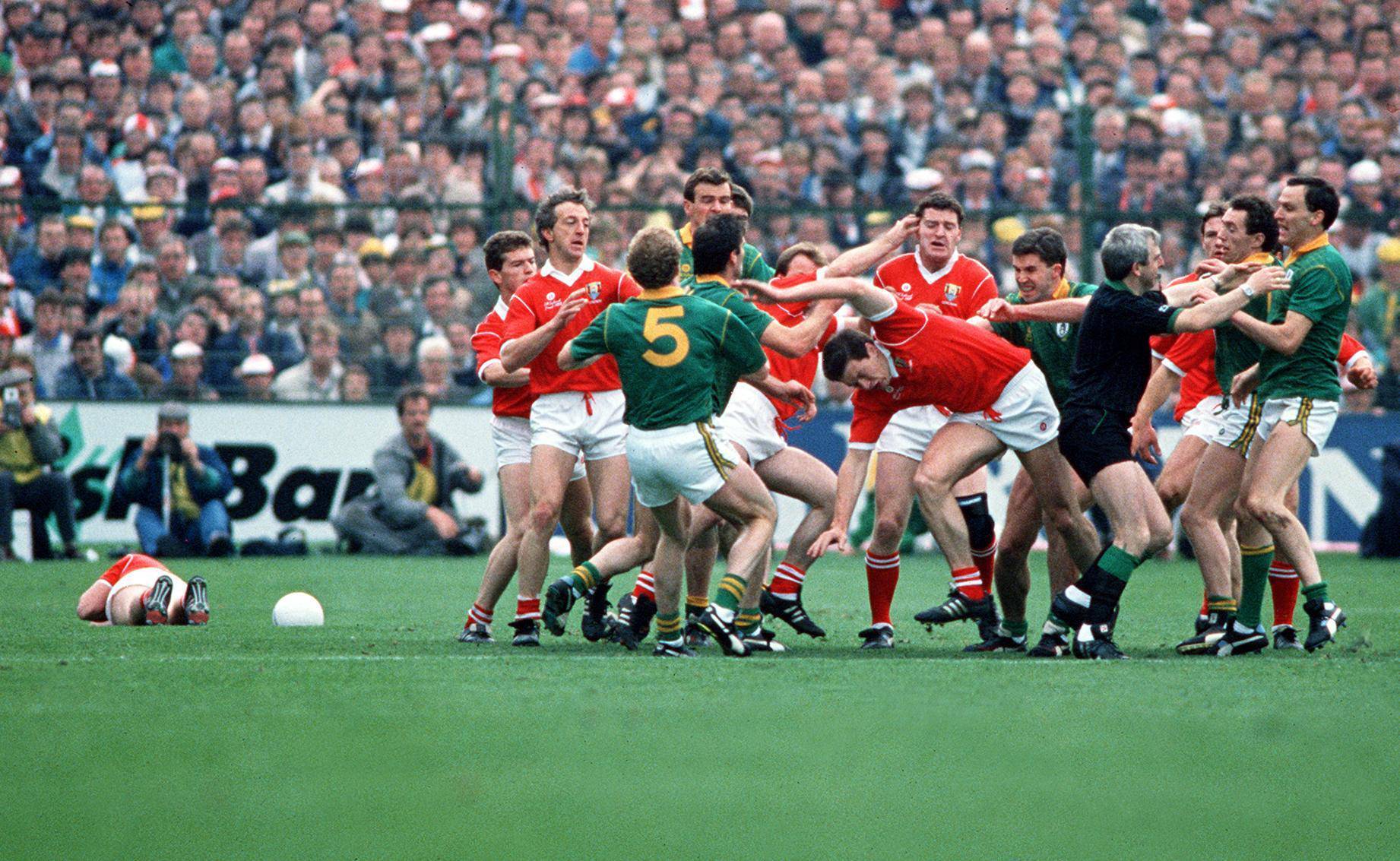
All Ireland Football Final Cork vs Meath 1988 A fight breaks out as the referee restrains Gerry McEntee of Meath. McEntee was later sent off. Picture: INPHO/Billy Stickland
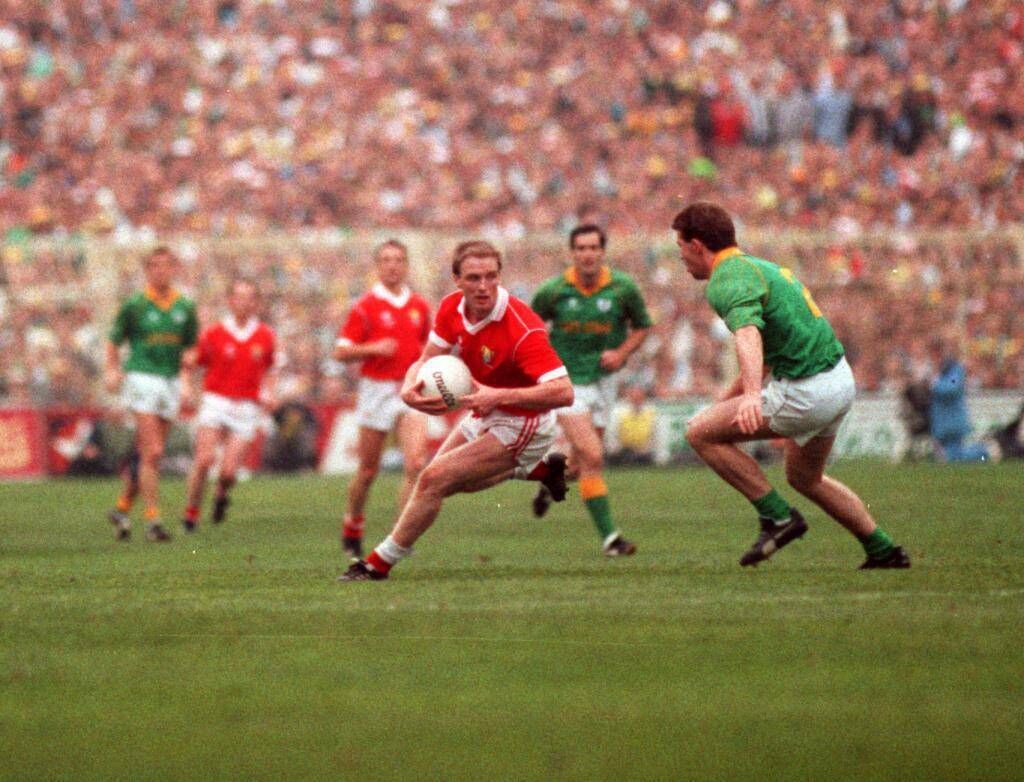
We got a great start to the 1988 All-Ireland final against Meath.
I was doing okay physically but then a ball broke around the middle and I felt the hamstring go. I headed for the sideline to tell Billy I was gone, but before I got my words out, Billy was roaring at me to swap with Teddy.
I said to myself... If this is the last game I play, I’ll wipe the pain out of my head. As a forward, you’re looking to get off the mark, anticipating a break when the ball comes towards you. At midfield, you’re going for the ball in the air and you’re at a different pace, so that suited me rather than having to sprint for the ball.
We owned the ball in the second half, but we did not capitalise on all our opportunities. On the 70th minute mark Dave Barry was fouled and a free awarded. Dave gave me the ball.
‘Whatever you do... put it over!’ he said.
Tommy Sugrue from Kerry was refereeing, and I thought I heard him say, ‘Time is up!’ I put down the ball and I turned to Hill 16 and I blessed myself. I knew as soon as I had kicked the ball that it was going over.
I didn’t even have to look at it. Dave jumped up on my shoulders and I fell to the ground. Then, McQuillan kicked the ball out and the ref let play go on. Shea Fahy caught it cleanly and went to fist it to Tony Nation, but the ball went out over the sideline at the Cusack side.
Still, he still let play go on.
Martin O’Connell sent a massive kick in and everyone went for it, before David Beggy threw himself on the ball. And Sugrue gave a free. It was easy for Stafford and that was it, a draw, 1-9 to 0-12. Sugrue came in for some stick, I remember Conor trying to keep the peace.
There was hardly a word spoken in the dressing-room afterwards.
The only noise I can remember was Dr Con Murphy bawling crying, something I had never seen before. I was banjaxed.
I could hardly walk and Dr Con was saying that there was no way I’d be able to play in the replay. The one saving grace was that we had a three-week window – normally there would be two weeks until the replay but the Nissan International Cycling Classic was finishing in Dublin on October 2, and so the game was put back to October 9.
When we got back to the railway station on the Monday night after the drawn game, we were fairly deflated. I was expecting to have to get the leg iced on the Tuesday by Dr Con to get the rehabilitation going, but I got a phone call late that night from Frank Murphy.
He asked if I could be at Cork Airport the following morning. Dan Hoare, the county board treasurer, would meet me with money and a plane ticket to Manchester – I was being sent to Manchester United for treatment.
The pilot on the flight over was a man by the name of Con Foley, a brother-in-law of Barry Coffey’s. Con’s uncle, Donal Foley was chief pilot in Aer Lingus at the time and the two of them used to fly us all over the country to national league games.
When I landed in Manchester, I was met by former Manchester United player, Paddy Crerand, who had been a member of the team that won the European Cup in 1968. That was around 10am or 11am and he took me straight to the training ground, known as The Cliff. I was to be staying near Old Trafford in the Copthorne Hotel, which was owned by Aer Lingus.
I couldn’t get over the size of the training ground, there were loads of pitches and the main building was nearly all glass. Bryan Robson, the United captain, had a reserved parking spot but it was empty – I didn’t know it at the time but it was because he was off the road. In the first-team dressing-room, each cupboard had a player’s name on it and there was a jacuzzi in the middle of the floor, a step up from what we had in Páirc Uí Chaoimh!
Paddy brought me to meet the physio, a Scotsman named Jim McGregor, up in the treatment area on the first floor. Norman Whiteside and Clayton Blackmore were being treated and Alex Ferguson popped in.
‘I heard you were coming,’ Fergie said. ‘You’re one of us now... anything you want, just ask, but you’re to be here at quarter to nine in the morning like any other player.’ Jim McGregor took a look at me and he was shocked. He said it was the worst hamstring tear he’d ever seen in his life, that I had a lump the size of his fist.
‘How the hell did you play on?’ he wanted to know.
That sounded ominous, but there was a positive, of sorts.
‘If you’re willing to suffer, we have a chance,’ he said. ‘I’ll have to sign a form declaring that you’re able to play and I’ll have to be truthful.’ Treatment started straight away. I lay down and he handed me a strap, and said, ‘Bite on that!’ I noticed a bucket on the ground under my head. I learned later that it was there to mop up the sweat and the sick because of the severity of the treatment. He went at it hard, and my screams were loud.
Norman Whiteside was lying beside me, getting treatment, and he was laughing at me. ‘You GAA lads must be made of paper,’ he told me. I didn’t try to hide the pain from him, or anybody else. The pain was brutal. I was taken back to the hotel in a taxi and, even after two treatments, it was beginning to feel better.
The following morning, I was collected by Paul McGrath, who had given Bryan Robson a lift. Robson was asking me about Kevin Moran, who had recently left United to move to Sporting Gijon in Spain. Robson said he still couldn’t believe how we’d be playing in front of 90,000 people and not get paid a penny for it.
It was back up to Jim McGregor for more of the same.
He had a big window looking out on to one of the pitches, allowing him to tell lads to go down for a run so he could see how they were going. Whiteside was beside me again, being treated for an Achilles tendon problem. McGregor told him to go out and do a few laps but he was back in within 10 minutes. ‘I’ll get the same money lying here on the table!’ he laughed.
On the Saturday, I had one round of treatment in the morning and then Alex Ferguson gave me a player’s pass - United were playing West Ham and I got to sit with the squad members behind the dugout. The players all showed up beforehand in their suits, they didn’t even have to bring a pair of socks with them, all the gear and everything else was laid out. A far cry from home.
The boots were shining as if they were going to Sunday Mass.
On the way there, I asked the driver how he thought United would do that season and he said that, if nothing else, they’d win the drinking league!
The following week I was still getting three treatments each day, with stretching and gym time thrown in. But I got out in the evenings. My driver brought me to the Old Nag’s Head, where I got to chat with Mark Hughes and Brian McClair for a few hours. I left early; they were in for the long haul.
I was named to start the replay and I was planning to go home on the Thursday, flying from Manchester to Dublin and then on to Cork in time for a team meeting in Jurys Hotel.
Jim put me through 50 minutes of a fitness test at Old Trafford in the morning and I came through that fine; I was sprinting and the hamstring felt great. He signed the letter clearing me to play and told me I’d worked really hard. I boarded the flight for Dublin but as we came in to land, the weather was beginning to get worse.
I didn’t think too much of it and I checked in for the flight to Cork – it was due to land at 7pm and the meeting was 8pm. I went to get a bite to eat but then I met the Dublin player, Paul Clarke, who worked as an airport policeman. He said that the forecast was for a storm and that the flight to Cork was cancelled. People were being sent back on a late train but that wouldn’t be in until midnight.
I didn’t know what to do but who did I bump into only Con Foley, who had flown me over – he was due to fly the plane from Dublin to Cork! I told him my situation and he said to hang on, that he might be able to clear it to go back as the plane had to be in Cork for the morning. When he came back and gave the thumbs-up, I assumed that the scheduled flight was back on. But I was the only passenger; me with three air hostesses!
It was rough coming into Cork. It took about three-quarters of an hour to land. There was talk that we’d have to be diverted to Shannon but eventually we got down. The plane was nearly landing on one wheel.
I felt like the President coming off the plane on my own but I had to rush to Jurys. I was telling the other lads what had happened but they wouldn’t believe me at all; they said it was too far-fetched!
TOMMY Sugrue was the referee again. Nowadays, it’s always a different ref for a final replay. In the second game Sugrue was a busy man. Meath had felt that they let us away with too much in the drawn game and they made sure that they wouldn’t be caught again.
The weekend before the replay, they had gone to Dundalk and Seán Boylan had abandoned a training match after a quarter of an hour because they were killing each other. They were definitely more geed up and it felt like there was a fight every 10 minutes; they wanted to make it a physical battle. Gerry McEntee was sent off early on for a kick on Niall, but we couldn’t make use of the extra man. We led at half-time, 0-6 to 0-5, but we weren’t patient enough.
We went 0-8 to 0-6 ahead in the second-half but they got four points in a row and led from there. Liam Hayes was brilliant at midfield for Meath; PJ Gillic slotted in alongside him, and we couldn’t reproduce our dominance of the drawn game.
It was 0-13 to 0-9 for them with seven minutes of normal time left and we ate into that lead with points from Dinny Allen, myself and Barry Coffey, but the referee blew up when it felt like we might have been given more time.
It was fairly sickening to lose another final but the injury was fine at least and I felt I played well.
There was one sour note at the final whistle, when Gerry McEntee, with whom I was friendly, ran across the field.
‘Ye’ll never beat us!’ he shouted at me. I ran after him to clock him but, as I was running, the crowd was coming in and I got hit by the end of a flag on top of my head.
In the dressing room Niall Cahalane was crying, and Dr Con was telling him that the reason he himself had been crying after the draw was because he felt our chance was gone.
We went to the function that night, organised by the Dublin Corkmen’s Association, as people had paid their money for that. At the time, there used to be a luncheon organised on the Monday for the two teams in the Royal Hospital in Kilmainham and you can imagine how little appetite there was for that.
I didn’t bother going; instead, a few of us congregated at Paddy Cullen’s pub in Ballsbridge. As it happened, we missed the GAA president, John Dowling lamenting the manner in which the game had been played and, later in the year, when he would go to Meath to present their medals, Liam Harnan and Gerry McEntee would refuse to accept theirs.
On the Monday after the final, McEntee was feeling guilty about what happened between us. He hoped to apologise to me at the luncheon but when I wasn’t there, he asked Dr Con where I might be and so he rang Paddy Cullen’s. We were drowning our sorrows, and I didn’t come on the phone to him. To be fair to him, he got in touch again a few days later. He apologised and I said that I should have taken the call. In life, you meet sincere and honest guys; you realise how much these things mean to them, and it was easy for me to forgive him.
It’s an All-Ireland final, you’ll do anything you can and the emotions are high. I’m not the kind of person to hold grudges for the rest of my life. It was something he felt bad about and I would have preferred if it hadn’t happened but these things occur in the heat of battle. Gerry McEntee is a hell of a guy and I wouldn’t let that incident lower his colours.
We had known each other going a way back. He looked after me when I got the blow to the head in 1983 and we won our first All Stars together in ’87 – on that occasion, we each turned to the other and said that it was well overdue!
We parted on a good note and we’ve always got on well since.
COMING back down to Cork after the final, we were low but I don’t think there were any doubts about Billy’s future. Looking back, 1988 was a very defining year for Cork, as the team grew up as men.
There were savage leaders in there. We had measured up to the challenge of Meath and a bit of luck just went against us. Meath came out of the drawn game saying they had let us play too much so they had to make it a bloodbath the second day, whereas we came out saying not to get involved and to play football.
No Cork fella backed down, fights and scuffles broke out and each fella fought his battle, but they were willing to go that bit further.
Still, I’d never take away from Meath’s victories against us, because I know how good they were.

CONNECT WITH US TODAY



Be the first to know the latest news and updates