1,000 days later, still waiting for the GAA’s prize project in Ulster
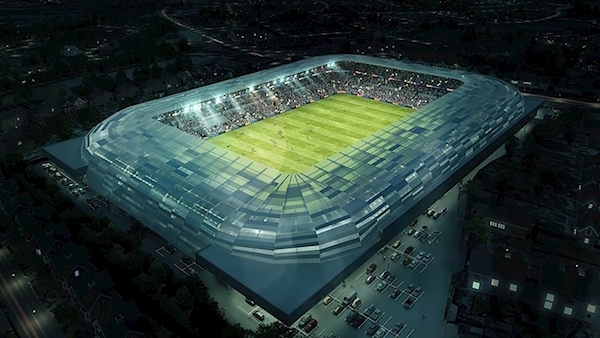
On Monday, an ignominious landmark in the Casement Park Project was reached — 1,000 days since the last planning application was lodged.
In advance of the occasion, the Ulster Council took the unprecedented step to sending an open letter to all its units conveying its deep dissatisfaction with the process, ahead of the club AGM and county convention season.
Over the past year, a number of county board meetings have aired arguments for and against the development of Casement Park into what the Ulster Council aspires to be a provincial stadium.
The concept has been developed by the award-winning architects at Populous who have designed the Tottenham Hotspur, Emirates, and Aviva stadiums.
From the initial proposal, the Ulster Council have scaled back the size to become a proposed capacity of 34,500 inclusive of 8,500 standing spaces and roof capacity for all spectators.
However, the Ulster Council remain entirely committed to the process and feels mounting frustration that other projects such as the Belfast Transport Hub — a £200m (€233.4m) project which was submitted for planning after the Casement project — has already been processed, with work due to begin soon.
Part of the hold-up comes with the collapse of the Stormont Assembly. In the absence of politicians being able to apply pressure, key capital projects are being decided upon by senior civil servants — something that has frustrated Stephen McGeehan, a prominent member of the Ulster Council’s Planning and Development Committee since the genesis of the idea.
“If there were a government sitting, major decisions — be it in planning, education or whatever — would more likely have been taken because administration would be there with the wherewithal to make those decisions,” he said.
“Things like the Casement Park Project is still in the Programme for Government priorities. It was in the foreword in the previous Programme for Government whenever we did have an assembly, and that’s great kudos for the project.
“There are two strands of that programme that have been developed, Windsor Park and Ravenhill. It’s inconceivable we wouldn’t be cleared up with the third strand with Casement Park delivered for the GAA because it was a government requirement for all three sports.
He continued: “In the last week or 10 days we had one of the best teams in the Netherlands playing in Windsor Park, one of the best club teams in rugby in Cleremont playing on Friday night at Ravenhill, and even from a GAA perspective, we are impatiently waiting for our opportunity to bring the best teams in football and hurling to Casement.
“It’s frustrating, but we are sticking at it. It has been difficult, but we want to see this through to the point where there’s an indication that there is a decision ready to be made.
“The politics of how a decision would be made, that’s for the civil servants and the politicians to work on. And I wish there was more progress on that front.”
The open letter did receive a reply from the Planning Department, who responded:
“The department recognises the importance of the planning application for Casement Park. We appreciate that there is frustration at the time taken to process it, however this is a complex proposal where different views and concerns are apparent.
It is essential that the planning process is progressed in a thorough, fair, and objective manner that ensures that all relevant factors are considered.
The last high-profile game at Casement Park was back in the summer of 2013 when Monaghan beat Antrim in the Ulster Football Championship.
In the meantime, Antrim GAA has been left without a ‘home’ venue leading the flagship county teams touring around venues such as Corrigan Park in Belfast and Ahoghill, while the hurlers tend to rotate the games around Cushendall, Dunloy, and Ballycastle.
McGeehan acknowledged the damage that this is doing to the perception of Antrim GAA.
A number of high-profile players have described their dismay that they might go their entire careers without playing once in a Casement Park and the work on the ground requires the temptations that it might bring.
“There are huge benefits of major sporting fixtures being brought to Casement Park — Ulster finals being one major example,” said McGeehan.
“The GAA needs to have a presence in Belfast. Currently, there is no covered accommodation owned or managed by the GAA.
For a city of its size and the good work that is going on with the Gaelfast project, trying to grow Gaelic games in the city, Casement Park needs to be a catalyst for that.
“Because it was so long ago since those plans were unveiled, people have just got a bit battle-weary over it. It is still a big prize that the GAA needs.”

CONNECT WITH US TODAY



Be the first to know the latest news and updates