Bernard Brogan: ‘You’d always think that you’d get another chance’
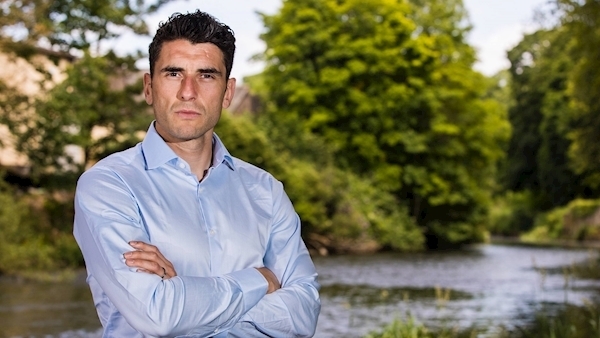
After more than two years of constantly being asked about and reminded of his place on the margins of the Dublin panel, there’s been something refreshing and comforting in recent days for Bernard Brogan that people haven’t forgotten when he was king of the Hill and just about everything else in football.
The recent re-appreciation began with Jim Gavin.
Before all the flood of tributes on social media and the airwaves and in the papers, Brogan met up with his manager this day last week in the Westin Hotel on Westmoreland Street.
The two of them shot the breeze for a while, Brogan intrigued by how Gavin and his aviation colleagues weremaking contingency plans for Brexit, Gavin curious and even proud of how another one of his players was winning off the field upon enquiring how Brogan’s twin boys and twin businesses, Legacy and Pep Talk, were coming along.
Brexit and business though wasn’t why Brogan had requested a meeting: Out of courtesy he wanted to inform the Dublin manager that he was “handing in the gun and badge” and to thank Gavin for affording him each licence for seven years.
After Gavin asked if he was sure and Brogan assured him that he was, Gavin conveyed his sadness, congratulations and especially his gratitude.
From his own playing days he knew how difficult it could be for a new management to succeed one that had won an All-Ireland but his task in 2013 had been made much easier by the buy-in and the performances of such a key player as Brogan.
For the first 15 minutes of that year’s All-Ireland final they could barely get out of their own half against a rabid Mayo challenge but then amoment of magic from Brogan suddenly propelled Dublin back into a game they’d edge by a point.
Brogan ended that day with 2-3, all bar a point from play.
Whenever Gavin would think of Bernard Brogan, he’d always remember and be thankful for what he did in 2013.
“It was nice to hear that,” says Brogan. “The last few days it’s been nice like that.”
People recalling some standout performance from his under the bright Croker lights, in turn triggering Brogan to remember a host of fond memories and old colleagues that warm his heart.
He thinks back to when he first started on the Dublin panel.
For a couple of years it was as frustrating as the past two, receiving such limited game time, but all the while he was learning his craft from senior peers and enjoying their company.
“Senan Connell used to pick us up to go training in his little boxcar,” he smiles.
Myself, Alan, [Declan] Lally, sometimes Barry Cahill, all [St]Declan’s boys like Senan who’d have taught us there. We were carpooling you might say but it wasn’t to save petrol, it was to have the craic. Sure with Senan you just wouldn’t stop laughing from the moment you got into the car.
“At one stage Pillar [Caffrey] and [selector] Ski Wade suggested to Lally that he travel on his own to training because he was sick of the five of us clowns getting out of the car breaking our sides laughing; we were probably expending too much energy before training had even started! He could nearly hear a circus clown horn whenever the car would pull up!”
Brogan was also there for when the Vengabus pulled up outside his house one Monday evening in 2005.
You’ve probably heard of it before, first here in these pages from Ciarán Whelan, then some more in Jason Sherlock’s autobiography, of how the day after a huge Leinster semi-final win against Wexford in front of a full Croker, a day’s golf ended up with a bus rounding up unsuspecting Dublin panellists in varying states of attire.
Barry Cahill was hauled out in his pyjamas. Mossy Quinn was in a sleeveless Aussie Rules top. The bould Berno?

“I was actually in my nip — for whatever reason, I don’t know why, I used to sleep in the nip! I didn’t hear the doorbell, I was flat out from a late night in Copper’s the night before. Next thing one of the Magees comes rumbling up the stairs and into my bedroom. I’m going: ‘I’m in the nip, I’m in the nip! My mum is outside! Let me put on some boxers!’ So the lads go: ‘Right, you’ve five seconds.’
“So I put on a pair of tracksuit bottoms, a T-shirt and a pair of runners and out the door. No socks. And that’s what I wore in Coppers that night — and at work the next day. I had a summer job [fitting] residential alarms, so I slept in [Plunkett’s teammate, Gareth] ‘Nesty’ Smyth’s house which was nearby and then went straight to work.
“That was just the way the culture was then [going out on the Monday after a championship game]. It wasn’t as if we were doing it more than anyone else. People will say that you never won anything back then and ask was that the reason but I don’t know. We had some great times together.”
He has a high regard for Caffrey. Would love to have played more for him in his first two years, feels he should have played more, but appreciates the ethos of self-improvement he’d cultivate among the players.
The same way in recent years a Brogan would mentor a Paul Mannion on the art of moving off the ball, a young Brogan would pick the brains of Tomás ‘Mossy’ Quinn on the art of finishing goals.
“Mossy is probably the best striker of a ball going for goal that I’ve seen. I would have talked to him a lot about it and he would have been very open with his time and knowledge. He had the guile to pick a spot and side foot it: Putting a bit of pace on it but keeping the ball down low so the ’keeper couldn’t get a hand to it.”
And of course there was Whelo. Ciarán Whelan.
They never got to play a full championship game together with Whelan at midfield and Brogan in the full-forward line,which is as plausible a theory as any as to why the Raheny man never won his All-Ireland. Brogan for one certainly feels Whelan could have done no more to win a deserved but elusive All-Ireland.
“Whelo was like a machine. Just his intensity, his energy. I remember he tackled me one day in training and it was like going into a car wash — just dush, dush, dush, like a punching bag, being tumbled around. I couldn’t get out. I just went onto my knees, just to get away from him. He was like a man mountain.”

There were all kinds of other physical milestones in the early years.
His first championship start in 2007, at wing forward, against Offaly.
“I took a shot into the Hill, it skewed away, and when Conor Evans came to block me, the two of us rolled onto the ground and he saidsomething like, ‘You’re in amongst the big boys now!’”
Then, later that summer, an All-Ireland semi-final chasing Tomás Ó Sé.
“I was playing in a position that I didn’t have the greatest engine for while he was an attacking wing-back at a time when it wasn’t really done. He was just so quick running with the ball, soloing mid-stride.
“There were a few days like that, against Kerry, against Tyrone, when you’d question yourself: ‘Jesus, this is the real deal. Am I really able for this at the top, top level?’”
By 2010, though he was the top, top level, steeled for every physical and mental and tactical challenge.
In that year’s quarter-final, both Tyrone and Dublin conceded the opposition’s kickout to shore things up at the back but Tyrone still couldn’t contain Brogan — that day he’d kick five frees, four points from play and no wides.
In the semi-final not even Cork, the eventual champions, could hold him as he raided them for 1-6 from play.
On the awards circuit he was the unanimous Footballer of the Year, becoming the only footballer to be so honoured without his side reaching the All-Ireland final.
“For me it was the most amazing summer ever, because all I was doing was playing football! What I love doing most! I’ve always played my best when I’m just playing football, game after game, week after week. No three-week gaps and giant team meetings and loads of talking. Just playing football, like.
“And I always seemed to play my best championship football coming off a league in which I had played right through, week in, week out.
2010 was the only year I’d say in which I felt I couldn’t miss. I felt I literally could not miss. I remember thinking that whenever I got a ball in my hands anywhere inside the 45, I was going to put it over the bar or in the net. I’d always try to get that feeling back. I’d always chase that 2010 feeling.
He’d make a very good stab at it. While he says of 2011 “I struggled”, he was an unquestionable let alone deserving All-Star as well as All-Ireland winner.
Right from the start of that season he set the tone for the Dubs, scoring 1-3 in a key win up in Armagh, the kind of venue and game where in the noughties Dublin would have always have come away from empty-handed; then a fortnight later under the Croker floodlights, kicking an injury-time winning point that whisked Marc Ó Sé’s fingertips, a foretaste of both his and Stephen Cluxton’s clutch points later that September.
He’d kick 1-3 in the league final, five points from play in the All-Ireland quarter-final against Tyrone, then, as numerous observers have highlighted this week, steered the team to victory in the gridlock of a semi-final that was their encounter with Donegal with his guile and patience.
2012 was undoubtedly a disappointing one for him.
“After I missed that one-on-one with [David] Clarke, I would have questioned my whole mindset and ability to make clutch decisions and plays.”
And in 2014 another surprising All-Ireland semi-final defeat would lead to even a greater degree of self-questioning.

That loss has now been put down to a systems failure on Dublin’s behalf. Brogan saw it a different way. Instead of being a matter of X and Os, he ascribed it more to a matter of flesh and blood. His.
“I missed two frees that day when things were going against us. I felt as if I let the team badly down. I didn’t step up on a day when we needed leaders.
“I actually remember standing over one of those frees, going: ‘Jesus, I actually don’t know if I’m going to kick this over the bar.’ It was the first time I ever doubted myself standing over a free. Against Kildare in 2011 [when he converted a match-winning free], I never even flinched. I just got up, took my breath, steps, bang, done. I never even thought about the occasion. My mindset was that strong.
“But that day against Donegal I started thinking: ‘Is this going to go over?’ My mind was fecked at that stage. I very much felt as if I was out of my depth.
“That knocked a lot of confidence out of me; on the back of that, Deano [Dean Rock] took the frees; he’s so accurate, being able to kick frees off the ground, whereas with my [first] cruciate [sustained when he was 19], I couldn’t.
“Even in 2015 I scored something like 6-21 and nearly won the golden boot without taking any frees but I never felt massively comfortable or confident. Some of those six goals were palmed goals. I often felt, ‘God, am I bluffing my way through this a bit?’”
Here’s the thing though. Every dip in form, every doubt, was countered. After missing that goal chance against Mayo in 2012, he’d take them for 1-6, 0-5 and 2-2 from play in 2013, another year he’d end up winning an All-Star and an All-Ireland. In that 2015 season that he sometimes felt he ‘bluffed’, he’d hit Fermanagh for 1-6 in theAll-Ireland quarter-final, score a goal and then set up one for Philly McMahon to turn the All-Ireland semi-final, and then kick two huge scores for play in a low-scoring final against Kerry.
Because, always, in his mind he had the mentality there’ll be another chance. His natural and learned optimism would invariably trump any imposter syndrome.
“You’d always think you’d get another chance. As a forward I’d always have it in my head with, say, five minutes to go: ‘I’m going to get another chance to do something here, to help us win the game. I’m going to get one more ball and I’m going to take it.’ And the way it worked out, a lot of the time I would get it.”
And so that’s why he persevered the last couple of years. Beneath the model good looks was a warrior. His whole career, from never overlooked by the county minors, to not breaking through with Pillar earlier, he’d feel through grit and patience he’d get there.
And last Tuesday Gavin told him it’s why he had him on the team bus and matchday 26 for the replay against Kerry: If they were behind and needed scores in the final quarter, he’d have been on. Because he’d likely get and take that one last chance.
But again it was as much as the moments off Broadway as those on it that sustained him.

“I remember when I was about 20, coming back from the [first] cruciate, trying to break into Dublin squads, I played a game for the club [Oliver St Plunkett’s] against Naomh Barróg. A lovely man, a friend of the family, called Jim Fitzmaurice would have been their club chairman; I’d actually bring the Sam Maguire out to his funeral over in Sutton. And whenever I’d meet him, he’d say: ‘God, I remember that day you scored 1-13 against us. Everything you touched turned to gold!’
That always stuck in my head. That day has always stuck in my head. There were scores I kicked that day that I can remember as well as any I kicked in Croke Park.
“There’d be this thing I’d always say to myself. Play like a kid. In All-Ireland finals, semi-finals, those big games against Kerry, Mayo, Tyrone. Just play like a kid like you did that day out in Naomh Barróg.”
Last Saturday, the day after going on the Late Late Show, Brogan played for his club in a championship relegation play-off against St Sylvesters. The stakes were high with the threat of the drop looming yet he’d play enough like a kid to score 1-5 to secure his team the win.
He won’t just play football for the club next year. Just before he has to dash off, he reminds you of a conversation Declan Lally has reminded him about recently.
The day Brogan learned he hadn’t made the Dublin minor football panel, Lally, a close friend of Alan’s, called to the house and was taken aback by how pleasant and positive Alan’s younger brother was.
He was going to make the Dublin minor hurling panel now: A setback had opened up a new opportunity, a new challenge. And he would make that Dublin panel, albeit being an unused sub in a first-round loss against Kilkenny.
And now he plans to play hurling again with the club. Junior or senior, he’s not yet sure, only that he’ll be playing. And if at all possible, like a kid.